Overview
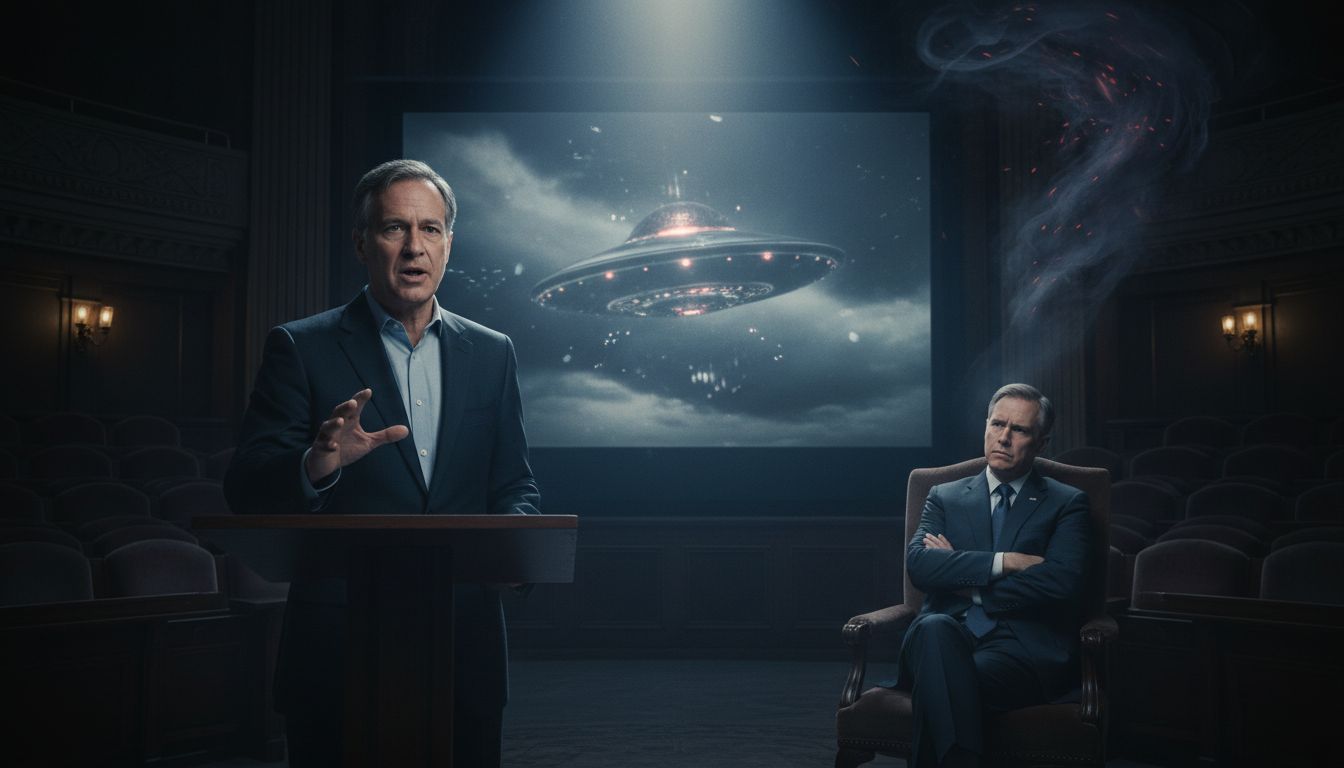
Astrophysicist Avi Loeb, the Harvard‑Smithsonian chair of Science and Technology Studies, issued a public rebuke on Monday after U.S. Senate Vice‑President JD Vance suggested that unidentified flying objects (UFOs) could be “demonic” entities. Loeb, who has spent the past several years advocating for a systematic, peer‑reviewed search for extraterrestrial intelligence, warned that resorting to supernatural explanations distracts from legitimate scientific inquiry and undermines the credibility of ongoing UAP (unidentified aerial phenomena) investigations.
Context of the Controversy
Vice President Vance, speaking at a televised town‑hall meeting, remarked that the “strange lights in the sky” reported by citizens might be “something demonic” rather than a technological or natural phenomenon. His comments quickly spread on social media, prompting a flurry of reactions from both political commentators and members of the scientific community.
The remark arrived amid renewed congressional interest in UAPs, following the release of the Pentagon’s 2021 Unidentified Aerial Phenomena Task Force report and the subsequent establishment of the All‑Domain Anomaly Resolution Office (AARO). Lawmakers have called for greater transparency and data sharing, while scientists have urged a disciplined, evidence‑based approach to any anomalous observations.
Loeb’s Response
In a Medium post titled “UFOs Are Not Demons,” Loeb wrote:
“When we encounter phenomena that defy our current models, the proper response is rigorous observation, data collection, and hypothesis testing—not the invocation of myth or theology.”
He added that the scientific method remains the most reliable tool for distinguishing between atmospheric optics, classified aerospace technology, and any potential signals of non‑human intelligence. Loeb emphasized that “the universe is vast, and the probability of life elsewhere is non‑trivial; dismissing it out of hand does a disservice to both science and the public.”
Scientific Community’s Perspective
Many researchers echoed Loeb’s sentiment. Dr. Sara Seager, an exoplanet specialist at MIT, noted that “the search for biosignatures on distant worlds is already a mature field; extending that rigor to near‑Earth phenomena is a logical next step.” Similarly, the Scientific Coalition for UAP Studies (SCUAPS) released a statement affirming that “any claim of demonic origin falls outside the scope of empirical science and risks politicizing a genuinely open research question.”
The broader scientific consensus stresses that UAPs should be catalogued, subjected to multi‑sensor analysis, and compared against known atmospheric, astronomical, and technological sources. This approach mirrors the protocols used in meteorology and aerospace safety, where anomalous data are first logged, then investigated without pre‑conceived conclusions.
Implications for Policy and Public Discourse
Loeb’s critique arrives at a pivotal moment for UAP policy. The Senate’s UAP Subcommittee is slated to hold hearings later this year, where experts will present de‑classified sensor data and discuss funding for dedicated research programs. By framing the conversation in scientific terms rather than theological or sensationalist language, policymakers may be more inclined to allocate resources for high‑resolution radar, optical, and spectroscopic measurements.
Moreover, Loeb cautioned that public perception matters: “When officials label unexplained phenomena as demonic, it fuels fear and speculation, making it harder for credible scientists to engage the public.” He called for educational outreach that explains how probabilistic reasoning and statistical analysis are applied to differentiate noise from potential signals of extraterrestrial origin.
Looking Ahead
The episode underscores a growing tension between political rhetoric and scientific methodology in the UAP arena. While Vance’s remarks reflect a broader cultural fascination with the unknown, Loeb’s insistence on empirical rigor signals a shift toward treating UFOs as a legitimate scientific problem rather than a mythic curiosity.
If forthcoming congressional hearings adopt the standards advocated by Loeb and his peers, the United States could establish a transparent, data‑driven framework for investigating aerial anomalies—one that respects both national security concerns and the public’s right to know. Until then, the scientific community remains poised to answer the question not “what demons might be out there?” but “what data can we collect, and what do they truly tell us about the skies above us?”


