Overview
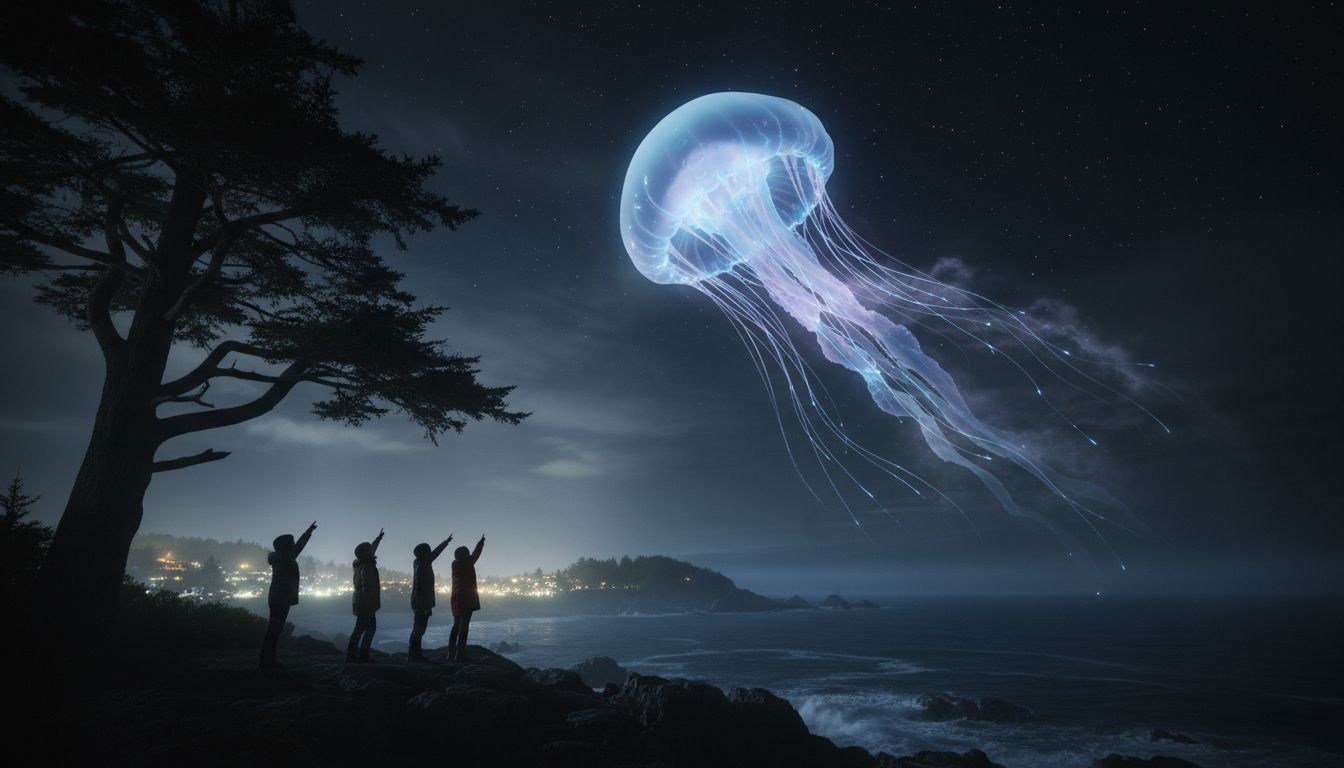
On the night of May 5, 2026, residents across the interior of British Columbia—and in parts of Alberta and Vancouver Island—reported a large, white, jelly‑fish‑like light drifting slowly across the horizon before vanishing. The phenomenon was observed between 10:15 p.m. and 10:30 p.m. PT, with dozens of videos posted to local Facebook groups and shared on CBC’s platform. While the sighting sparked lively speculation, astronomers and aerospace analysts quickly converged on a more mundane explanation: a visual effect generated by the SpaceX Falcon 9 launch that took place earlier that evening from California’s Vandenberg Space Force Base.
Eyewitness Accounts
The reports came from a wide geographic swath, from Williams Lake and Prince George to the Nass Valley and even Sherwood Park, Alberta. Sarah Siemens of Vanderhoof recalled, “It’s like, hey, you should believe,” after she and her husband Jared had just been telling their son that UFOs are “most likely not real.” Ashley Megan, who stopped her car near New Aiyansh, said, “I thought it was the moon,” before realizing the object was moving independently of any celestial body. Brooke Merritt in Hixon described the sight as “super weird,” noting the slow, pulsating motion that set it apart from typical aircraft or weather balloons. The videos, each lasting under two minutes, show a diffuse, glowing shape that expands and contracts, giving it the appearance of a floating jellyfish.
Expert Analysis
Astronomer Malhar Kendurkar, president of the Prince George Astronomical Observatory, examined the footage and matched the timing to SpaceX’s Falcon 9 mission SL‑17‑29, which launched from Vandenberg at 8:55 p.m. PT. “The rocket’s second stage burned for several minutes, and under the right atmospheric conditions its exhaust plume can produce a high‑altitude, luminous sheath that refracts sunlight,” Kendurkar explained. This “twilight glow” can be visible hundreds of kilometres away, especially when the observer is situated under a dark sky while the sun is just below the horizon. The shape’s slow drift and gradual fade are consistent with the plume’s descent and dispersion, rather than the controlled flight path of a conventional aircraft.
Broader Context of Unexplained Aerial Phenomena
The B.C. sighting joins a series of recent reports worldwide that have drawn public attention to unexplained aerial phenomena (UAP). Earlier this month, residents of Hawaii reported intermittent green lights hovering over the islands, and in New Zealand a “donut‑shaped” glow lingered for several minutes over the South Island. While many of these events have later been linked to satellite re‑entries, atmospheric optics, or military test flights, they underscore a growing demand for transparent data sharing between government agencies, scientific institutions, and the public. Canada’s Department of National Defence has pledged to continue its UAP task‑force investigations, emphasizing the need to differentiate between ordinary aerospace activity and genuinely anomalous observations.
Conclusion
Although the floating, jelly‑fish‑like light captured imaginations across British Columbia, the preponderance of evidence points to a SpaceX launch plume as the most plausible source. The incident illustrates how modern launch schedules, combined with clear night‑sky conditions, can produce visual effects that are easily misinterpreted by observers unfamiliar with the physics of high‑altitude exhaust. As launch frequency increases, experts recommend that communities receive real‑time launch notifications and that researchers develop public‑facing guides to help distinguish routine aerospace events from truly unexplained phenomena. In the meantime, the videos continue to circulate, reminding us that even ordinary spaceflight can inspire wonder—and a healthy dose of curiosity.