Overview
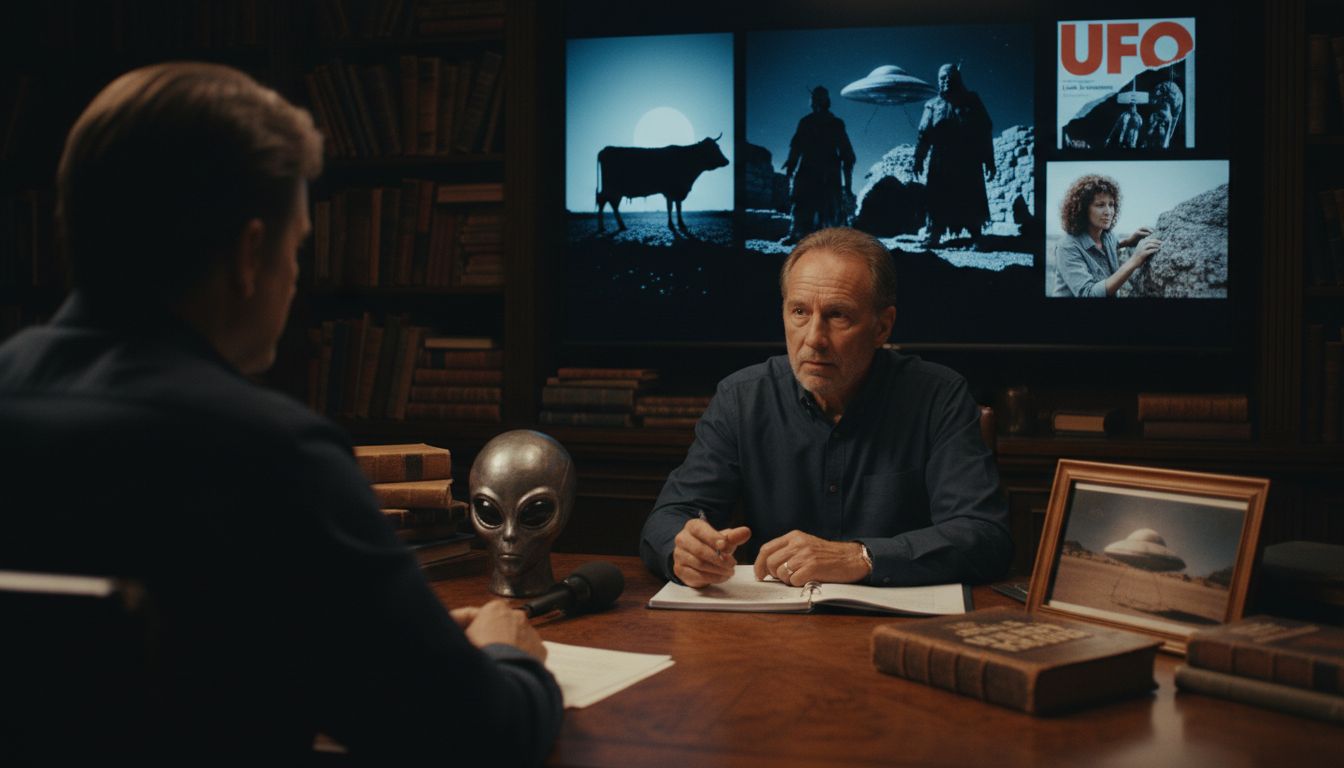
In a two‑hour episode of the UFO Talker podcast recorded on April 8, 2026, host Michael Ryan sat down with veteran ufologist Bill Birnes to discuss the origins and impact of his television series UFO Hunters. Birnes, who has spent more than three decades researching anomalous phenomena, traced his career from the 1995 documentary The Day After Roswell to his recent stewardship of UFO Magazine. He emphasized that his conviction—“I am 100 % certain that extraterrestrials are here now”—is grounded in a convergence of historical documentation, contemporary sightings, and interdisciplinary research.
From “The Day After Roswell” to “UFO Hunters”
Birnes recounted how The Day After Roswell sparked public interest in the 1947 incident and laid the groundwork for his later television work. He explained that the series UFO Hunters was conceived as a “field‑reporting” platform, allowing investigators to travel to sites of reported activity and interview witnesses in real time. The show’s format, he noted, was deliberately different from earlier speculative documentaries: it combined forensic‑style evidence gathering with narrative storytelling, a blend that attracted both skeptics and believers. Birnes also highlighted the series’ coverage of cattle mutilations, noting that forensic analyses often reveal precise, non‑human surgical precision that remains unexplained by conventional veterinary practices.
Editorial Leadership and Scholarly Collaboration
In 2023 Birnes assumed editorial control of UFO Magazine, a move he described as “a chance to bring rigor to a publication that has long been a voice for the community.” Under his direction, the magazine has featured peer‑reviewed articles on topics ranging from Biblical Nephilim—the enigmatic giants of Genesis—to modern scientific approaches to the UFO phenomenon. Birnes praised the work of Linda Zimmermann, whose research on animal behavior around UFO events suggests that many species exhibit acute stress responses, such as sudden flight or vocalization, when exposed to unidentified aerial phenomena. “Animals don’t have cultural bias,” Zimmermann told Birnes, “their reactions can be a valuable, objective data set.”
Revisiting Classic Cases
The conversation also turned to historical incidents that continue to shape the field. Christine Scott offered a critical review of Budd Hopkins’ memoir, The UFO Experience, arguing that while Hopkins pioneered the “close‑encounter” classification, some of his later claims lack corroborating evidence. Meanwhile, Dr. Irena Scott examined the 1973 UFO flap, focusing on the Coyne helicopter sighting over the Midwest and a simultaneous nationwide thunderclap reported by thousands of observers. Dr. Scott suggested that the synchronicity of these events points to a coordinated, possibly atmospheric, phenomenon that warrants further scientific inquiry. She also promoted her forthcoming book on the Hickson/Parker abduction, which compiles newly de‑classified documents and first‑hand testimonies to reassess the case’s credibility.
Looking Ahead: Disclosure and Public Perception
Birnes concluded the interview by addressing the broader issue of governmental disclosure. He argued that incremental releases of classified material have already altered the public discourse, moving the conversation from fringe speculation to mainstream policy discussion. “When agencies acknowledge that they are investigating unidentified aerial phenomena, it validates the work of investigators and witnesses alike,” Birnes said. He also referenced a recent comment from John Lennon’s estate, noting that the late musician’s interest in extraterrestrials—evident in his 1970s lyrics—reflects a cultural shift that predates current media coverage. Birnes maintains that continued documentation, interdisciplinary research, and transparent dialogue are essential steps toward a definitive answer.
Contextual Takeaway
The episode of UFO Talker provides a concise snapshot of the current state of UFO research: a blend of historical casework, scientific inquiry, and media engagement. By highlighting the collaborative efforts of investigators like Birnes, Zimmermann, and the Scotts, the discussion underscores a growing consensus that the phenomenon demands rigorous, multidisciplinary study. As Birnes puts it, the evidence is accumulating, and the question is no longer “if” extraterrestrials are present, but “how” and “why” they are interacting with our planet.


