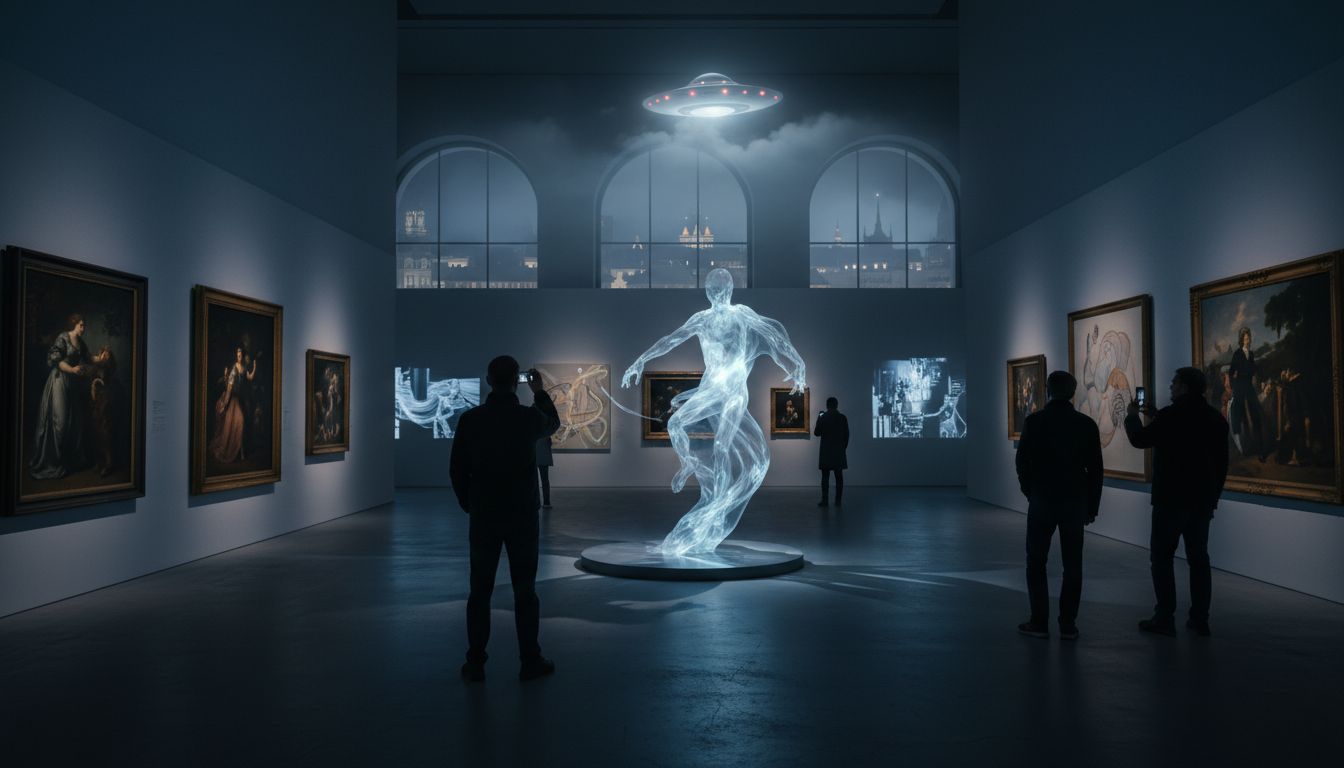
The Kunstmuseum Basel’s new survey “Ghosts: Visualizing the Supernatural,” which will remain on view until 8 March 2026, offers a chronological sweep of how painters, sculptors and installation artists have tried to make the invisible visible. Curated by Jo Lawson‑Tancred, the show assembles roughly 160 works spanning a quarter‑century of artistic response to the specter, from the fervent spiritualism of the nineteenth century to the data‑driven hauntings of the digital age. By juxtaposing historic canvases with contemporary interventions, the exhibition underscores a persistent cultural fascination with what lies beyond empirical sight, while also tracing how scientific breakthroughs—most notably the public harnessing of electricity in the Enlightenment—have reshaped the language of the supernatural.
Among the early entries, Canadian painter William Blair Bruce’s 1888 work The Phantom Hunter stands out for its stark, snow‑bound tableau. A lone figure reaches toward a translucent double, a visual metaphor for the “fear‑chill like a shroud” that curator Eva Reifert describes as the “shift in atmosphere” associated with an unseen presence. The painting echoes a period when séances and occult societies proliferated across Europe and North America, offering a visual counterpart to the era’s obsession with communicating with the dead. Reifert notes, “The idea that the past lives on is very powerful; the idea that we can’t control ghosts’ appearances is, in turn, a very scary thought.”
The 20th‑century contributions highlight how artists began to treat the ghost as a conceptual device rather than a literal apparition. Meret Oppenheim’s 1962 Ghost with Sheet (Spectre au drap) reduces the specter to a stylised, fabric‑bound face, suggesting that the uncanny can be evoked through material reduction. René Magritte’s The Comical Spirit (date not listed) further plays with perception, inserting a whimsical, semi‑transparent figure into a familiar setting to destabilise the viewer’s confidence in visual reality. These works anticipate the post‑modern turn, where the invisible is interrogated through irony, parody and the language of mass media.
Contemporary artists in the show push the dialogue into the realm of performance, technology and bodily intervention. Erwin Wurm’s 2024 sculpture Yikes (Substitutes)—a cluster of disembodied, rubber‑like forms that suggest a missing body—was described by the artist as “a physical manifestation of the anxiety we feel when the familiar disappears.” Urs Fischer’s installations employ kinetic elements that flicker and dissolve, while Rachel Whiteread’s casts of empty spaces capture the absence of objects as a ghostly echo. Ryan Gander and Nicole Eisenman contribute works that blend humor with scholarly research, using archival documents and scientific diagrams to illustrate how the quest to “render things visible that are on the edges of our perception” continues to inspire interdisciplinary experimentation.
The exhibition’s catalogue frames the visual history with an Emily Dickinson excerpt: “One need not be a chamber–to be haunted, / One need not be a House–, / The Brain has Corridors–, surpassing, Material Place–.” This poetic framing reinforces the curatorial thesis that ghosts function as “figures of memory, of a person we loved, or, more probably, of violent and wrongful happenings in the past that have come to haunt the present.” By linking artistic strategies to broader cultural anxieties—whether rooted in the Enlightenment’s rationalism, the Victorian era’s occult fervour, or today’s data‑driven surveillance—the Basel show offers a measured, scholarly perspective on a theme that has long hovered at the intersection of science, folklore and imagination.


