Overview
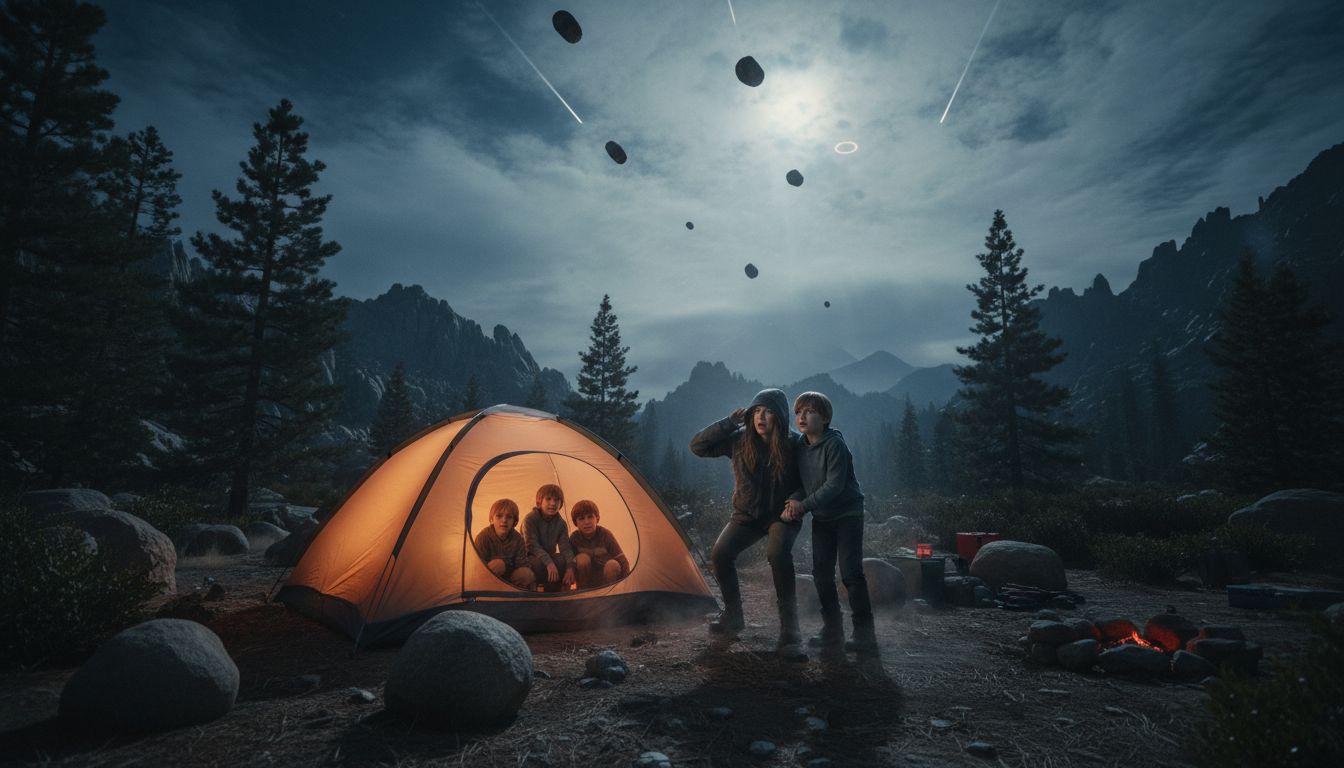
In November 2025 a family camping near Mount Baldy in Southern California reported an unusual early‑morning disturbance that they attribute to a possible Bigfoot encounter. The mother, accompanied by her 15‑year‑old son and two teenage nephews (ages 14 and 17), said they were awakened at approximately 3:30 a.m. by a series of soft‑ball‑sized rocks striking the ground around their tent, followed by a prolonged howl that differed from typical coyote calls. The incident was submitted to the Bigfoot Field Researchers Organization (BFRO), which assigned it a Class B rating—indicating a credible, but not definitive, sighting.
Incident Details
According to the camper’s written account, the group arrived at the deserted campground around 8:30 p.m., set up a tent on a level spot near the restroom facilities, and spent the evening listening to coyotes before retiring for the night. At roughly 3:30 a.m., the mother described hearing “the sound of rocks hitting the ground—like 10–15 rocks, not pebbles, but substantial, baseball‑to‑softball sized.” The rocks landed on the side of the tent where the campers’ heads were positioned, yet none struck the canvas. After remaining motionless, the family heard an “unusually long howl” that, in their view, did not match known coyote vocalizations. In the morning, they collected eight rounded rocks, each roughly the size of a baseball or softball, as physical evidence.
“It sounded like substantial rocks being thrown from a distance and then rolling toward us,” the mother told BFRO. “None of them ever made contact with the tent. This had to be a Bigfoot.”
Expert Analysis
BFRO analysts reviewed the report, audio recordings, and photographs of the recovered stones. The organization’s Class B designation reflects a “moderately credible” encounter: eyewitness testimony is consistent, physical artifacts are present, and the event occurs in an area with a documented history of cryptid reports. Researchers note that the howl recorded by the campers exhibits a lower frequency and longer duration than typical Canis latrans (coyote) howls, aligning with criteria used in BFRO’s “anomalous howl” database. However, they caution that alternative explanations—such as a prank, a misidentified human activity, or an unusual wildlife behavior—cannot be ruled out without further forensic analysis of the stones and a controlled acoustic study.
Context and Significance
Mount Baldy, part of the San Gabriel Mountains, has long been a focal point for Bigfoot folklore, with sightings dating back to the 1970s. The region’s dense chaparral, steep terrain, and frequent nocturnal wildlife activity create conditions conducive to misidentification, yet also provide a plausible habitat for an undiscovered primate species, according to some cryptozoologists. The BFRO’s classification system, ranging from Class A (highly credible) to Class E (unlikely), helps filter anecdotal reports for scientific scrutiny. This incident adds to a growing body of anomalous howl cases that researchers are using to develop acoustic profiles that may differentiate cryptid vocalizations from known fauna.
Next Steps
BFRO has requested that the family preserve the recovered rocks for laboratory testing, including mineral composition and possible impact marks, to determine whether they were deliberately thrown. The organization also plans to conduct a field survey of the campsite, deploying motion‑activated cameras and acoustic sensors to capture any future activity. Local wildlife officials have been notified, though no immediate threat to public safety has been identified. As the investigation proceeds, the case underscores the importance of systematic data collection in the study of unexplained phenomena, balancing open‑minded inquiry with rigorous scientific standards.
The report and accompanying media are available through BFRO’s online database (report ID 79588). Further updates will be provided as additional evidence is analyzed.