Overview
A motion‑activated camera deployed in a remote part of Chile’s Patagonian wilderness recorded three brief, intense light flashes on the night of 13 January 2025. The images, captured by a research team monitoring wildlife activity, have sparked a flurry of inquiries from astronomers, atmospheric scientists, and defense analysts seeking a natural explanation. While the Chilean event is the latest in a series of unexplained aerial sightings—including reports from England, the United States, and Mexico—researchers caution that extraordinary claims require rigorous data before any conclusions can be drawn.
The Chile Observation
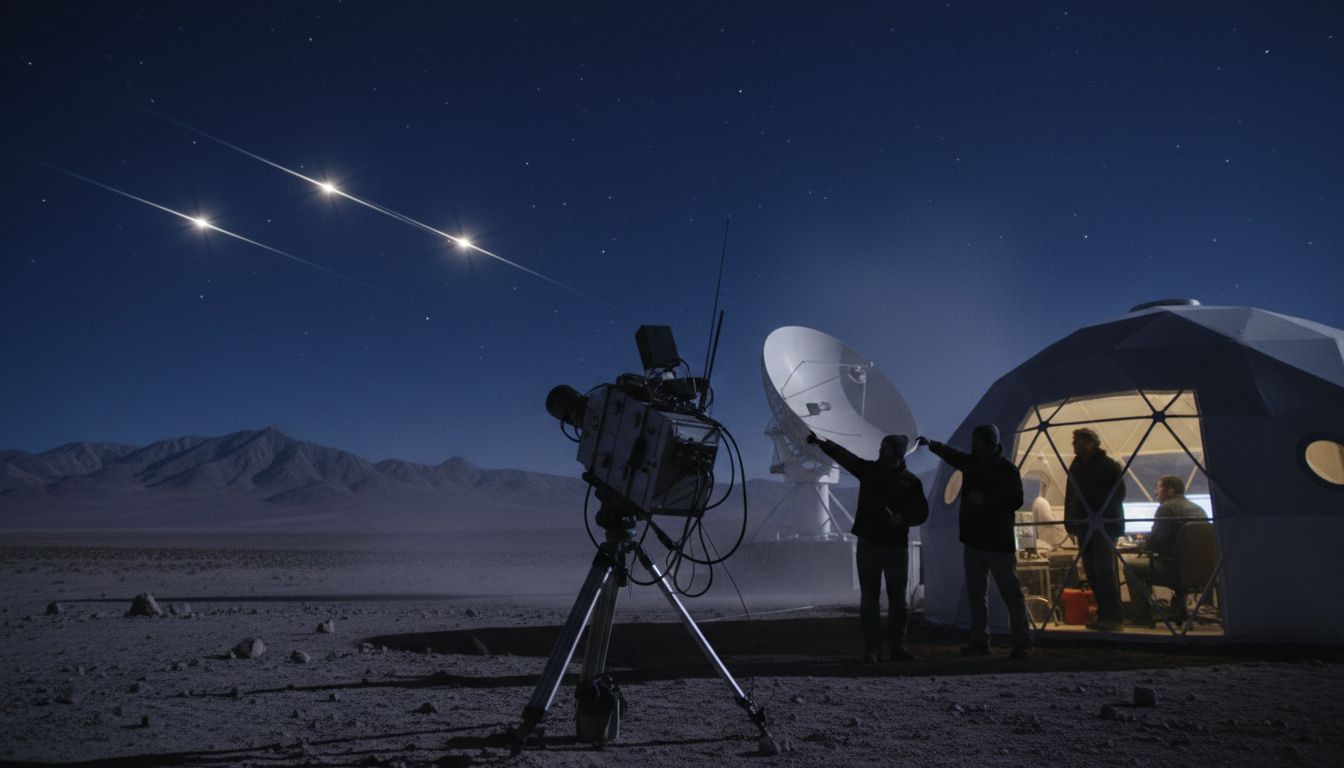
The camera, part of a long‑term ecological study run by the Universidad de Chile’s Department of Wildlife Ecology, was positioned near the Río Pascua to document the movements of the endangered Andean huemul. On the video, three luminous points streak across the frame within a span of roughly 15 seconds, each lasting less than a second. The flashes appear white‑blue, with no discernible shape or trailing smoke, and the camera’s infrared sensor registers no accompanying heat signature.
“We were reviewing routine footage for animal activity when the lights appeared, and the sudden brightness saturated the sensor,” said Dr. María González, the project’s lead ecologist. “The event was completely unexpected, and the footage is the only record we have.” The team promptly uploaded the clip to an open‑access repository and alerted the Chilean National Commission for Scientific and Technological Research (CONICYT) for further analysis.
Comparative Incidents
The Chilean flashes echo a handful of recent, unrelated sightings that have surfaced on public forums and in local media. In early February, residents of a small village in northern England reported “orbs of light” moving erratically across the night sky, later captured by a homeowner’s dash cam. In the United States, a police helicopter near Lakenheath, Virginia, experienced a brief, bright illumination that pilots described as “a white‑blue burst that lingered for a fraction of a second before disappearing.”
Mexico’s Ministry of Defense released a statement in March after a military radar anomaly coincided with a visual report of “multiple flickering lights” over the state of Jalisco. Although the incidents differ in location and detection method, each shares the hallmark of a short‑duration, high‑intensity flash without an obvious source.
Scientific Response
A multidisciplinary panel convened by the International Astronomical Union (IAU) has begun reviewing the Chile footage alongside the other reports. Dr. Alan Whitaker, an atmospheric physicist at the University of Colorado, emphasized the importance of ruling out known phenomena.
“Balloon releases, meteoric entry, and satellite glints can all produce brief flashes, but they each have characteristic signatures—trajectory, duration, and spectral profile—that we can test against the video data.”
Preliminary spectroscopic analysis by a team at the European Space Agency (ESA) suggests the Chilean lights lack the infrared afterglow typical of meteors, but the data set is too limited for a definitive classification. Meanwhile, the Chilean researchers have installed additional cameras with higher frame rates and calibrated photometers to capture any future events with greater fidelity.
Next Steps and Public Interest
The Chilean team plans a targeted field campaign over the next three months, deploying an array of optical and radio sensors across a 10‑kilometer radius of the original site. They have also reached out to local Indigenous communities, whose oral histories include references to “sky fire” phenomena, to gather any anecdotal parallels.
Public reaction has been swift, with social‑media threads debating extraterrestrial origins alongside calls for transparent, peer‑reviewed research. “While the allure of UFO narratives is strong, the scientific method remains our best tool for understanding these events,” noted Dr. González.
As the investigation proceeds, the Chilean flashes serve as a reminder that even in well‑studied ecosystems, the night sky can still present puzzles that challenge our current models of atmospheric and near‑Earth space activity.


