Overview
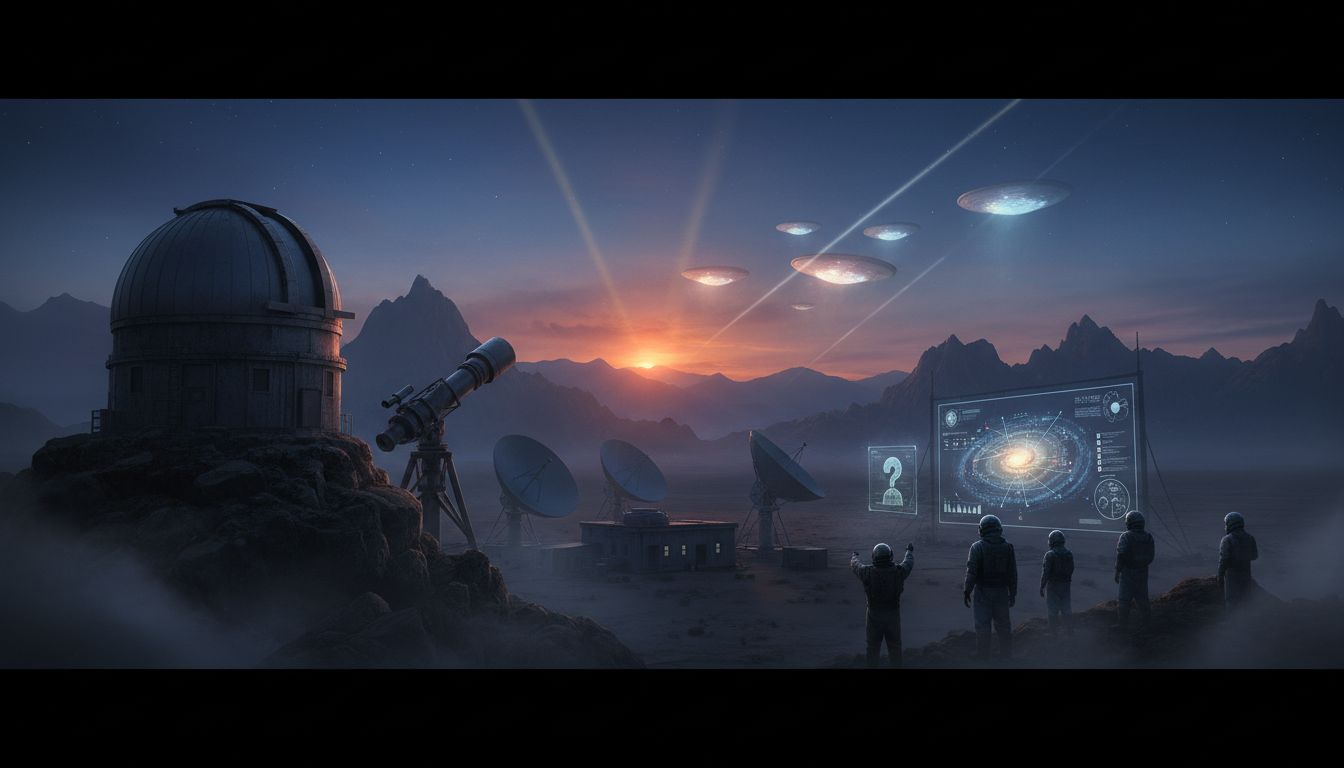
The question of whether intelligent extraterrestrial life exists has resurfaced in public discourse, buoyed by recent UAP (Unidentified Aerial Phenomena) sightings and renewed scientific inquiry into the Fermi paradox. While definitive evidence remains elusive, a growing body of research—ranging from astrophysics to astrobiology—continues to explore the statistical likelihood of life beyond Earth. Parallel to these scientific efforts, Catholic scholars have examined the theological implications, concluding that the discovery of alien intelligence would not conflict with core Church teachings on creation.
Scientific Context
Physicists and astronomers point to the sheer number of potentially habitable exoplanets identified by missions such as Kepler and TESS as a compelling argument that intelligent life could be common in the cosmos. The Fermi paradox—why we have not yet observed signs of such civilizations—remains unresolved, prompting hypotheses that range from the rarity of technological development to the possibility that advanced societies deliberately avoid contact. Recent de‑classified UAP reports, released by several governments in 2025, have documented anomalous aerial observations that defy conventional explanations, though experts caution that these data do not constitute proof of extraterrestrial technology. The scientific community therefore maintains a cautious optimism: the search for biosignatures and technosignatures continues, and each new discovery keeps the question open.
Catholic Theological Perspectives
Catholic thinkers have long engaged with the prospect of alien life, emphasizing that all rational beings share the same divine Creator. Christopher Baglow, director of the Science and Religion Initiative at the University of Notre Dame’s McGrath Institute, argued in a 2021 lecture that extraterrestrials would possess “the capacity for a special relationship with God in which they can know Him and respond to Him with freedom and love.” He echoed the sentiment attributed to Pope John Paul II, who told a child that any extraterrestrials would be “children of God, just as we are.”
The discussion dates back to the 15th‑century philosopher‑cardinal Nicholas of Cusa, who speculated that God’s creativity makes intelligent life elsewhere “probable.” In contemporary times, Jesuit astronomer Brother Guy Consolmagno—former director of the Vatican Observatory—posed the question “Would you baptize an alien?” in his 2014 book, answering affirmatively on the condition that the being freely requests the sacrament. Consolmagno’s stance, reiterated in a 2010 interview with The Guardian, underscores the Church’s view that any sentient entity, regardless of form, possesses a soul and could partake in Christian rites if it chooses.
Ongoing Debate and Institutional Responses
Although the Catholic Church has not issued an official doctrine on extraterrestrial life, its scholars routinely stress that the existence of alien intelligences would expand, not diminish, the scope of God’s creation. Vatican officials have welcomed scientific collaboration, as illustrated by Pope Leo XIV’s 2025 visit to the Vatican Observatory, commemorating the 50th anniversary of the Apollo 11 moon landing. The Vatican’s openness reflects a broader trend among religious institutions to engage constructively with astrobiology, recognizing that the discovery of extraterrestrial life would raise profound ethical, pastoral, and philosophical questions.
Meanwhile, secular institutions continue to refine detection methods. Projects such as the Breakthrough Listen initiative scan the radio spectrum for technosignatures, while upcoming space telescopes aim to characterize exoplanet atmospheres for potential biosignatures. The convergence of improved observational capabilities and interdisciplinary dialogue suggests that the conversation will evolve from speculative philosophy to evidence‑based discourse within the next decade.
Looking Ahead
The absence of concrete proof does not diminish the significance of the inquiry. As new telescopic data, UAP analyses, and theological reflections emerge, the question of intelligent extraterrestrial life remains a focal point for both science and faith communities. Researchers stress that any future discovery would require careful verification and a measured response, balancing excitement with scientific rigor. For the Catholic Church, the prospect invites a reaffirmation of humanity’s place in a vast, creator‑filled universe—one where the possibility of sharing divine love extends beyond Earth.


