Overview
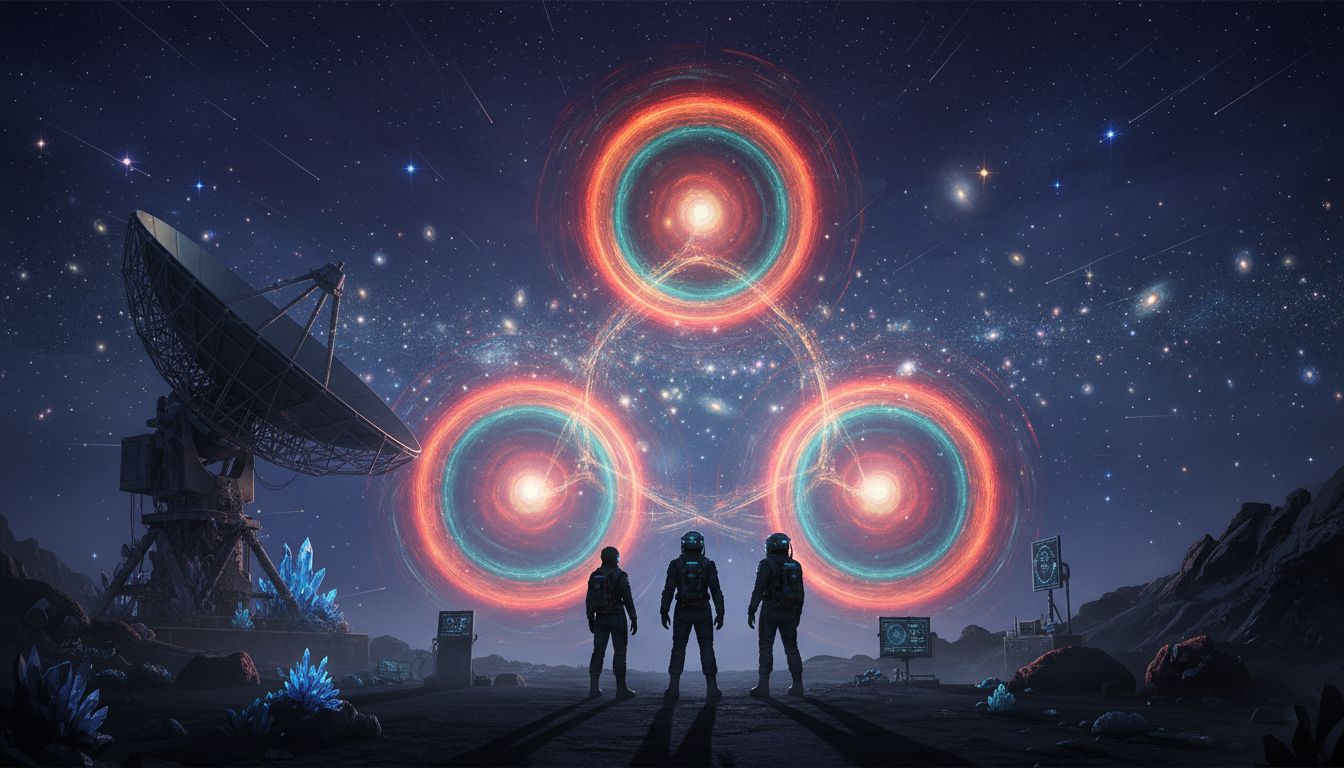
A team of professional astronomers, working with a global network of citizen scientists, has announced the discovery of three new odd radio circles (ORCs) that dwarf all previously known examples. The structures, each spanning up to 978,000 light‑years in diameter, were identified in deep‑field observations of distant galaxy clusters using the Australian Square Kilometre Array Pathfinder (ASKAP). The findings, released on 15 January 2026, represent the largest and most energetic ORCs recorded to date and extend the pioneering 2019 ASKAP detection that first brought the phenomenon to the attention of the astronomical community.
Discovery Details
The new ORCs were uncovered through the “Radio Galaxy Zoo” citizen‑science platform, where volunteers examined terabytes of radio‑frequency data for anomalous shapes. “The sheer scale of these circles was immediately striking,” said Dr. Lina Martínez, lead author of the study and a researcher at the University of Sydney. “When we overlaid the radio maps with optical images, we saw that the emission forms a near‑perfect ring, with no obvious central source.”
Each ORC resides in a separate galaxy cluster at redshifts between z ≈ 0.4 and 0.6, corresponding to a look‑back time of roughly 5 billion years. Radio luminosities exceed 10³⁴ W Hz⁻¹, making them four to six times more powerful than the 2019 prototype. The twin structures in one cluster are separated by only 200 kpc, suggesting a common triggering event. Follow‑up observations with the MeerKAT array confirmed the spectral steepness and polarization patterns that are characteristic of synchrotron emission from relativistic electrons spiraling in magnetic fields.
Scientific Implications
ORCs remain one of the most puzzling classes of extragalactic radio sources. Their circular morphology hints at large‑scale shock fronts, but the exact mechanism—whether driven by episodic outbursts from supermassive black holes, galaxy‑cluster merger shocks, or a yet‑unidentified process—has not been resolved. The unprecedented size and power of the newly identified circles provide fresh constraints. “If these rings are the result of a single, explosive event, the energy budget required is comparable to the combined output of thousands of supernovae,” noted Professor James O’Leary of the CSIRO Astronomy and Space Science division. “Alternatively, they could trace the edges of expanding bubbles created by jets that have since faded, a scenario that aligns with the lack of a bright central engine in the optical data.”
The twin ORCs in the same cluster also raise the possibility of synchronous activity, perhaps triggered by a merger between two massive galaxies that ignited simultaneous outflows. Modeling these events will help refine simulations of intracluster medium dynamics and may illuminate how energy is redistributed on megaparsec scales.
Role of Citizen Science
The success of this discovery underscores the growing impact of public participation in high‑volume astronomical surveys. Over 30,000 volunteers contributed classifications, flagging the anomalous ring‑shaped emissions that automated pipelines initially dismissed as artifacts. “Citizen scientists act as an extra layer of pattern recognition that algorithms still struggle with,” explained Dr. Martínez. “Their contributions accelerate the identification of rare phenomena and broaden the scientific return of facilities like ASKAP.”
Looking Ahead
The research team plans to obtain high‑resolution X‑ray observations with the upcoming Athena mission to probe the hot gas surrounding the ORCs, which could reveal shock temperatures and further test formation theories. Additionally, coordinated multi‑wavelength campaigns—including optical spectroscopy and low‑frequency radio imaging—are slated for the next year. As more data pour in from next‑generation arrays such as the Square Kilometre Array (SKA), astronomers anticipate that additional ORCs—perhaps even larger and more luminous—will emerge, offering a clearer picture of these enigmatic cosmic circles.