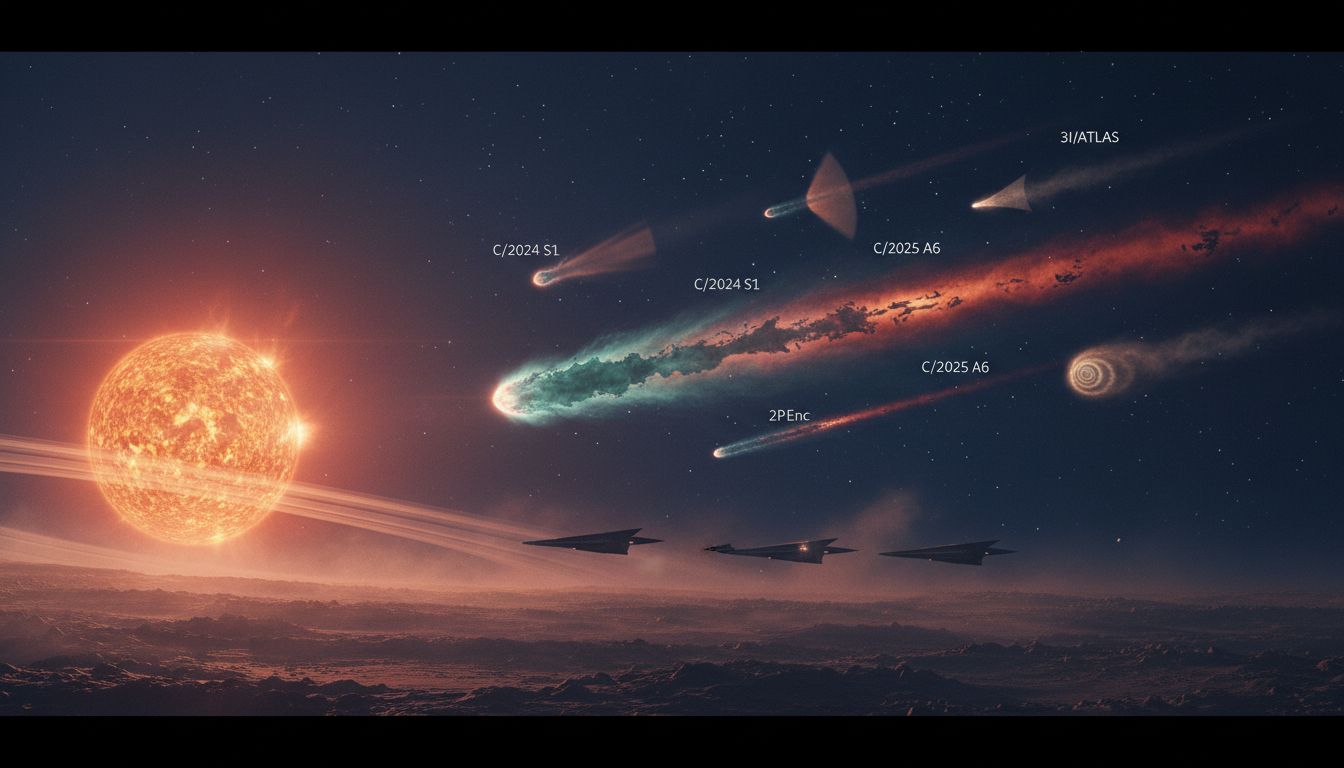
Since late 2023 astronomers have been tracking the interstellar visitor designated 3I/ATLAS, the second known object to enter the Solar System from beyond the Sun’s gravitational reach. Unlike most comets, which are born in the Oort cloud or Kuiper belt, 3I/ATLAS follows a hyperbolic trajectory that will bring it to its closest approach to the Sun—its perihelion—around October 29‑30, 2025. The object’s high inclination (about 142°) and a perihelion distance of roughly 0.008 AU place it among the most extreme solar grazers ever recorded, prompting a flurry of scientific papers that describe its composition as unusually volatile and its light curve as erratic. While the majority of planetary scientists classify it as a cometary fragment, Harvard astrophysicist Avi Loeb has publicly suggested that its anomalous acceleration and reflective properties could indicate an artificial origin, urging the public to “take a vacation” before the perihelion date in case the object behaves in an unexpected way.
Loeb’s hypothesis has reignited public interest in “Halloween comets,” a loosely defined group of celestial bodies that happen to reach perihelion or close Earth approach near the end of October. The most recent addition, C/2024 S1 (ATLAS), was discovered by the ATLAS survey in Hawaii on 27 September 2024 and passed its perihelion on 28 October, just before Halloween, before disintegrating in the solar glare. Earlier this year, C/2025 A6 (Lemmon) reached its nearest point to Earth in early January and, because of its orbital geometry, will also appear in the sky during the Halloween period. Both of these comets are non‑periodic, meaning they are expected to pass through the inner Solar System only once, unlike the classic “Halloween comet” 2P/Encke, a short‑period comet that returns every 3.3 years.
Encke’s link to the October holiday is indirect but historically significant. The comet is the parent body of the Taurid meteor complex, which produces two distinct showers: the Beta Taurids in June–July and the Taurids in late October, peaking around the 20th‑30th. During these peaks, observers can see bright fireballs—larger meteoroids that burn up in the atmosphere—adding a dramatic, almost theatrical, element to the night sky. Some popular‑culture accounts have gone further, suggesting that ancient observers of these spectacular fireballs may have inspired the swastika motif, a symbol that appears in various pagan traditions. Scholars of archaeo‑astronomy note that while the visual similarity is intriguing, there is no definitive evidence linking Encke’s debris to the symbol’s origin; the connection remains speculative and is often cited in fringe discussions rather than academic literature.
The convergence of several comets near Halloween has also sparked a wave of conspiracy‑theory narratives that blend astrophysics with apocalyptic speculation. Social‑media posts have quoted Loeb’s warning, extrapolating that a confirmed artificial object could trigger societal upheaval comparable to the 1938 “War of the Worlds” broadcast. Experts in planetary defense, however, caution against such hyperbole. Dr. Elena Martínez of the International Astronomical Union’s Working Group on Near‑Earth Objects emphasized that even if 3I/ATLAS were an engineered probe, its trajectory is well‑determined and poses no impact threat to Earth. “The object will pass safely at a distance of several million kilometres from our planet,” she said, “and any potential signals would be detectable well before perihelion.”
Nevertheless, the public’s fascination with the intersection of cosmic events and cultural rituals is understandable. Astronomers plan to use the perihelion window to conduct high‑resolution spectroscopy and solar‑corona observations that could reveal the composition of interstellar material, offering a rare glimpse into the building blocks of distant planetary systems. As the October sky darkens, amateur skywatchers will have the chance to view the Taurid fireballs, while professional observatories focus their instruments on 3I/ATLAS. Whether the object proves to be a natural comet or something more exotic, its passage will add another chapter to humanity’s long‑standing practice of reading the heavens for both scientific insight and seasonal wonder.