Overview
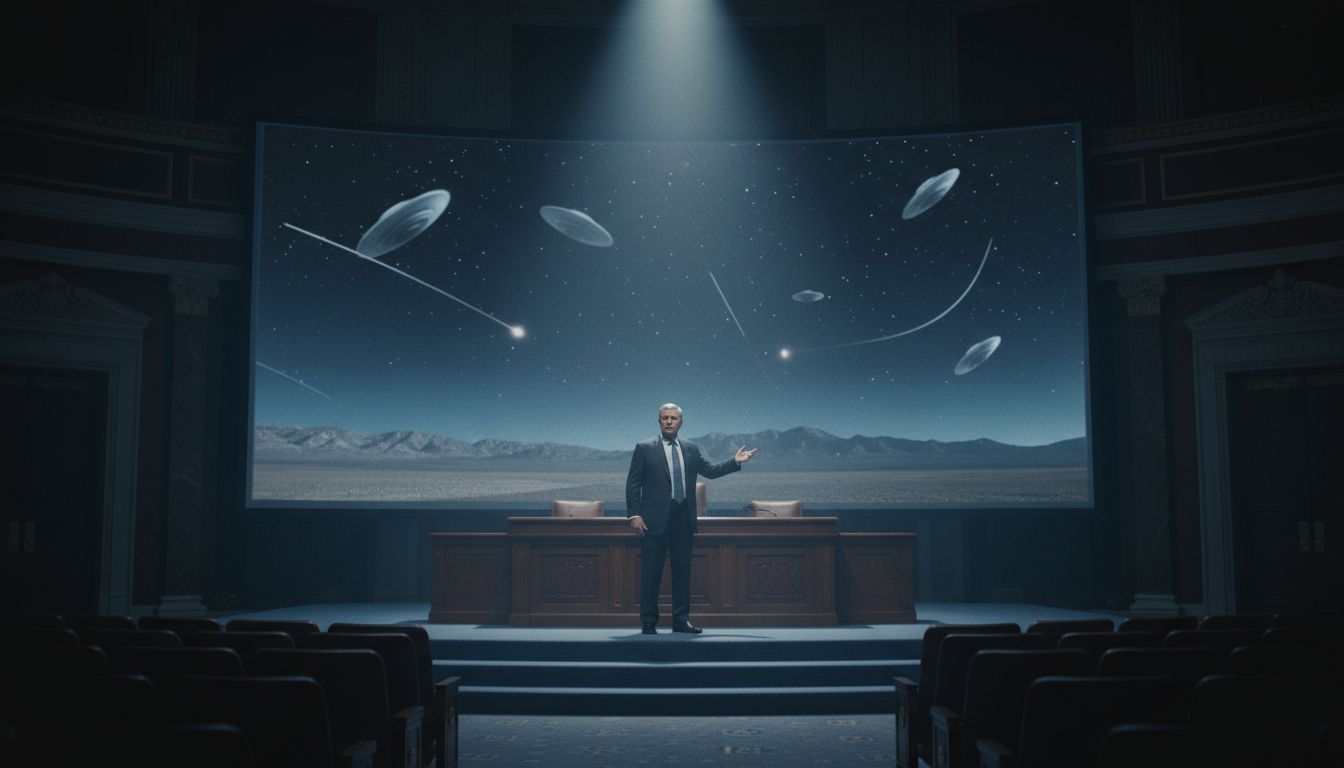
On March 29, 2026, a senior member of the U.S. House of Representatives publicly described three recently declassified Pentagon videos of unidentified aerial phenomena (UAP) as “defying logic.” The congressman, Rep. Tim Burchett (R‑TN), said the footage—originally captured by Navy pilots and released through the Department of Defense’s UAP Task Force—shows objects moving in ways that conflict with known aerodynamics and physics. Burchett’s remarks come amid growing congressional pressure for a comprehensive investigation and for the intelligence community to provide greater transparency on what officials term “unexplained aerial phenomena.”
The Videos and Their Content
The three clips, first leaked in 2020 and officially released in 2023, depict high‑altitude objects executing rapid accelerations, abrupt direction changes, and hovering without visible propulsion. In one segment, a spherical shape accelerates from a standstill to over 2,000 km/h within seconds; another shows a “tic‑tac”‑shaped craft performing a 180‑degree turn in a fraction of a second. Engineers and aerospace experts who have examined the footage note that the observed kinematics exceed the performance envelope of any known aircraft or drone, and the lack of discernible exhaust plumes or control surfaces adds to the mystery.
Congressional Reaction
Rep. Burchett, who chairs the House Committee on Oversight’s Subcommittee on National Security, addressed the videos during a closed‑door briefing before releasing a statement to the press. “What we are seeing defies logic and challenges the very foundations of our current scientific understanding,” he said. He joined a growing list of lawmakers—including Representatives André Carson (D‑AZ) and Mike Gallagher (R‑WI)—who have called for a full, bipartisan review of UAP data. The congressman emphasized that the videos are “not a hoax” and that the Pentagon’s own analysis acknowledges the phenomena remain “unexplained.”
Calls for Transparency and Investigation
Burchett’s statement reiterates a broader legislative push that began with the 2022 Intelligence Authorization Act, which mandated the establishment of an annual UAP report to Congress. In his remarks, the representative urged the Department of Defense and the Office of the Director of National Intelligence to release “all raw sensor data, sensor logs, and pilot testimonies” related to the three videos. He also advocated for the creation of an independent scientific panel, modeled after the National Academies’ 2023 study, to evaluate the physical plausibility of the observed maneuvers and to explore potential national‑security implications.
Context and Implications
The Pentagon’s UAP Task Force, rebranded in 2024 as the All‑Domain Anomalous Phenomena Office (ADAPO), has cataloged more than 400 sightings since 2004, most of which remain unexplained. While some incidents have been linked to foreign adversary technology or sensor artifacts, a subset—particularly the Navy videos—continues to elude conventional explanations. Experts caution that “extraordinary claims require extraordinary evidence,” and they stress the importance of rigorous data analysis before drawing conclusions about extraterrestrial origins. Nonetheless, the persistent lack of clear answers has fueled public curiosity and heightened calls for accountability.
Next Steps
The House Oversight Committee is slated to hold a public hearing on UAPs in June 2026, where Rep. Burchett plans to question senior defense officials about the release timeline, classification standards, and the agency’s risk‑assessment protocols. Meanwhile, the Department of Defense has indicated that a supplemental report will be submitted to Congress by the end of the year, potentially expanding on the three videos with additional sensor data. As the debate moves from classified briefings to the public arena, lawmakers like Burchett argue that “the American people deserve to know” what, if any, threats these phenomena may pose—and whether they represent a breakthrough in physics or a gap in our current surveillance capabilities.


