Overview
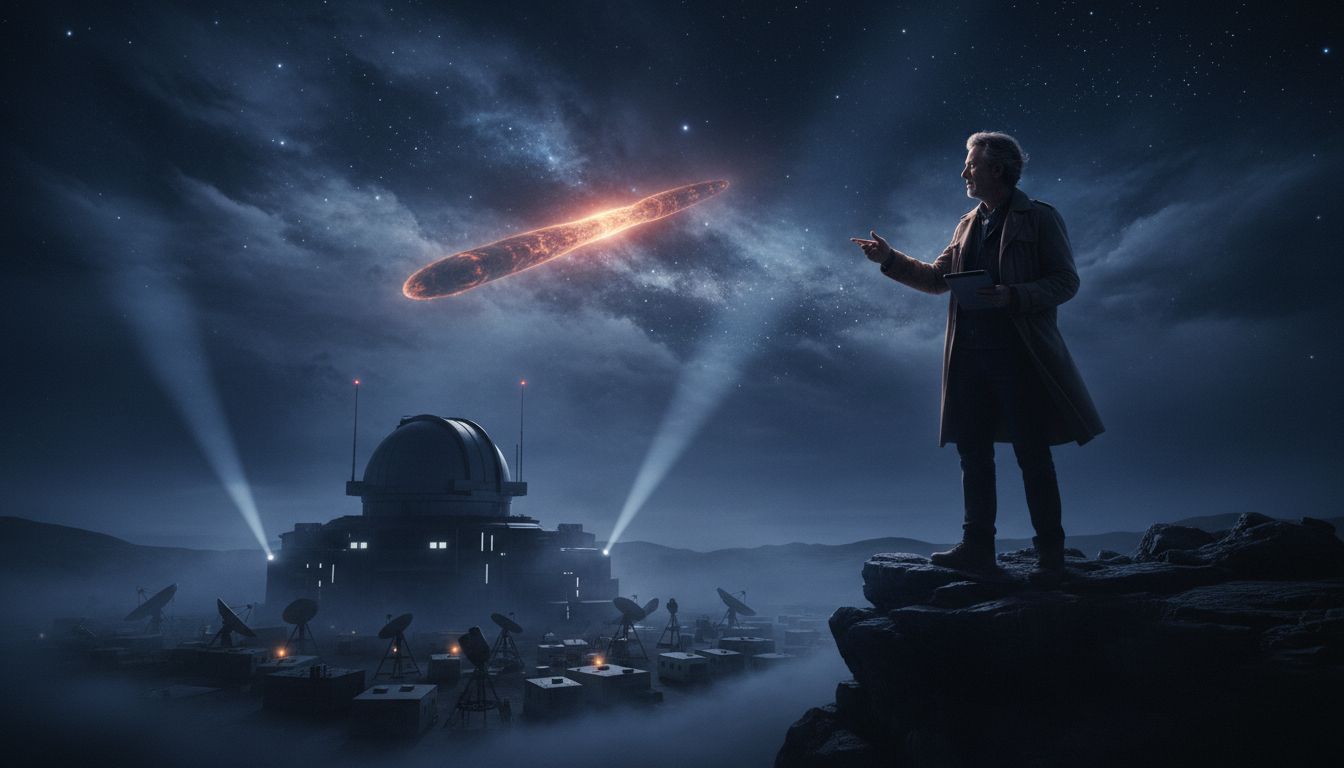
Astronomer Avi Loeb, a former Harvard professor and author of the controversial book Extraterrestrial: The First Sign of Intelligent Life Beyond Earth, has taken to social media and public interviews to criticize NASA and a swath of planetary‑science researchers. His target: what he describes as a “defensive” scientific establishment that, in his view, refuses to seriously consider anomalous data from interstellar visitors. The criticism comes as the newly identified interstellar object 3I/ATLAS—the third confirmed object from beyond the Solar System—makes a rapid pass through the inner Solar System.
3I/ATLAS Discovery
3I/ATLAS was first spotted by the ATLAS (Asteroid Terrestrial‑Impact Last Alert System) survey on 23 October 2024. Preliminary orbital calculations confirm a hyperbolic trajectory, indicating an origin outside the Solar System. At a speed of roughly 45 km s⁻¹ relative to the Sun, the object will skim past Earth’s orbit in early December before heading back into interstellar space. Early photometric data suggest a highly elongated shape and a surface that reflects little sunlight, characteristics reminiscent of the 2017 interstellar visitor ‘Oumuamua. While most astronomers expect 3I/ATLAS to be a natural cometary fragment or a fragment of a distant planetesimal, the object’s fleeting appearance has reignited debates about the nature of interstellar interlopers.
Loeb’s Critique
In a series of tweets and a recent interview with The New York Times, Loeb accused NASA and fellow researchers of “protecting their turf” rather than “engaging with the data on its own terms.” He quoted his own earlier statements on ‘Oumuamua, noting, “When the data don’t fit the textbook, we should be open to new physics—or even technology.” Loeb argued that the rapid response teams assembled to observe 3I/ATLAS have been hampered by bureaucratic constraints, saying, “We are still waiting for a green light to point a high‑resolution spectrograph at an object that could be the most profound discovery of our era.” He also suggested that the funding structures governing NASA’s planetary science division discourage the pursuit of “high‑risk, high‑reward” investigations that could challenge the prevailing paradigm.
Scientific Community Response
The broader planetary‑science community has pushed back against Loeb’s accusations. NASA’s Office of Planetary Defense issued a statement emphasizing that “the agency follows a rigorous, peer‑reviewed process to allocate telescope time, ensuring that observations are scientifically justified and that resources are used efficiently.” Dr. Sarah M. Hawley, a senior researcher at the Jet Propulsion Laboratory, noted that “the data we have on 3I/ATLAS so far are consistent with a natural origin, and we are focusing our limited observing windows on gathering spectra that can confirm its composition.” Critics also point out that Loeb’s previous claims about ‘Oumuamua being an alien probe have been largely dismissed by experts who cite more mundane explanations such as outgassing or an elongated, low‑albedo asteroid. Nevertheless, some scientists, including Dr. Michael M. Michaels of the University of Arizona, acknowledge that “while the alien‑technology hypothesis is speculative, it does serve as a useful reminder to keep an open mind and to design observations that can rule out all plausible explanations.”
Looking Ahead
As 3I/ATLAS approaches perihelion on 2 December, a coordinated effort among ground‑based observatories—including the Very Large Telescope in Chile and the Keck Observatory in Hawaii—is slated to capture high‑resolution spectra and photometry. The data will be released publicly within weeks, allowing independent analysis by the global scientific community. Whether the object will substantiate Loeb’s long‑standing claim that interstellar visitors could be evidence of extraterrestrial engineering remains to be seen. What is clear, however, is that the episode has highlighted a persistent tension in modern astronomy: the balance between rigorous, evidence‑based inquiry and the allure of bold, paradigm‑shifting hypotheses. As the scientific process unfolds, the eyes of both skeptics and believers will remain fixed on the fleeting trail left by 3I/ATLAS across our night sky.


