Overview
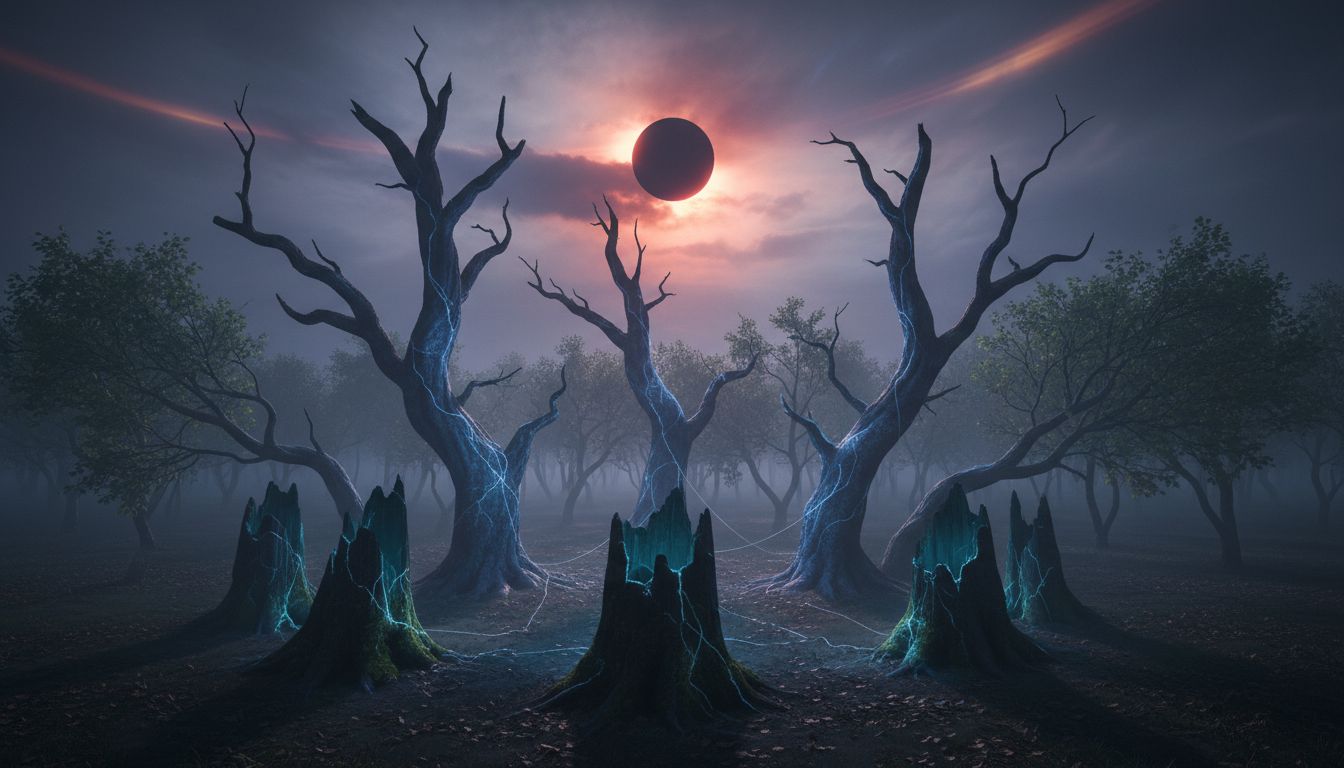
A recent paper in Royal Society Open Science claims that a cluster of spruce trees and five stumps in northern Italy detected subtle electrical and gravitational shifts before a partial solar eclipse and “warned” younger trees, suggesting a form of deep, long‑term memory. The authors, led by Alessandro Chiolerio, reported a synchronized spike in bio‑electrical activity about 14 hours before the eclipse, interpreting it as evidence that the trees anticipated the event. The study has ignited a debate among botanists, ecophysiologists, and skeptics who argue that the data can be explained by ordinary weather phenomena.
The Original Claim
Chiolerio’s team measured voltage fluctuations across the trunks of Picea abies specimens during the eclipse on 2 May 2024, noting a sudden rise in electrical signals that coincided with a brief dip in solar irradiance of roughly 10.5 %. The researchers also reported minute changes in local gravity, inferred from nearby seismometers, and suggested that the older trees “communicated” this information to saplings via electrical pathways. In their paper, they framed the finding as “bio‑electrical synchronization” that reflects a collective memory built up over previous eclipses in the Saros 124 cycle.
Scientific Skepticism
The response has been swift. Evolutionary ecologist Ariel Novoplansky of Ben‑Gurion University, the first author of a critical commentary in Trends in Plant Science, described the original work as “the encroachment of pseudoscience into the heart of biological research.” He points out that the study site experienced a local thunderstorm and a series of lightning strikes on the same afternoon, conditions known to induce transient electrical surges in plant tissues. “Instead of considering simpler, well‑documented environmental factors… the authors leaned into the more seductive idea that the trees were anticipating the impending solar eclipse,” Novoplansky said. He also emphasized that the light reduction during the eclipse was modest and fleeting, far less than the variations caused by ordinary cloud cover in the region.
Context and Precedent
Plants are known to respond to genuine stressors—drought, herbivory, sudden temperature shifts—often through rapid changes in membrane potentials. However, predictive behavior typically relies on reliable cues, such as photoperiod or seasonal temperature trends, not on rare astronomical events. The notion of a “deep memory” spanning multiple eclipse cycles conflicts with current understanding of plant physiology, which lacks mechanisms for precise long‑term timekeeping beyond circadian rhythms. Moreover, similar sensational claims—like the legendary ghost ship SS Ourang Medan—have historically circulated without empirical support, underscoring the need for rigorous peer review.
Outlook
While the idea of trees foreseeing celestial events captures public imagination, the prevailing scientific consensus remains that the observed electrical spikes are far more plausibly linked to storm‑related electromagnetic disturbances than to any eclipse‑specific anticipation. Further controlled experiments, ideally isolating weather variables, will be necessary to test the hypothesis. Until such data emerge, the claim stands as a cautionary example of how extraordinary interpretations can outpace the evidence, reminding researchers and journalists alike to prioritize methodological rigor over intrigue.


