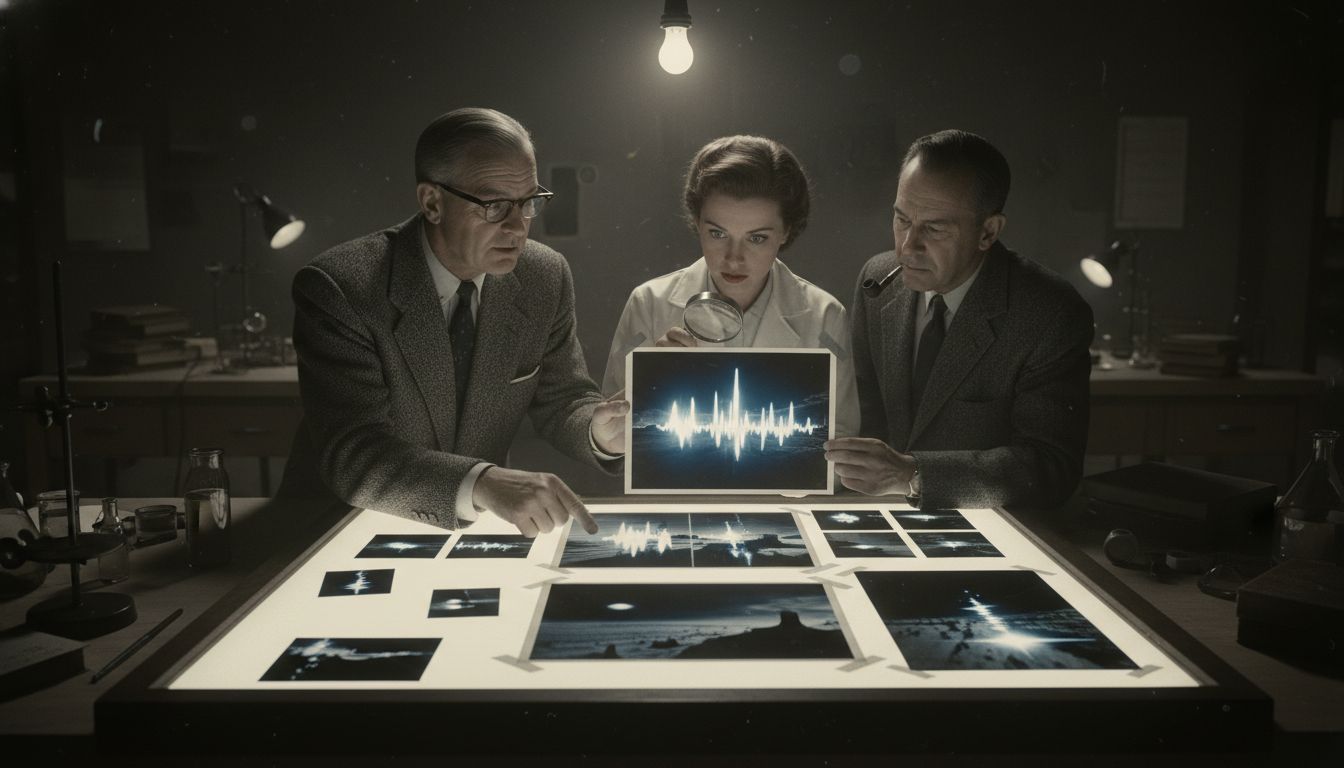
The photographs in question were taken between 1953 and 1957 by a series of amateur astronomers and military personnel who were documenting night‑time sky conditions for a variety of research projects. In each image a brief, bright flash appears in the same region of the frame, lasting only a fraction of a second and leaving no discernible trail. A team led by Dr. Emily Carter, an astrophysicist at the University of Arizona, published a peer‑reviewed paper last week in Astronomical Journal that re‑examines the original negatives using modern digital scanning and statistical noise‑analysis techniques. “When we applied high‑dynamic‑range reconstruction to the 35 mm film, the flashes remained distinct from the background grain,” Carter said. “Their intensity and spectral signature, inferred from the film’s emulsion response, are consistent with a point source of several thousand candela at a distance of roughly 20–30 kilometres.”
Carter’s group argues that the flashes cannot be explained by common photographic artifacts such as lens flare, sensor blooming, or film defects. The researchers cross‑checked the timing of the exposures against known satellite launches, missile tests, and meteor shower calendars for the same dates, finding no overlap. “We also ruled out aircraft navigation lights because the flashes are far brighter and lack the characteristic red‑green colouration of standard beacons,” Carter added. The team therefore proposes that the events could represent a class of unidentified aerial phenomena (UAP) that were active during the early Cold War, a period when both the United States and the Soviet Union were experimenting with high‑altitude reconnaissance platforms that were not publicly disclosed.
Not all experts are convinced. Dr. Michael Turner, an imaging specialist at the National Institute of Standards and Technology, cautions that the analysis may overlook subtler sources of error. “The 1950s film emulsions were highly sensitive to ionizing radiation, and cosmic ray hits can produce localized over‑exposures that mimic point‑source flashes,” he explained. Turner also noted that the original exposure logs indicate that some of the photographs were taken near known auroral activity, which can generate brief, intense bursts of light that scatter into the camera lens. “Without contemporaneous atmospheric data, it’s difficult to exclude natural phenomena,” he said.
The debate echoes earlier controversies surrounding historic UFO sightings. In the 1970s, the U.S. Air Force’s Project Blue Book examined similar photographic evidence and often concluded that “most cases are attributable to misidentifications or optical artifacts.” However, the recent establishment of the All‑Domain Anomaly Resolution Office (AARO) and the declassification of several Cold‑War‑era UAP reports have renewed scholarly interest in revisiting archival material with contemporary tools. “What makes this study noteworthy is its methodological rigor,” said Dr. Julie Barlow, a historian of science at the University of Cambridge. “It demonstrates how modern image‑processing can shed new light—literally—on data that were previously dismissed as noise.”
Whether the 1950s flashes will be classified as genuine UAPs or simply as an artifact of early photographic technology remains unresolved. Carter’s team plans to extend their survey to additional collections held by the Smithsonian Astrophysical Observatory and the Royal Astronomical Society, hoping to establish a larger statistical sample. “If similar flashes appear across independent datasets, the case for an unexplained aerial source strengthens,” she said. Until then, the images serve as a reminder that the night sky of the mid‑twentieth century still holds mysteries that modern science is only beginning to re‑examine.