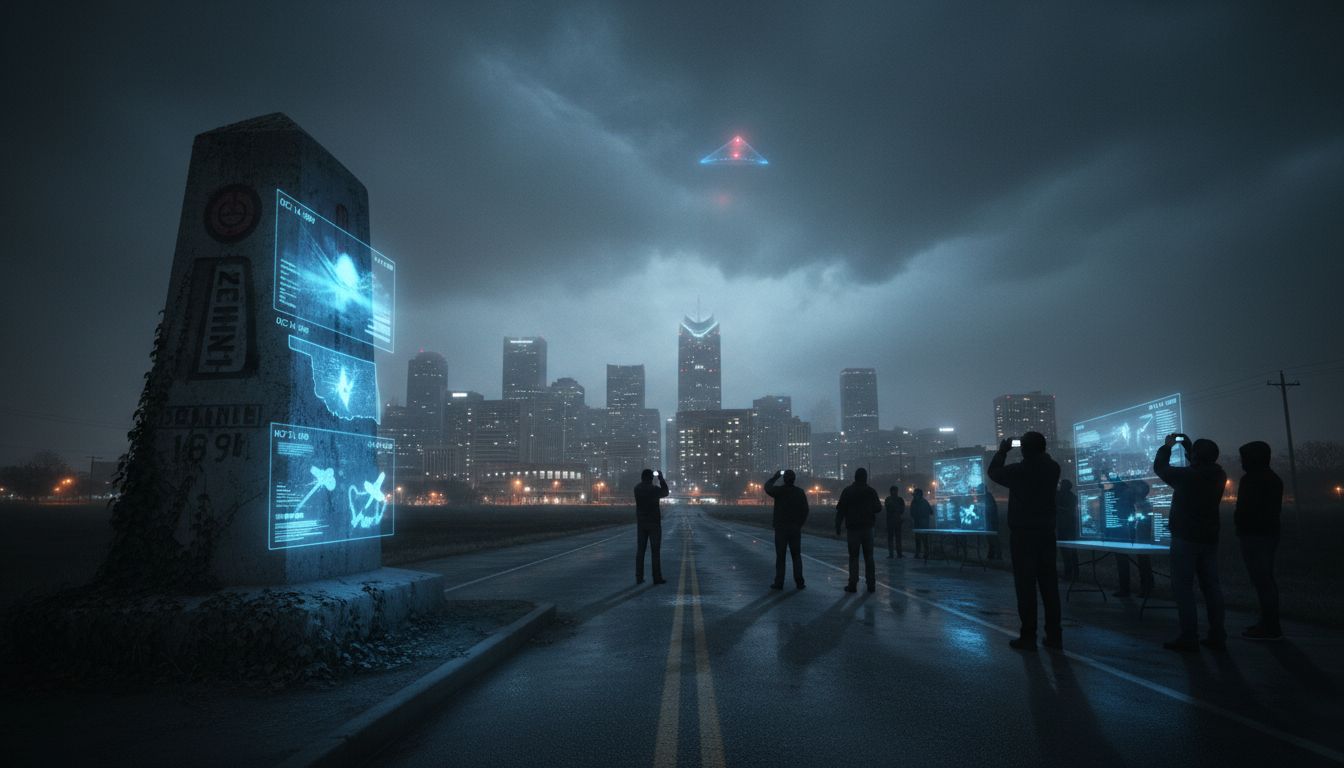
Overview
On May 22, 2026, the Pentagon released a second batch of declassified records documenting unidentified aerial phenomena (UAP) observed over the United States, including multiple sightings in Oklahoma City. The files, part of a broader transparency effort launched earlier this year, contain written reports, audio transcripts, and more than 50 video clips captured by military platforms. While the material does not identify the objects, it adds new detail to a decades‑long archive of UAP encounters and renews discussion about their possible national‑security relevance.
New Declassifications
The latest tranche follows an initial release on May 8 and fulfills a directive issued by the former president in 2023 to increase public access to UAP data. Among the newly released assets are recordings from an infrared sensor aboard a U.S. military platform operating within the United States Central Command (CENTCOM) area of responsibility in 2020. The Pentagon’s website describes the footage as “likely derived from an infrared sensor… uploaded to a classified network in June 2024.” The video shows a luminous sphere moving over a populated area, though the exact location remains undisclosed. Accompanying audio excerpts feature service members describing objects that “appear to be traveling exactly my speed… it’s going faster than I am as a matter of fact,” underscoring the difficulty pilots have in gauging the performance of these phenomena.
Oklahoma City Sightings
Oklahoma City appears twice in the newly released documents. The first reference is a July 1947 interview with 38‑year‑old private pilot Byron Savage, who reported a perfectly round, flat object streaking across the sky above Northwest 29th Street with “no trailing effects” and moving faster than any jet of the era. The FBI and Army Air Force Intelligence investigated Savage’s account, marking one of the earliest formal government inquiries into a civilian UAP report. The second file dates to 1958 and contains a letter from Oklahoma resident James Maney to FBI Director J. Edgar Hoover asking whether “flying disc” reports were factual. Hoover’s reply indicated that the FBI did not conduct UFO investigations but suggested Maney contact the Air Force Office of Special Investigations, which was then undertaking related studies.
These historical records are complemented by contemporary astronaut testimonies included in the release. L. Gordon Cooper Jr., a Mercury‑Atlas 9 crew member, recalled “fireflies… white, whitish, with almost a green, like real fireflies,” while Scott Carpenter of Mercury‑Atlas 7 described “more of the white particles in view below the capsule.” Apollo 17 astronauts later noted “jagged, angular fragments” that appeared to tumble and twinkle, illustrating that anomalous sightings have persisted from early spaceflight to modern aerial operations.
Historical Context
The Pentagon’s declassification effort builds on a legacy of UAP documentation that stretches back to the post‑World‑War II era. Earlier releases, such as the 2020 “Advanced Aerospace Threat Identification Program” (AATIP) files, revealed that the Department of Defense has routinely collected and analyzed sensor data on unexplained aerial objects. The Oklahoma City entries demonstrate that civilian reports have historically intersected with military and intelligence investigations, a pattern that has continued into the 21st century. By making these records public, the government acknowledges both the scientific curiosity and the potential security implications of unidentified aerial activity.
Implications and Next Steps
While the declassified materials do not provide definitive explanations, they reinforce the need for systematic analysis of UAP encounters. The Department of Defense’s UAP Task Force, reconstituted as the All‑Domain Anomaly Resolution Office (AARO) in 2024, is tasked with evaluating sensor data, pilot testimony, and historical archives to assess any threat to airspace safety or national security. Congressional committees have expressed interest in the findings, and the Office of the Director of National Intelligence plans to release an annual report on UAPs beginning in 2027.
For Oklahoma residents, the newly released files may prompt renewed local interest and possible collaboration with academic institutions studying atmospheric phenomena. As the Pentagon continues to release additional records, the balance between transparency and operational security will shape public perception and policy decisions regarding these enduring mysteries.


