Overview
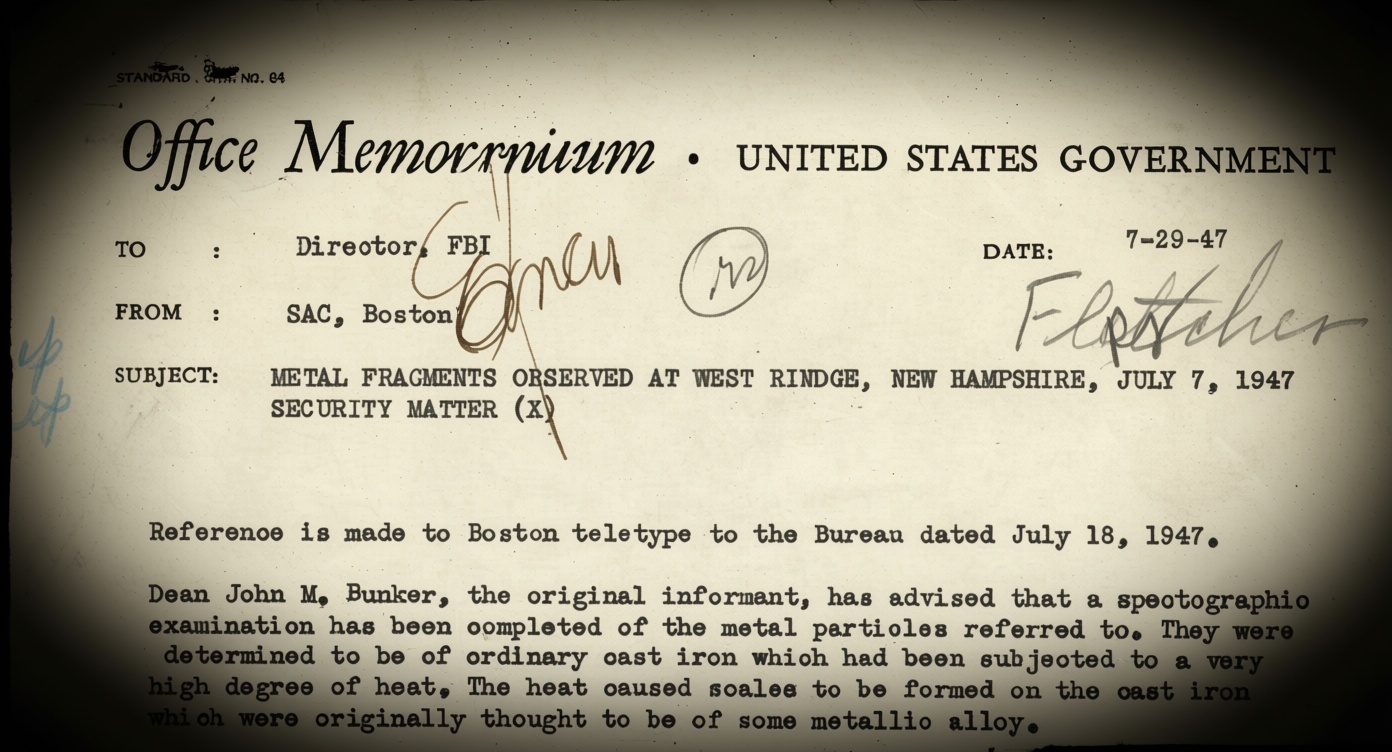
The Pentagon’s latest batch of declassified UFO-related records has brought renewed attention to a mysterious 1947 incident in West Rindge, New Hampshire, one of the early cases preserved in federal files. Released last month, the material includes memos, summaries and FBI communications describing small flaming metal fragments that landed in a field and along Route 202, prompting a formal investigation that, even after scientific testing, never produced a definitive explanation.
The newly released documents do not resolve the case, but they do add historical detail to an event that unfolded just weeks after the so-called “flying saucer” era began in 1947. According to the declassified FBI report, retiree Charles N. Tasker was sitting on a porch in West Rindge around 3 p.m. on July 7 when he noticed “little curls of smoke” and burned spots on a green lawn. Nearby, several small blazes had started in dry grass along Route 202, forming a roughly 200-foot circle of fire apparently linked to scattered metallic fragments.
The investigation
Tasker alerted the local fire department, which extinguished the flames, while another observer, identified in the files as “Mr. Appel,” collected the fragments and sent them to researchers at the Massachusetts Institute of Technology. There, the examination was led by Dr. John W. Bunker, dean of the graduate school, who reported findings to the Boston FBI Field Office. The first step was determining what the material was made of. Using a spectrograph, MIT scientists concluded the fragments were ordinary iron that had been exposed to “terrific heat,” causing a cast-iron-like scaling.
That result narrowed the possibilities but did not settle them. Because Tasker found the pieces about 700 feet from a railroad track, investigators initially considered whether they might have come from a steam locomotive smoke stack liner or another engine component. That theory, however, was later rejected by further testing. One metallurgist suggested the pieces could have been part of the lining from a jet turbo plane, but another scientist questioned whether fragments falling from high altitude could still have retained enough heat to ignite grass on impact.
Unresolved questions
The scientists also explored whether the fragments had once been part of a larger object that broke apart on landing. Their reconstruction suggested the metal may have been part of one hollow cylinder, about 8 inches in diameter and 3/16 of an inch thick, apparently made by machinery. But the report stops short of identifying the source, and the file’s conclusions remain cautious rather than definitive. In other words, the material was real, the fires were documented, and the investigation was serious — yet the origin of the fragments remained unclear.
Why the case still matters
For researchers and historians of UAP cases, the West Rindge file is notable less for any extraordinary conclusion than for what it reveals about the government’s early handling of unexplained reports. The documents show a chain of inquiry involving local witnesses, fire officials, MIT scientists and the FBI, reflecting the way unusual aerial or atmospheric events were being cataloged even before UFOs became a fixture of public debate. More than seven decades later, the case remains an example of how declassified records can deepen the historical picture without necessarily solving the mystery.