Overview
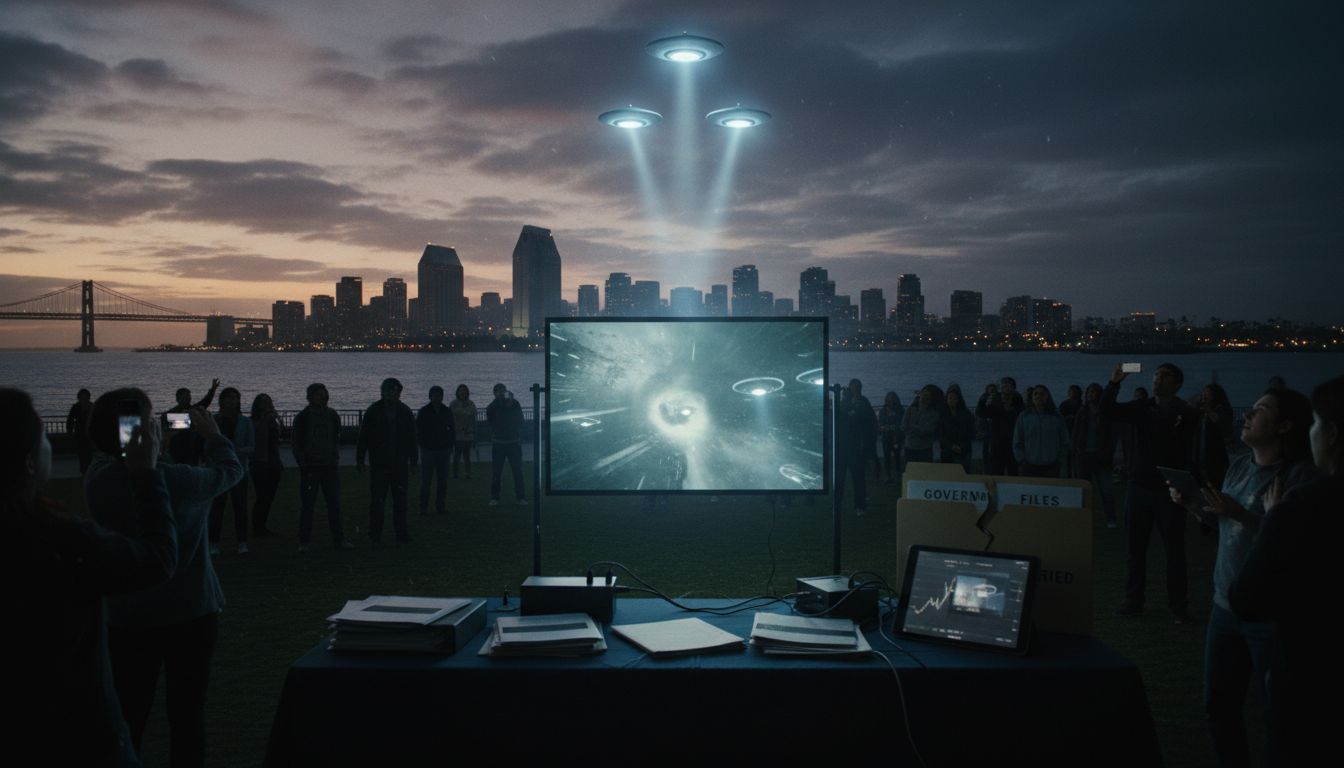
Recent declassification of government documents has placed a spotlight on a series of unidentified aerial phenomena (UAP) observed over San San Diego. The files, released through the Pentagon’s UAP Task Force and made publicly available via the Freedom of Information Act, contain dozens of witness statements, radar logs, and short video clips captured by both civilian and military sensors. While the material does not provide definitive explanations, it underscores the continued frequency and diversity of UAP encounters in a region that hosts several naval and aerospace installations.
New Evidence from the Declassified Files
The released docket includes 12 separate incidents recorded between 2018 and 2023. Six of these were captured on high‑definition video from commercial dash cams and coastal surveillance cameras; the remaining six consist of radar tracks corroborated by pilots from the U.S. Navy’s Pacific Fleet. In one notable case from July 2022, a Navy F/A‑18 pilot reported a “fast‑moving, spherical object” that executed abrupt altitude changes without visible propulsion. The accompanying radar data showed a velocity spike of over 3,000 knots, far exceeding the performance envelope of known aircraft.
Accompanying the technical data are written testimonies from local residents, commercial pilots, and base personnel. A San Diego resident, who asked to remain anonymous, described the sighting: “It hovered silently for about thirty seconds, then shot straight up and disappeared. It left no sound, no exhaust—just a bright, pulsing light.” The documents also note that the videos have been authenticated by independent analysts for authenticity and have not been altered.
Witness Accounts and Community Response
Local authorities have received an uptick in reports since the files’ release, prompting the San Diego Police Department to open a dedicated UAP reporting portal. “We’re seeing a measurable rise in civilian submissions, which helps us build a more complete picture of what’s happening in our airspace,” said Police Chief Michele Brown in a press briefing on May 24.
Military witnesses emphasized the operational impact of the sightings. Lieutenant Commander James Alvarez, a senior pilot with the Naval Air Warfare Center, remarked, “When you’re flying a mission and an object behaves in ways that defy our flight dynamics, it’s not just a curiosity—it’s a safety concern.” He added that the Navy has incorporated the declassified data into its UAP Task Force’s risk‑assessment models, seeking to determine whether any of the phenomena pose a threat to flight operations.
Investigation and Analysis
The Pentagon’s UAP Task Force, now operating under the Office of the Under Secretary of Defense for Intelligence and Security, has classified the San Diego incidents as “unexplained but not necessarily hostile.” Analysts are focusing on three primary questions: frequency, characteristics, and potential origins. Preliminary statistical review suggests an average of four to five credible sightings per year in the San Diego basin, a rate higher than the national average of approximately two per year.
Technical experts from the National Institute of Standards and Technology (NIST) are examining the sensor data for patterns in electromagnetic signatures, flight paths, and maneuverability. Early findings indicate that several objects exhibit rapid acceleration and deceleration without detectable heat signatures, a combination that does not align with conventional aircraft, drones, or known atmospheric phenomena. However, officials caution that data gaps remain, and alternative explanations—such as classified test vehicles or sensor anomalies— have not been ruled out.
Next Steps and Public Transparency
The Department of Defense has pledged to release additional data as it becomes available, aiming for quarterly updates to maintain public confidence. In a statement, Under Secretary of Defense for Intelligence Lloyd Austin affirmed, “Our commitment is to a transparent, science‑based approach that safeguards both national security and the public’s right to know.”
San Diego’s city council is also considering a community outreach program to educate residents on proper reporting procedures and to collaborate with local universities on research initiatives. As the investigation proceeds, the declassified files serve as a reminder that UAP phenomena remain an open question, demanding rigorous analysis rather than sensational speculation. The ongoing dialogue between government agencies, the scientific community, and the public will shape how these mysterious aerial events are understood in the years ahead.


