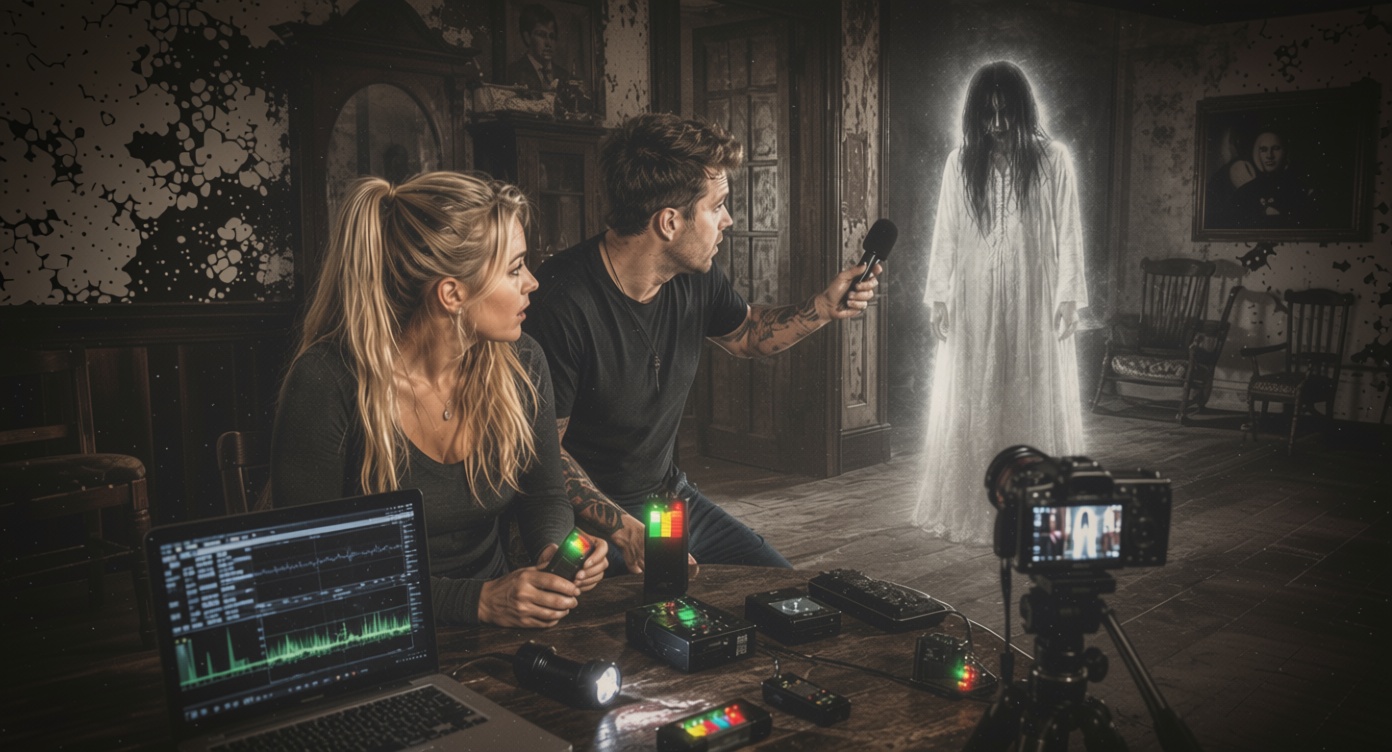
Overview
Paranormal investigators often rely on small, portable instruments to search for evidence of ghostly activity, but the devices they carry are rooted less in folklore than in basic physics. The most widely used tool is the EMF meter, or electromagnetic field meter, which is designed to detect changes in electrical and magnetic energy. In ghost-hunting circles, a sudden spike in the meter’s flashing lights is often interpreted as possible spirit contact, especially when it occurs while an operator is asking a question. But researchers and skeptics alike note that the same devices can react to far more ordinary sources, from household wiring to nearby electronics.
The EMF Meter and Why It Matters
The EMF meter is popular because it is handheld, inexpensive, and easy to use. According to the source material, these devices detect electromagnetic fields produced by power lines, motors, appliances, radio-frequency transmitters, Wi-Fi, and cell phones. Some models measure only magnetic fields, while more advanced versions can register both electric and magnetic components. Inside, a sensor coil or Hall-effect sensor converts a passing field into an electrical signal, which is then amplified and displayed as a reading. Many devices also use colored lights for quick visual feedback: yellow for low intensity, green for stronger activity, and red for the highest readings.
Beyond EMF: Other Portable Detectors
Investigators and parapsychology enthusiasts also use other lightweight tools to scan for unusual energy patterns. RF meters are built to respond to high-frequency signals such as Wi-Fi, Bluetooth, cell phone traffic, and radio broadcasts. A gauss meter measures magnetic field strength more specifically, and many modern versions also rely on Hall-effect sensors. More sensitive still is the magnetometer, which can detect Earth’s magnetic field, buried metal, geological structures, and magnetic anomalies. These instruments are often used in both research and field settings because they can help identify environmental factors that may otherwise be mistaken for paranormal activity.
Sensitivity, Interpretation, and Limits
Among the more advanced devices is the fluxgate magnetometer, which can detect very weak magnetic fields and minute changes in Earth’s magnetic field. The source notes that these instruments can identify disturbances thousands of times weaker than those picked up by simpler EMF meters, making them valuable in scientific surveying as well as exploratory investigations. Even a compass can serve as a basic magnetic detector, since it reveals the direction of Earth’s magnetic field lines and can show irregularities in the environment. But the central challenge remains interpretation: a reading may indicate a genuine anomaly, or it may simply reflect the presence of wiring, iron, electronic recording equipment, or other man-made interference.
A Familiar Tension Between Science and Belief
The enduring appeal of these devices lies in the tension between measurement and mystery. For paranormal researchers, portable detectors offer a way to search for patterns that might suggest unexplained activity. For scientists and skeptics, the same equipment underscores how easily environmental noise can be misread as evidence of ghosts. That divide explains why EMF meters and related tools remain so common in ghost investigations: they provide a tangible, immediate response in settings where certainty is rare. Whether they are revealing spirits or simply mapping invisible fields, these instruments have become central to the modern language of paranormal inquiry.