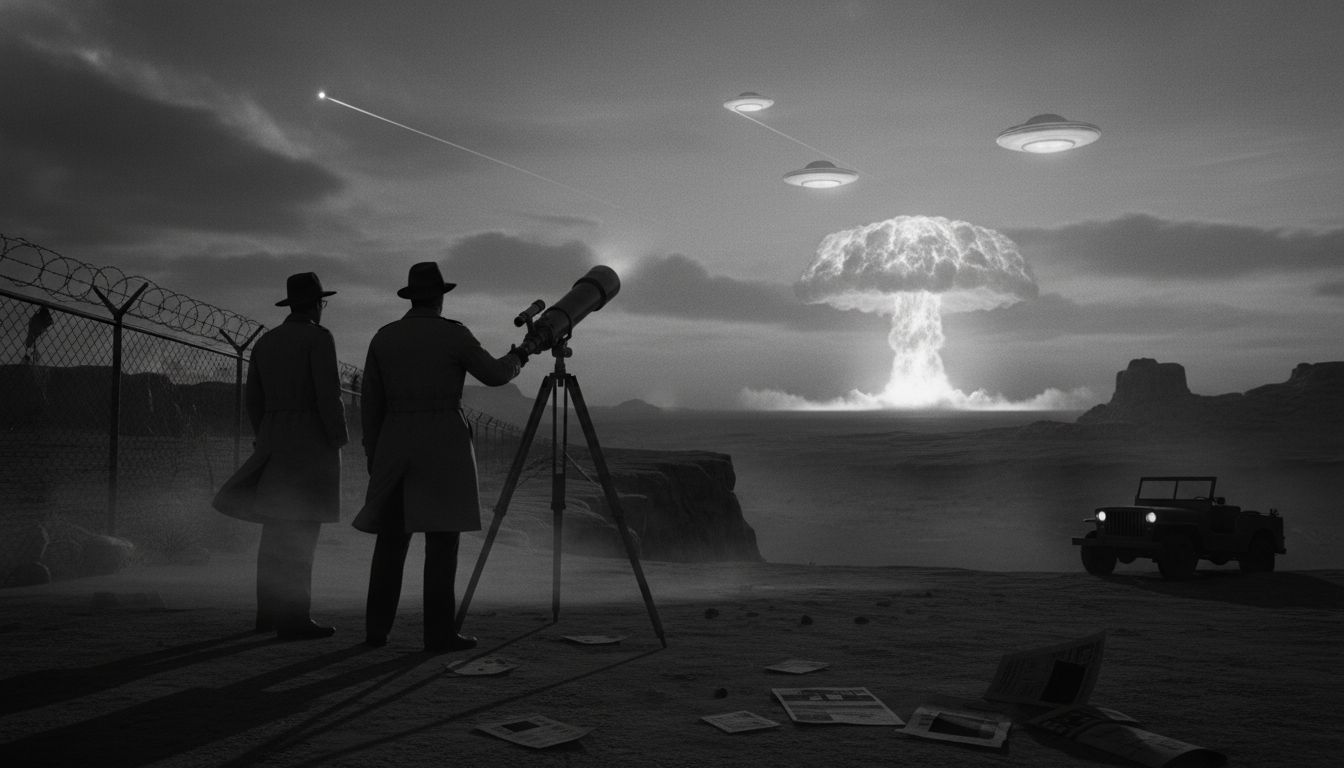
Researchers from Stockholm University in Sweden and Vanderbilt University in Tennessee have published a pair of peer‑reviewed studies that link a series of unexplained flashes captured in historic astronomical photographs to the era of above‑ground nuclear testing in the United States. By scanning observatory plates taken between 1949 and 1957 at facilities in the northern United States, the team identified “transient star‑like objects” that appear as brief, bright spots in otherwise ordinary sky images. The researchers say the timing of these flashes coincides with several dates on which the United States conducted atmospheric nuclear detonations at sites such as the Nevada Test Site and the Pacific Proving Grounds, as well as with a spike in contemporary reports of unidentified flying objects.
“We examined over 10,000 archival plates and found a statistically significant clustering of anomalous light events within a narrow window of a few days before or after a nuclear test,” said Dr. Lina Svensson, lead author and professor of astrophysics at Stockholm University. “The correlation does not prove causation, but it suggests that whatever produced these flashes was present in the same geographic region and temporal frame as the tests.” The study employed a Monte Carlo simulation to assess the likelihood of the observed clustering occurring by chance, arriving at a probability of less than 1 percent. Nonetheless, the authors caution that the evidence remains circumstantial; the plates provide no direct information about the altitude, speed, or composition of the objects.
The findings emerge amid a renewed wave of official attention to unidentified anomalous phenomena (UAP). Since July 2023, Congress has convened three public hearings on the subject, and the Department of Defense’s Unidentified Aerial Phenomena Task Force has released annual reports acknowledging numerous sightings that lack conventional explanations. “The renewed congressional scrutiny has created a climate where rigorous scientific inquiry into historical data is both possible and welcomed,” noted Dr. Michael H. Lee, a senior researcher at Vanderbilt’s Department of Physics. “Our work adds a new dimension by looking backward, using data that predate satellite surveillance, which eliminates a common source of modern contamination.”
Critics point out that the era’s limited photographic technology and the prevalence of atmospheric phenomena—such as meteors, auroras, and lightning—could account for many of the observed flashes. The researchers addressed these concerns by cross‑referencing the plates with known meteor showers and weather logs, finding that the majority of the anomalous events did not align with any recorded natural occurrence. “We are not claiming these are extraterrestrials,” Svensson emphasized in the press release. “They are simply unidentified. The term ‘UAP’ is deliberately neutral, allowing us to investigate without presupposing an origin.” The authors also stress that the lack of satellite data from the 1950s removes a modern source of interference, but it also means there is no contemporaneous corroborating evidence from other sensors.
The broader implications of the research touch on longstanding speculation that foreign or non‑human observers might have been monitoring the United States’ nuclear capabilities during the Cold War. While the studies do not confirm any surveillance, they revive a question that has persisted in both popular culture and intelligence circles for decades. “If there were entities—whether terrestrial or otherwise—interested in our nuclear activities, the timing of these flashes is consistent with a pattern of observation,” said Lee, “but we must remain disciplined and let the data guide us.” As the U.S. government continues to declassify Cold‑War‑era documents and expand its UAP investigative framework, the academic community is likely to receive more opportunities to re‑examine archival records with modern analytical tools.
For now, the Stockholm‑Vanderbilt collaboration offers a meticulously documented, data‑driven perspective on a topic that often veers into speculation. By grounding the analysis in statistical methods and historical context, the researchers provide a measured contribution to the ongoing conversation about unidentified phenomena, nuclear history, and the limits of current scientific understanding. Their work underscores the importance of revisiting old data with fresh eyes, especially as policymakers grapple with how to address the unknowns that continue to appear on the horizon.