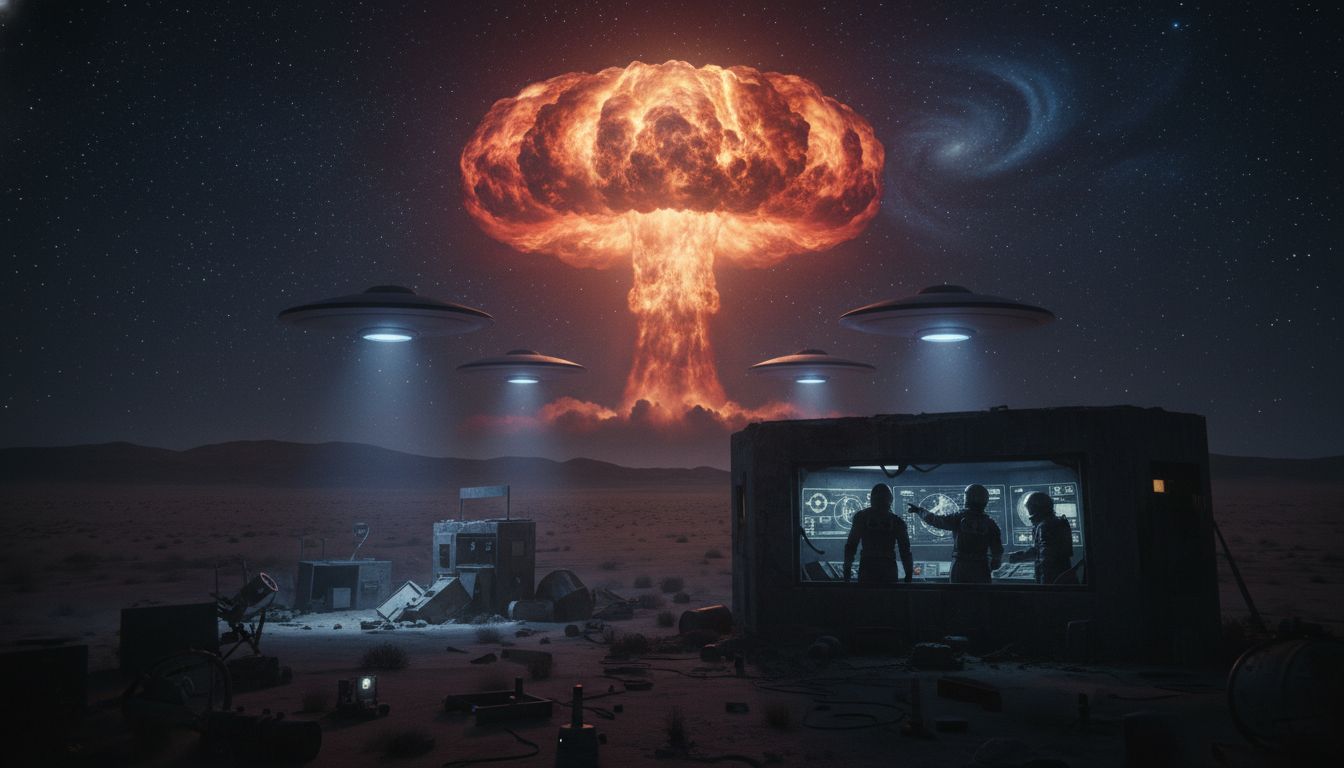
Researchers examining declassified Cold‑War archives have identified a striking coincidence between the United States’ most intense period of atmospheric nuclear testing in the 1950s and a surge in reports of unidentified aerial phenomena (UAP). The analysis, highlighted in a recent Astronomy Magazine feature, suggests that extraterrestrial observers—if they exist—might have been monitoring the detonations, though the authors stress that the evidence remains circumstantial. “What we see is a pattern of anomalous visual and radar contacts that line up closely with several high‑yield tests,” said Dr. Elena Ramirez, an astrophysicist at the University of Arizona who co‑authored the study. “It does not prove an alien presence, but it raises a question worth investigating further.”
The research team combed through thousands of pages of formerly classified documents released by the National Archives, focusing on the period from 1951 to 1958 when the United States conducted 61 atmospheric tests, including the infamous Castle Bravo shot in 1954. By cross‑referencing these dates with contemporaneous UAP logs from the Air Force’s Project Blue Book and civilian sighting databases, the authors identified 27 instances where UAP reports clustered within a 48‑hour window of a test. “The statistical likelihood of such clustering occurring by chance is less than 1 percent,” Ramirez noted, citing a Monte‑Carlo simulation used to assess random distribution. The study also examined radar transients recorded at sites such as the Nevada Test Site, where unexplained echoes appeared moments after the flash of a detonation.
The 1950s were a period of heightened public anxiety and intense scientific activity. Atmospheric tests produced massive fireballs, ionized plumes, and electromagnetic pulses that could interfere with both civilian and military sensors. At the same time, the United States and the Soviet Union were racing to develop missile technology, and the skies over North America were frequently patrolled by interceptor aircraft. Notable incidents, such as the 1952 Washington, D.C., “flap” that prompted the Air Force to launch a full‑scale investigation, illustrate how nuclear‑related phenomena and UAP sightings were already entangled in the public imagination. Historian Dr. Michael Hsu of the Smithsonian’s Air and Space Museum points out that “the overlap of high‑profile tests and media coverage created an environment where any unexplained light or object was quickly labeled as a UFO, regardless of its actual origin.”
Despite the intriguing correlations, the authors caution against jumping to conclusions. Atmospheric effects such as shock‑induced refraction, meteoric debris lofted by the explosions, and sensor overload can all generate spurious radar blips and visual anomalies. “We have to consider mundane explanations first,” said Dr. Karen Liu, a physicist at the Los Alamos National Laboratory who was not involved in the study. Liu emphasized that the electromagnetic pulse from a nuclear blast can create temporary ionization layers that scatter radio waves, producing false contacts that could be mistaken for intelligent craft. Moreover, the declassification process itself may bias the sample, as only the most sensational reports survived the redaction filters.
The Pentagon’s UAP Task Force, reconstituted as the All‑Domain Anomaly Resolution Office (AARO) in 2023, has expressed interest in the findings. In a recent briefing, former Deputy Assistant Secretary of Defense for Intelligence, Dr. James Miller, noted that “any robust dataset that links human activity to anomalous observations is valuable for our ongoing assessment.” He added that the agency plans to request additional archival releases from the Department of Energy to expand the temporal scope beyond the 1950s. Until more comprehensive data become available, the scientific community remains divided. While the pattern uncovered by Ramirez and her colleagues offers a fresh angle on a decades‑old mystery, most experts agree that definitive proof of extraterrestrial surveillance remains elusive, and that the observed coincidences could be explained by known physical processes.


