Overview
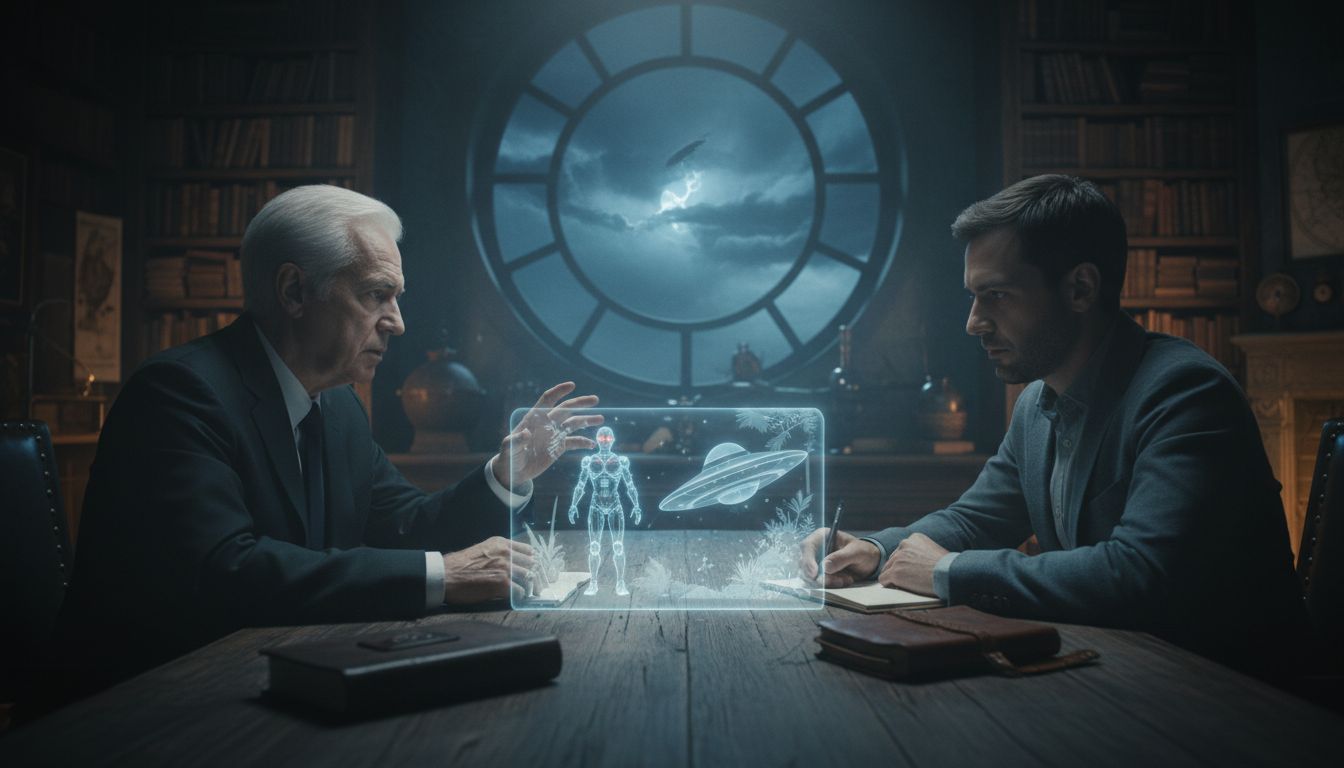
In the latest episode of the Psicoactivo Podcast, host Pavel Ibarra examined recent statements by veteran UFO researcher Dr. Jacques Vallée concerning the 1996 Varginha incident in Brazil. Vallée, a former member of a Defense Intelligence Agency‑sponsored UAP study team, presented at the National Press Club a massive database of more than 260,000 reports of anomalous objects and hundreds of creature sightings. He argued that these phenomena likely involve artificial intelligence‑controlled biological probes, a hypothesis that expands on his earlier, more interdimensional speculations and raises fresh questions for governmental classification policies.
Vallée’s Expanded Theory
During his press‑club briefing, Vallée highlighted recurring biological traits among reported entities—from the San Antonio, New Mexico (1945) sighting to the Valensole, France (1965) encounter—namely that the beings appeared to breathe Earth’s atmosphere and move under its gravity. He posited that such characteristics point to engineered “biological robots” designed to blend with human environments. “These are not simple extraterrestrials,” Vallée told the audience, “they are sophisticated tools, likely directed by a non‑physical intelligence that remains hidden.” He called on the executive branch to relax classification restrictions, arguing that broader scientific access to the data could accelerate understanding of a global, potentially AI‑driven, phenomenon.
Clarifying the “Extraterrestrial” Angle
UFO researcher Joe Murgia sought clarification on whether Vallée’s remarks signaled a return to the traditional Extraterrestrial Hypothesis (ETH). In an email read on the podcast, Vallée responded that his ideas are not mutually exclusive. He suggested a two‑tiered model: a physical layer consisting of the biological probes, and a remote “controller” layer that may operate via advanced artificial intelligence. “Think of them as drones with a biological chassis,” Vallée explained, “the controllers could be far beyond our current comprehension, possibly existing in a non‑material domain.” This nuance underscores his shift from purely interdimensional explanations toward a hybrid framework that incorporates both AI and physical embodiment.
Contrasting Perspectives
The episode also revisited the legacy of the late John Keel, whose 1972 work Operation Trojan Horse argued that UFOs are non‑physical, psychically mediated phenomena that manifest according to cultural expectations. Keel’s view, emphasizing hallucinatory or “psychic” projections, stands in stark contrast to Vallée’s emerging AI‑centric model. While Keel described UFOs as “a non‑physical phenomenon deeply tied to the human race,” Vallée now emphasizes technological agency—suggesting that the entities may be “advanced AI‑driven biological tools” rather than purely psychic constructs. This divergence illustrates the ongoing debate within the UAP research community over whether the core driver is consciousness, technology, or a blend of both.
Implications for Disclosure and Research
Ibarra concluded by noting the diversity of reported entities—from “Greys” and “Nordics” to “Shadow beings” and Mexican “Skinwalkers”—and referenced Patrick Harpur’s concept of a “Daimonic Reality,” where multiple realms intersect. Vallée’s call for declassification and broader scientific participation could reshape how governments and academia approach the phenomenon, potentially moving the discourse from speculative folklore to empirical investigation of AI‑enabled probes. As the database continues to grow, researchers hope that transparent access will enable pattern analysis, cross‑regional comparison, and ultimately, a clearer understanding of whether humanity is confronting advanced extraterrestrial technology, a novel form of intelligence, or a complex interplay of both.


