Overview
Retired NASA scientist Dr. Richard F. Haines sat down with UFO Talker host Michael Ryan on April 29, 2026 to discuss a series of aerial phenomena recorded by U.S. military personnel during the Vietnam War. Drawing on research for an as‑yet‑unpublished manuscript that covers June 1966 through October 1973, Haines detailed several incidents that were logged by official channels, investigated by U.S. authorities, and witnessed by thousands of service members and local civilians. The conversation also touched on a pattern of unexplained deaths among researchers in the United States, China and Australia, which Haines believes warrants a coordinated scientific inquiry.
The Nha Trang Event
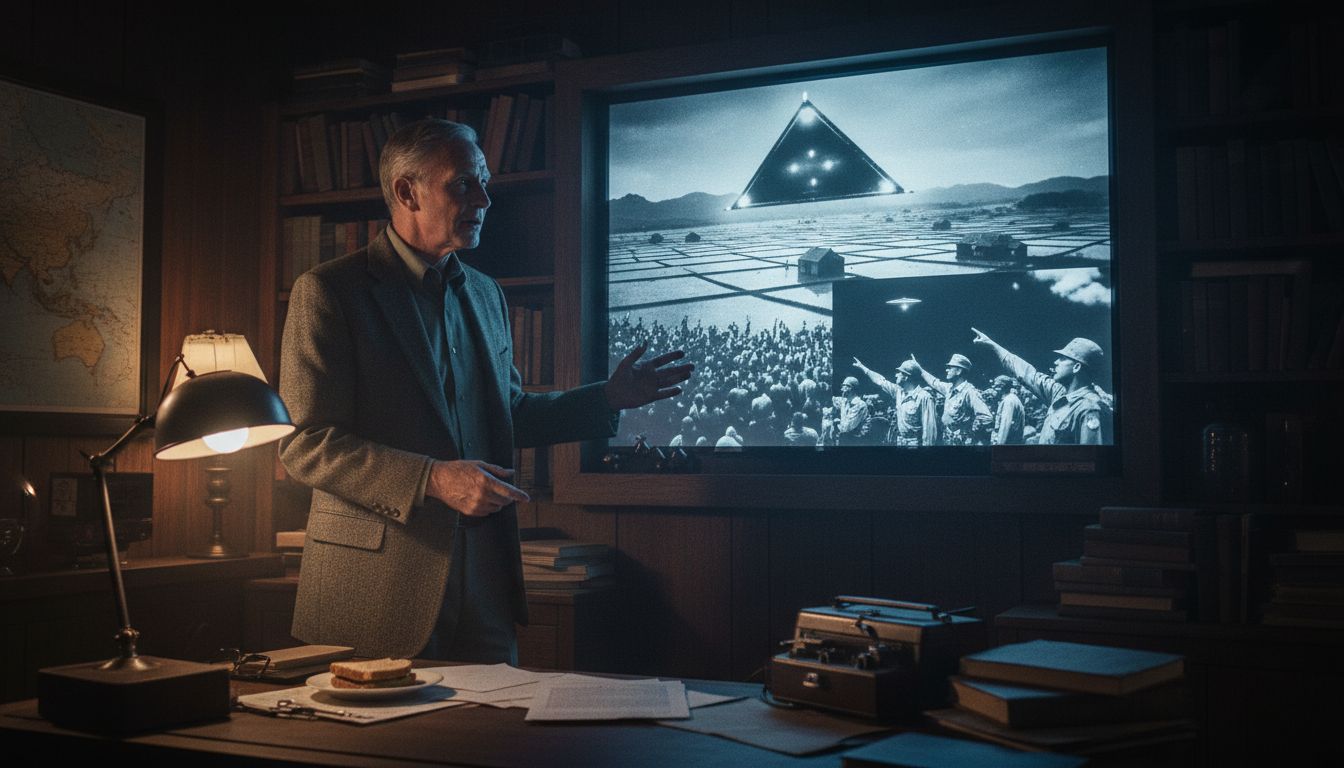
The most striking case Haines described occurred on Nha Trang Air Base in early 1970. According to declassified after‑action reports, a disc‑shaped object roughly 50 feet in diameter hovered at an altitude of about 300 feet directly above the runway. Within seconds the base’s entire electrical grid shut down, plunging the installation into darkness. Simultaneously, witnesses reported an intense illumination that “made it look like daytime,” a phenomenon attributed by the crew to the craft’s own light source.
The power loss affected over 2,000 personnel stationed at the base and nearby civilian facilities. Military communications recorded multiple eyewitness statements, and a U.S. Air Force investigative team was dispatched to assess the incident. “The equipment on the ground simply stopped responding, and the only thing we could see was this bright, silent object hovering above us,” recalled a former air‑base electrician who spoke on the condition of anonymity. No aircraft or ground‑based source could account for the sudden outage, and the incident remains classified in the Department of Defense’s UFO files.
Other Vietnam War Sightings
Haines also highlighted a lesser‑known encounter at Chu Chee fire base, where a soldier claimed he was momentarily lifted aboard an unidentified craft before being returned to the ground unharmed. The soldier’s report, filed in a standard incident log, was corroborated by two additional witnesses and a forward‑area radar sweep that showed a brief, anomalous blip coinciding with the event.
These accounts, along with dozens of smaller sightings—such as luminous orbs observed over the Mekong Delta and unexplained radar returns near Da Nang—were compiled by the National UFO Records Center (NUFORC) during the war years. While many were dismissed as weather balloons or experimental aircraft, a subset, including the Nha Trang and Chu Chee cases, retained a “high‑confidence” rating due to multiple independent testimonies and contemporaneous documentation.
Unexplained Scientist Deaths
The interview shifted to a broader, more unsettling trend: the premature deaths of several researchers studying anomalous aerial phenomena in the United States, China, and Australia over the past two decades. Haines cited the 2019 passing of Dr. Mei‑Ling Zhou (China), the 2022 sudden cardiac arrest of Australian physicist Dr. James Whitaker, and the 2024 unexplained demise of U.S. aerospace engineer Dr. Alan Greene.
While no causal link has been established, Haines emphasized that the coincidences are “statistically improbable” and merit systematic review. He urged academic institutions and governmental agencies to share data openly and to fund multidisciplinary panels capable of evaluating both the physical evidence of sightings and the health records of involved scientists.
Looking Ahead
Haines’ forthcoming book, slated for release later this year, will compile the Vietnam War documentation alongside the recent scientist‑death cases, aiming to provide a comprehensive, peer‑reviewable archive. He plans to present his findings at the 2026 SCU Conference in Toronto and the Exeter UFO Festival, events that attract both skeptics and believers.
In the meantime, the UFO Talker episode serves as a reminder that military‑recorded UFO encounters remain part of the historical record, and that the scientific community continues to grapple with their implications. As Haines concluded, “If we are to understand what happened over Nha Trang and elsewhere, we must approach the data with the same rigor we apply to any other anomalous phenomenon—without sensationalism, but with an open, investigative mind.”