Overview
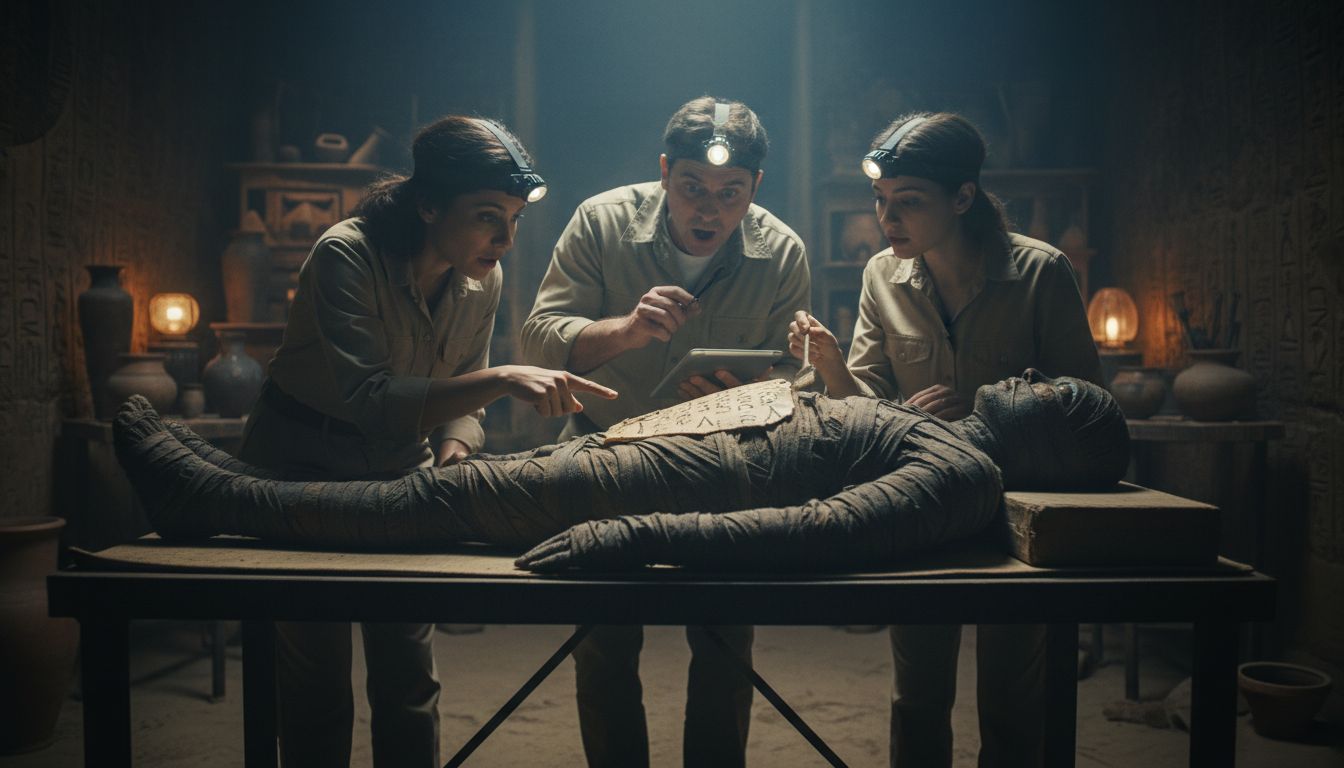
Archaeologists excavating a burial chamber in the Saqqara necropolis have uncovered an exceptionally well‑preserved mummy whose abdomen bears a faint, inked fragment of Homer’s Iliad. The discovery, reported by CNN on May 1, 2026, marks one of the few known instances of a literary text inscribed directly on a human remain. Researchers believe the inscription dates to the early Ptolemaic period (circa 300 BCE), a time when Greek culture was increasingly interwoven with Egyptian traditions.
The Find
The mummy was unearthed by a joint Egyptian‑German team led by Dr. Maha El‑Sayed of the Egyptian Ministry of Antiquities. While documenting the burial goods, the team noted a faint line of black pigment running across the lower torso. High‑resolution multispectral imaging revealed the characters to be a passage describing the “wrath of Achilles” from Book 1 of the Iliad. The ink appears to have been applied post‑mortem, likely as part of a funerary ritual. The body itself belongs to a middle‑aged male, identified through osteological analysis as a former scribe or priest, based on the presence of a wooden writing palette among the grave goods.
Historical Context
Greek literary works began to appear in Egypt after Alexander the Great’s conquest in 332 BCE, culminating in the Ptolemaic dynasty’s promotion of Hellenistic culture. However, direct evidence of Greek texts on Egyptian human remains is exceedingly rare. The Iliad fragment suggests that the deceased, or his family, may have embraced Greek literary traditions as part of their identity, reflecting a broader cultural syncretism. Similar cross‑cultural exchanges are documented in temple reliefs and papyri, but an inscribed line on a mummy’s flesh provides a tangible, personal link between the two worlds.
Expert Commentary
“This is a remarkable convergence of two ancient literary traditions,” said Professor Lydia Khan, a specialist in Greco‑Egyptian studies at the University of Cambridge. “The presence of Homeric text on a mummified body implies that the Iliad was not merely a distant literary curiosity but a living element of funerary practice for some Egyptians in the early Hellenistic era.” Dr. El‑Sayed added, “The ink’s composition matches pigments used in contemporary Greek manuscripts, supporting the hypothesis of a deliberate, culturally informed act rather than a later intrusion.”
Future Research
The team plans to conduct radiocarbon dating of the linen wrappings and pigment analysis to refine the mummy’s chronology. Comparative studies with other Ptolemaic burials may reveal whether such inscriptions were isolated or part of a broader, yet undocumented, funerary custom. If further examples emerge, they could reshape scholarly understanding of how Greek literature permeated daily Egyptian life, offering new insight into the complex cultural tapestry of ancient Mediterranean societies.


