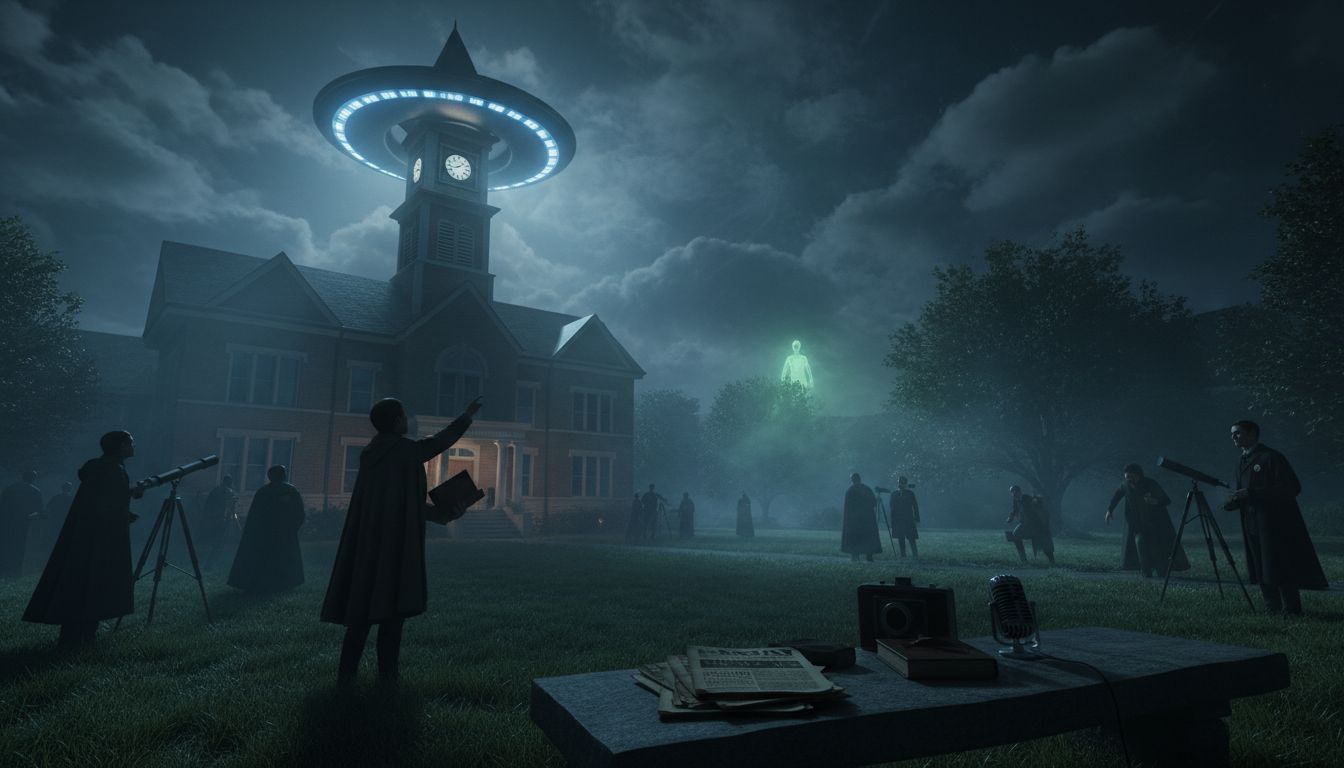
East Texas A&M University’s relationship with unidentified aerial phenomena stretches back more than seven decades, a timeline that mirrors the broader American fascination with “flying saucers.” The campus first entered the conversation in March 1950, when the student‑run newspaper The East Texan ran a piece titled “Students Offer Explanations for Flying Saucers.” In a handful of brief letters, undergraduates posited everything from secret government tests to extraterrestrial observers, with one succinct comment that still resonates today: “They’re watching us.” A second article a month later, “Saucer Theories Include ‘The Impossible,’” injected a dose of local humor—suggesting that neon‑lit Texas mosquitoes or Hollywood prop‑ware could be responsible—while also recounting a farmer’s claim that a saucer had sprayed his fields with kerosene. The tone of those early stories, half‑serious, half‑satirical, set a precedent for the campus’s open‑ended approach to the subject.
The university’s engagement has not been limited to folklore. Over the years, faculty have incorporated the mystery into curricula, turning speculation into scholarly inquiry. In 1967, a first‑year sociology class led by Ross Henderson conducted a “seek the truth” interview with a Colorado resident who linked a gruesome horse death to nearby UFO activity—a case study that illustrated how sociological methods can be applied to fringe claims. Five years later, Dr. Denis J. Quane’s chemistry course tackled the Drake Equation’s variables, asking students to calculate the statistical likelihood of intelligent life by integrating data from astronomy, geology, biology and physics. The interdisciplinary effort continued into the late 1970s when physics professor Dr. Arlen R. Zander organized public lectures that examined atmospheric optics and radar anomalies, explicitly distinguishing between natural phenomena and potential technological artifacts.
East Texas A&M’s willingness to host external experts further underscores its role as a regional hub for UFO discourse. In the 1990s, the university invited Dr. Jacques Vallée, a noted ufologist and former NASA consultant, to speak at a joint event with the university’s astronomy department. More recently, in 2023, a panel featuring former members of the U.S. Air Force’s Unidentified Aerial Phenomena Task Force convened on the campus’s science building, providing students with first‑hand insight into ongoing governmental investigations. These events have been framed as opportunities for critical thinking rather than endorsement of any particular explanation, aligning with the institution’s broader educational mission.
The campus narrative fits within a larger Texan tapestry of aerial sightings that has long attracted national attention. From the 1947 Roswell incident to the 1977 “Battle of Los Angeles” over nearby San Antonio, Texas has repeatedly surfaced in media reports and congressional hearings on unidentified aerial phenomena. In 2022, the Senate Armed Services Committee held a public hearing in Austin that referenced multiple sightings across the Lone Star State, noting that “the frequency of credible reports in Texas exceeds the national average.” East Texas A&M’s archival material—student newspaper clippings, course syllabi, and recorded lectures—offers a micro‑cosm of that statewide pattern, illustrating how academic communities can both reflect and shape public perception of the unknown.
Today, the conversation on campus remains diverse. A 2025 informal poll conducted by the university’s student government found that 42 % of respondents believe UFOs are likely to be advanced terrestrial technology, 31 % favor an extraterrestrial origin, and 27 % attribute sightings to atmospheric or psychological factors. While the university does not maintain an official research program dedicated to unidentified phenomena, it continues to provide platforms—through guest speakers, interdisciplinary courses, and archival preservation—for students and faculty to explore the topic with rigor. As the national debate evolves, East Texas A&M’s blend of historical documentation, academic inquiry, and community engagement ensures that the mystery above remains a legitimate, if still unanswered, part of campus life.


