Overview
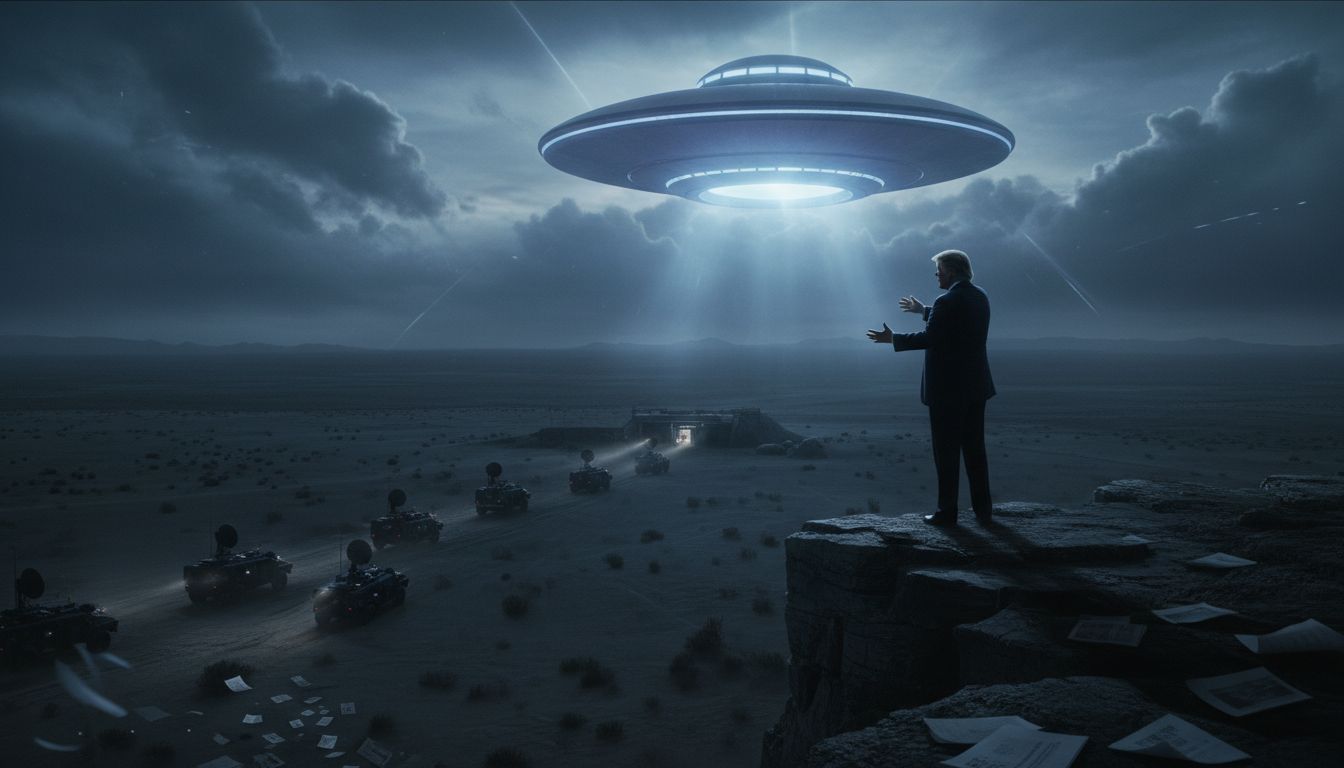
Former President Donald Trump has repeatedly referenced unidentified flying objects (UFO — now more formally termed “UAP” for unidentified aerial phenomena) in public speeches dating back to his first term and continuing into his 2024 campaign. The collection of his remarks, compiled by Newsweek on February 13 2026, illustrates a pattern of presidential “top‑level” acknowledgment that the phenomenon is “real,” that the United States has been “investigating it,” and that it deserves public attention. While Trump’s comments have often been framed by his critics as political theatrics, they echo a broader shift in the U.S. government toward greater transparency on the subject, following the release of the 2021 Office of the Director of National Intelligence (ODNI) report and the establishment of the All‑Domain Anomaly Resolution Office (ADARO) in 2023.
Presidential Remarks
The first notable reference came in July 2017 during a National Space Council meeting, where Trump said, “We have a very, very, very interesting thing that is happening. I’m looking at it.” He framed the issue as a matter of national security and hinted at a “top‑secret” investigation. In January 2020, while addressing a crowd in Iowa, he claimed, “I think it’s very, very interesting. We have had some very interesting stuff, and we’re looking into it.” The phr‑phrase “very interesting” became a signature phrase for his UAP references.
During the June 2022 Republican convention, Trump again alluded to the phenomenon, stating, “The United States has been looking at this for a long time. We have evidence that is being reviewed.” The phrasing mirrored language used by the Pentagon’s UAP Task Force in its 2021 public release, suggesting that the former president was aware of the intelligence community’s ongoing analysis.
Most recently, in a July 2024 campaign rally in Ohio, Trump declared, “UFOs are real, and we’re going to get the public the truth.” He pledged to “release any classified material that is not a threat to national security,” positioning himself as a champion of transparency ahead of the 2025 congressional hearings on UAP. Although the exact text of these speeches varies, the consistent themes—recognition of the phenomenon, acknowledgment of a systematic investigation, and a promise of public disclosure—have been captured in the Newsweek compilation.
Policy and Institutional Context
Trump’s statements dovetail with a series of institutional developments that have moved UAP from the fringe of conspiracy‑theory to the periphery of official policy. The January 2021 ODNI report, released under the Trump administration, catalogued 144 incidents of “potentially anomalous” phenomena, with 71 deemed “unexplained.” In April 2022, Congress passed the Intelligence Authorization Act, mandating a “comprehensive review of all UAP incidents” and establishing a “UAP Executive Office” within the Office of the Director of National Intelligence.
Under the Biden administration, the UAP Task Force was succeeded by ADARO in June 2023, broadening the scope of analysis to include maritime and land‑based anomalies. The administration’s decision in February 2025 to declassify a portion of the 2021 report—prompting a surge in public interest—has been referenced by Trump as evidence that “the truth is being hidden.” While the President does not have direct control over these agencies, his repeated references have amplified public pressure on Congress to fund further investigative efforts.
Political and Public Impact
Trump’s “UFO” remarks have generated a noticeable ripple across the political landscape. Poll‑trackers in early 2025 showed a 5‑point increase in public belief that the U.S. is investigating extraterrestrial phenomena, with higher rates among Republican respondents who cite Trump’s “very interesting” comments as a catalyst. Congressional Democrats have leveraged the heightened attention to push for a 2026 “UAP Transparency Act,” which would require the release of all non‑classified evidence within six months of any new incident.
Media coverage, while largely cautious, has mirrored the shift. Major outlets such as The Washington Post and BBC have begun to treat UAP investigations as a legitimate national‑security issue rather than a fringe topic. The phenomenon has also entered the entertainment industry, with a surge in documentary series released by streaming services in 2025, many of which reference the “Trump effect” as a catalyst for public interest.
Looking Ahead
As the United States prepares for the June 2026 congressional hearing on UAP—expected to feature testimony from former Air Force officer Robert Foster and intelligence analyst Mara Liu—Trump’s earlier claims will likely be revisited. Analysts anticipate that the former president’s promise of “release the truth” could pressure the administration to accelerate declassification, a move that may have both diplomatic and commercial implications, especially in the emerging “UAP‑related” sector of aerospace research.
Whether Trump’s remarks constitute genuine insight, political maneuvering, or a blend of both, they have undeniably contributed to a national conversation that is shifting from the margins of speculation to the corridors of Washington. As the public awaits the forthcoming testimony, the phrase “very, very, very interesting” may become a shorthand for an era in which the United States openly acknowledges that some of its most enigmatic encounters remain unsolved.


