Overview
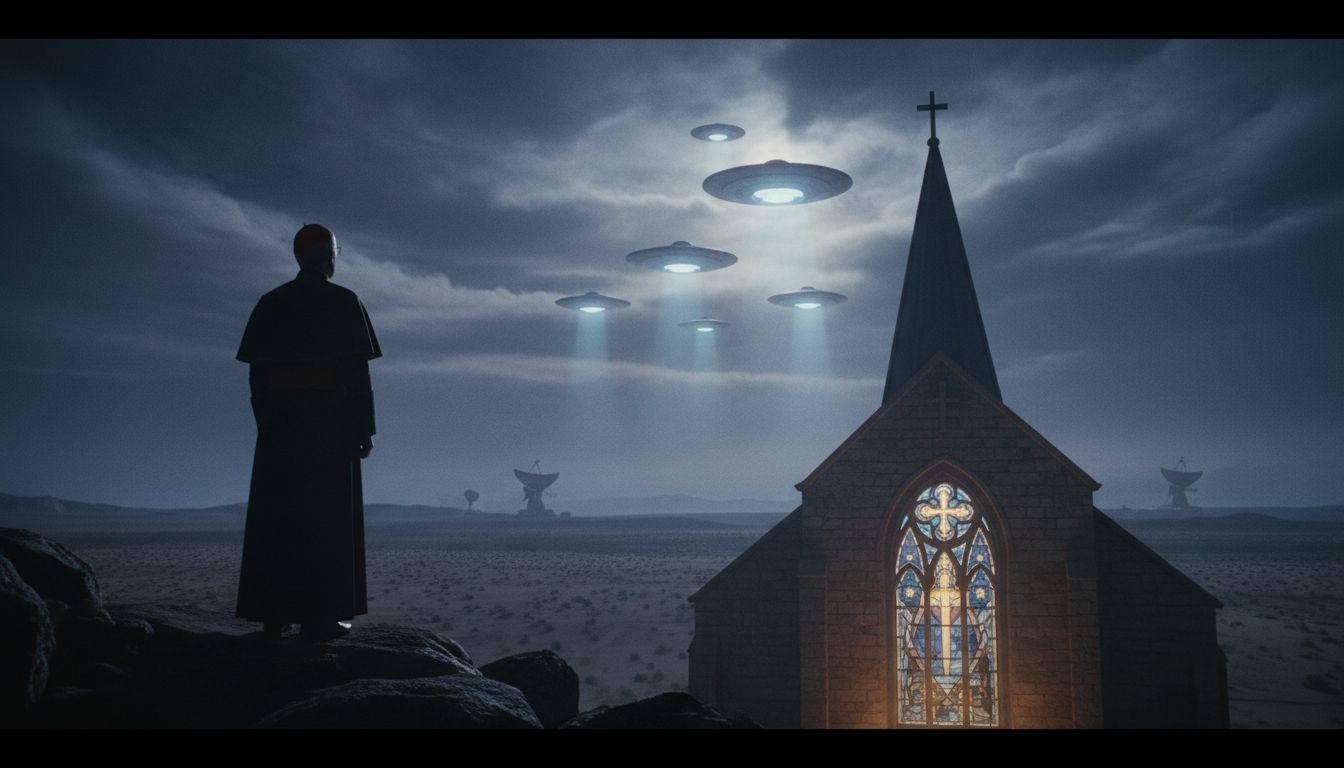
The U.S. government’s decision on May 8 to release a batch of formerly classified files on unidentified anomalous phenomena (UAP) has reignited public debate about extraterrestrial life. While the disclosures have spurred speculation about “aliens” and non‑human intelligence, the Catholic Church remains officially silent on the matter. According to scholars consulted by EWTN News, the Church has no dogma or formal teaching regarding UFOs or the existence of life beyond Earth, but it encourages scientific inquiry and views any discovery as part of God’s creation.
Historical Background
The question of life on other worlds is not new to Catholic thought. Medieval and Renaissance popes occasionally addressed related ideas, though their concerns centered on theological implications for humanity rather than modern notions of alien spacecraft. Pope Zachary (mid‑8th century) condemned a theory that “another orb” might host human beings, a stance likely aimed at preserving the doctrine of a single human lineage from Adam. Similarly, Pope Pius II in the 15th century rejected speculation about “other humans on other worlds,” again to safeguard the biblical narrative of original sin. These brief interventions illustrate that the hierarchy has historically treated the topic as theologically peripheral, allowing scholars to explore it without ecclesiastical censure.
Scholarly Perspectives
Modern Catholic scholars argue that the Church’s silence can be read as an implicit permission for open discussion. “You might say that the Church hasn’t pronounced on it through a kind of silence around the topic,” said Luke Togni, professor of religious studies at Saint Mary’s University in Nova Scotia. Togni adds that this “silence” is not a prohibition; rather, it reflects a prudent openness that accommodates scientific progress.
The late theologian Paul Thigpen, author of Extraterrestrial Intelligence and the Catholic Faith, asserted in a 2022 interview with the National Catholic Register that belief in intelligent life elsewhere is compatible with Catholic doctrine. Thigpen noted that earlier theologians who denied the possibility of other intelligent species often relied on limited scientific knowledge and philosophical assumptions that have since been superseded. “Some Christian theologians of the past have asserted that there can be no intelligent species other than humanity and the angels,” he explained, “but their reasoning was most often flawed by a reliance on certain philosophical or scientific premises that are no longer accepted.”
The Church’s Current Position
Although the Vatican has not issued a formal statement on recent UAP releases, its broader approach to science offers guidance. The Holy See’s Pontifical Academy of Sciences repeatedly affirms that faith and reason are complementary, encouraging the faithful to engage with empirical research. In a 2023 address, Pope Francis emphasized that the universe’s vastness points to “the inexhaustible creativity of God,” suggesting that discovering new forms of life would enrich, not diminish, the Christian understanding of creation.
The Church also stresses pastoral care for anyone who claims personal encounters with UFOs or extraterrestrials. Pastoral guidelines advise discernment, psychological evaluation, and theological reflection, ensuring that believers receive support without being dismissed outright.
Implications for the Faithful
If future investigations confirm the existence of extraterrestrial intelligence, Catholic theologians anticipate a re‑examination of certain doctrines, such as the uniqueness of Christ’s incarnation and the universality of salvation. However, the consensus among current scholars is that such a discovery would not overturn core tenets of Christianity; rather, it would expand the scope of God’s salvific plan.
In the meantime, the Church continues to encourage responsible scientific exploration while reminding the faithful that all of creation—whether terrestrial or cosmic—belongs to the same Creator. As the UAP files circulate and public curiosity grows, Catholic observers are likely to watch both the scientific developments and the theological conversations that follow, confident that faith can accommodate new horizons without compromising its foundational truths.