Overview
The latest episode of the “Faeries From a UFO” podcast revisits a series of unusual sightings that sit at the intersection of folklore and extraterrestrial lore. The program draws on Charles Lear’s extensive catalog of cases, beginning with a 1979 encounter in England’s West Midlands and extending to later reports from Italy, the United States, and a tongue‑in‑cheek “April‑fool” drop‑in known as Mr. X. The episode is framed by the seminal 1969 work Passport to Magonia by Jacques Vallée, which argues that modern UFO narratives may echo older fairy‑type traditions. By juxtaposing contemporary eyewitness testimony with historical analysis, the podcast seeks to assess whether these accounts represent genuine anomalous phenomena or cultural reinterpretations of myth.
The West Midlands “Flying Fairies”
The centerpiece of the episode is the 1979 incident reported by Jean Hingley of Rowley Regis, near Birmingham. As detailed in the Flying Saucer Review (Vol. 25, No. 6) and later retold by journalist Eileen Morris, Hingley described a cold, snow‑laden morning when an “orange light … turned white and lit up the whole area” of her garden. Three luminous entities, 3–4 feet tall, entered her home, producing a “Zee… zee… zee…” sound. Hingley recalled being “frozen” while her Alsatian dog behaved as if drugged, hair standing “like a hedgehog’s.”
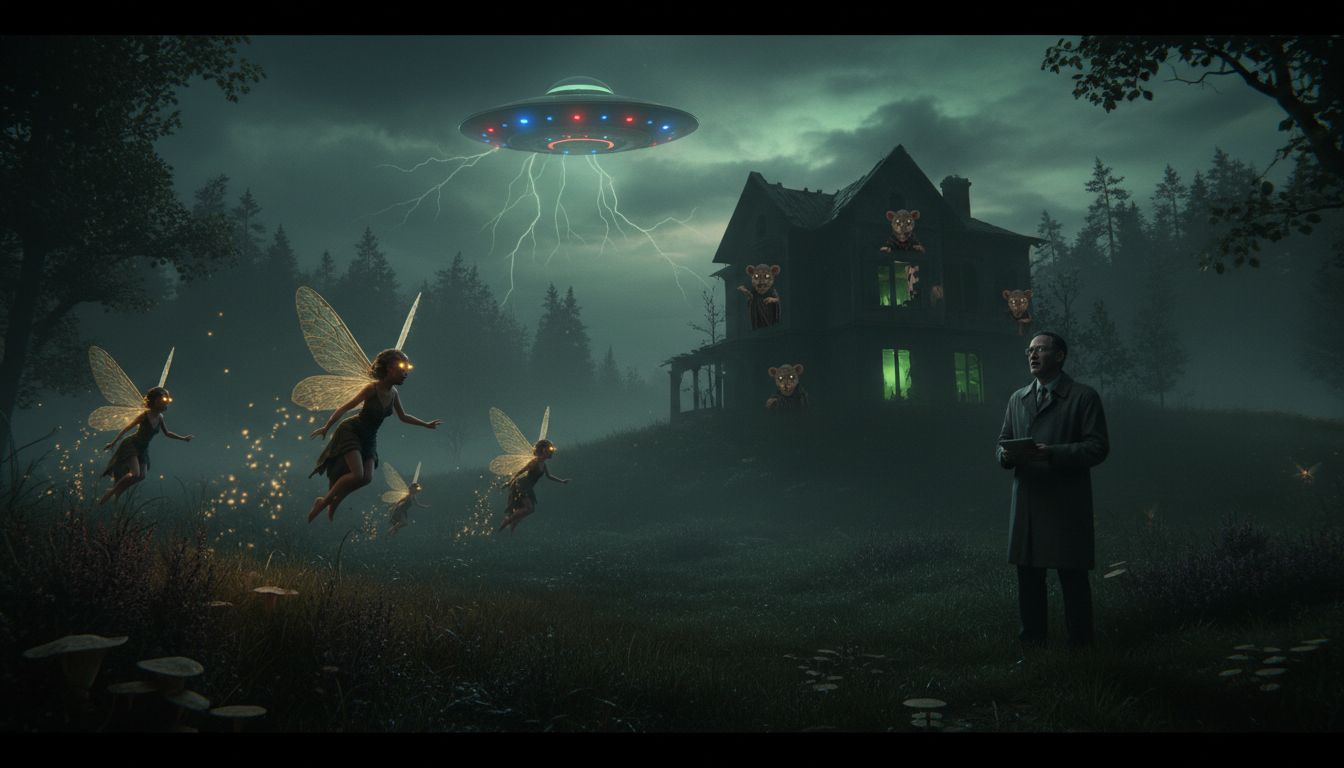
The beings were described as slim men clad in silvery‑green tunics and caps, their heads encased in transparent helmets. Their faces were “waxy, white, and corpse‑like” with “black‑diamond eyes.” Most striking were the large, oval‑shaped wings that glowed with “rainbow colours” and were dotted with luminous specks. Hingley reported a sensation of mental probing—“like a light or an X‑ray penetrating my mind”—and a fleeting feeling of warmth and weightlessness, which she likened to being “in Heaven.” The account, corroborated by Hingley’s own review of the transcript, remains one of the most detailed descriptions of “fairy‑like” UFO entities in the modern record.
International Oddities: Italy’s Rat‑Faced Visitors and the Alabama Hoax
The podcast expands its scope to include a 1982 sighting in northern Italy, where several witnesses claimed to have encountered small, rat‑faced humanoids emerging from a low‑flying disc. The description—sharp, whiskered faces, elongated snouts, and a pungent odor—bears a disconcerting resemblance to European folklore about “black dogs” or “night hags,” prompting researchers to question whether cultural archetypes are being projected onto anomalous aerial phenomena.
In contrast, the 1973 Jeff Greenhaw sighting in Alabama has been widely labeled a hoax. Greenhaw, a local farmer, reported a cluster of glowing, winged figures hovering above his fields before vanishing in a burst of static. Skeptics point to the lack of contemporaneous documentation and Greenhaw’s later admission that the story was “a bit of fun for the newspaper.” Nonetheless, the episode’s inclusion of Greenhaw underscores the podcast’s commitment to presenting the full spectrum of claims, from the plausibly authentic to the demonstrably fabricated.
The “Mr. X” Drop‑In: An April‑Fool Twist
A later segment of the episode introduces a “Mr. X” narrative, released on April 1 2025 as a deliberate “drop‑in” story. Supposedly, Mr. X contacted a UFO researcher claiming to have been abducted by tiny, luminous sprites that communicated through light patterns. The podcast hosts quickly disclosed the timing and tone of the piece, framing it as a self‑referential experiment to gauge audience susceptibility to sensational detail. While some listeners expressed genuine belief, the producers used the episode to illustrate how easily modern folklore can be seeded in the digital age, especially when presented alongside credible testimonies.
Ongoing Debate and Scholarly Context
The mixed roster of reports fuels an enduring debate within the UFO research community. Proponents, such as Vallée’s followers, argue that the recurrence of fairy‑type imagery across continents suggests a shared phenomenology that transcends cultural boundaries. Critics, however, emphasize methodological shortcomings: reliance on single‑witness accounts, absence of physical evidence, and the potential for confirmation bias when folklore is invoked as explanatory scaffolding. Dr. Mara Ellis, a professor of folklore studies at the University of Exeter, notes that “the human brain is wired to recognize pattern and agency, especially under stress; the ‘fairy’ label may simply be a narrative shortcut for an inexplicable experience.”
Conclusion
By weaving together the West Midlands “flying fairies,” Italy’s rat‑faced visitors, the contested Alabama sighting, and the intentional April‑fool “Mr. X” story, the “Faeries From a UFO” podcast offers a comprehensive snapshot of how modern UFO reports can echo age‑old mythic motifs. Whether these accounts represent genuine unknowns, cultural reinterpretations, or deliberate fabrications remains unresolved. What is clear, however, is that the dialogue between folklore and extraterrestrial speculation continues to shape public perception, urging both investigators and skeptics to apply rigorous standards while remaining open to the possibility that some mysteries may yet defy easy categorisation.