Overview
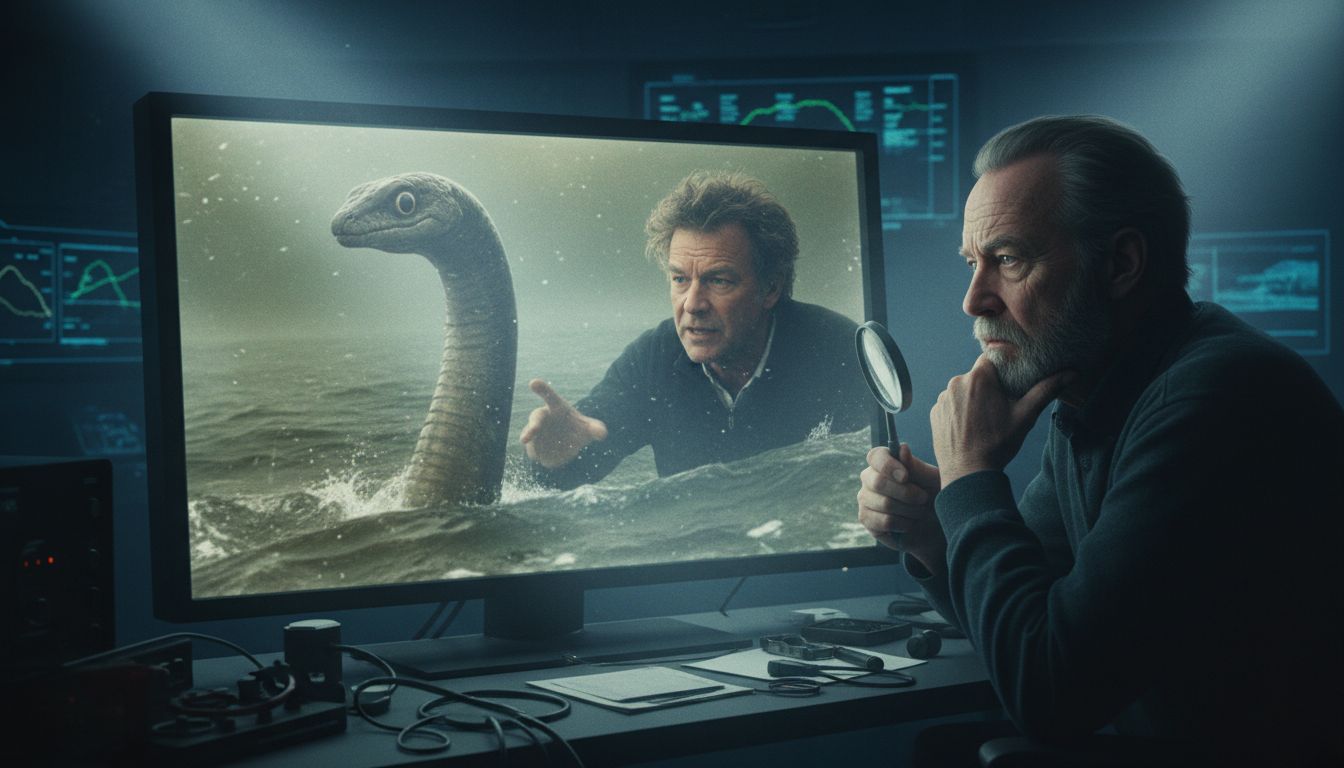
Veteran Loch Ness enthusiast Gordon Holmes has resurfaced a piece of video footage he originally recorded in 2007, claiming it is the “best‑ever close‑up” of the legendary creature known as “Nessie.” After applying modern image‑enhancement software, Holmes says the clip reveals unprecedented detail of a serpentine form gliding just beneath the surface of Scotland’s famed loch. The claim has reignited a debate that has persisted for decades, drawing both intrigue and skepticism from the small but vocal community of Nessie researchers.
Holmes’s Claim
In a recent interview, Holmes described the enhanced footage as “a breakthrough that finally gives us a clear look at the creature’s neck and a hint of its dorsal ridge.” The original material, shot with a consumer‑grade camcorder during a low‑light night in 2007, was reportedly taken from a small boat positioned near the loch’s western shore. Holmes says he used contemporary AI‑driven upscaling tools to reduce grain, increase contrast, and stabilize the image, resulting in a clip that, according to him, “shows the outline of a long, undulating body with a distinct head‑like bulge.”
Holmes added that the footage was taken at a depth of roughly 30 metres, a range that, if accurate, would place the creature well within the loch’s deeper basins where many historic sightings have been reported. He has offered the video to several documentary producers and is in talks with a British television network for a potential feature.
Expert Reaction
The response from the Nessie research community has been mixed, with Adrian Shine, a veteran investigator who has catalogued over 1,500 sightings, dismissing the clip as “nothing more than a surface ripple amplified by software.” Shine cautioned that “enhancement algorithms can easily introduce artefacts that look like organic forms, especially when dealing with low‑light water footage.” He emphasized the importance of independent verification, noting that “without raw, unprocessed data, it’s impossible to rule out digital manipulation.”
Other researchers, such as Dr. Emily MacLeod of the University of Aberdeen’s Department of Marine Biology, echoed Shine’s concerns but also acknowledged the potential value of revisiting older recordings with modern tools. “If the original file is made available for peer review, we could apply scientific image‑analysis techniques to assess the likelihood that the shape is a biological entity versus an optical illusion,” MacLeod said.
Historical Context
Holmes’s video joins a long line of alleged visual evidence, from the iconic 1934 Marmaduke Wetherell photograph to the controversial 1994 “Surgeon’s Photo” that was later debunked as a hoax. Over the past century, dozens of eyewitness accounts have described a creature ranging from a 15‑metre plesiosaur‑like animal to a more serpentine form. Notable sightings include the 1975 “Nessie‑2” incident, where a group of tourists reported a large, dark shape surfacing near the loch’s southern end, and the 2001 sonar echo that suggested a moving object of roughly 10 metres in length.
Holmes himself has been involved in Nessie investigations for over three decades, contributing to several field expeditions and co‑authoring a 2012 compendium of loch‑based sightings. His latest claim therefore carries weight within the community, even as it underscores the recurring challenge of separating anecdotal evidence from verifiable data.
Locating the Monster
The interview also revisited attempts to pinpoint where Nessie might reside within the loch. Holmes highlighted a “hotspot” near the Loch Ness Castle area, where the loch reaches depths exceeding 230 metres and where thermal stratification could support a large, cold‑water organism. He referenced a 2018 sonar survey that detected an anomalous echo at approximately 150 metres depth in that sector, suggesting a possible “habitat corridor” for a sizable creature.
Scientists, however, remain cautious. Dr. MacLeod noted that “the loch’s complex underwater topography, combined with seasonal temperature layers, makes it difficult to draw definitive conclusions from a single echo or visual anomaly.” She urged a coordinated, multi‑sensor approach—combining high‑resolution sonar, environmental DNA sampling, and calibrated visual recordings—to build a more robust picture.
Conclusion
While Gordon Holmes’s enhanced 2007 footage has sparked renewed excitement, the broader scientific community stresses the need for rigorous, transparent analysis before any definitive statements can be made about the existence of the Loch Ness Monster. As Holmes prepares to share the original files with interested parties, the episode serves as a reminder that modern technology can both illuminate and obscure, and that the quest for Nessie continues to balance hopeful curiosity with disciplined inquiry.


