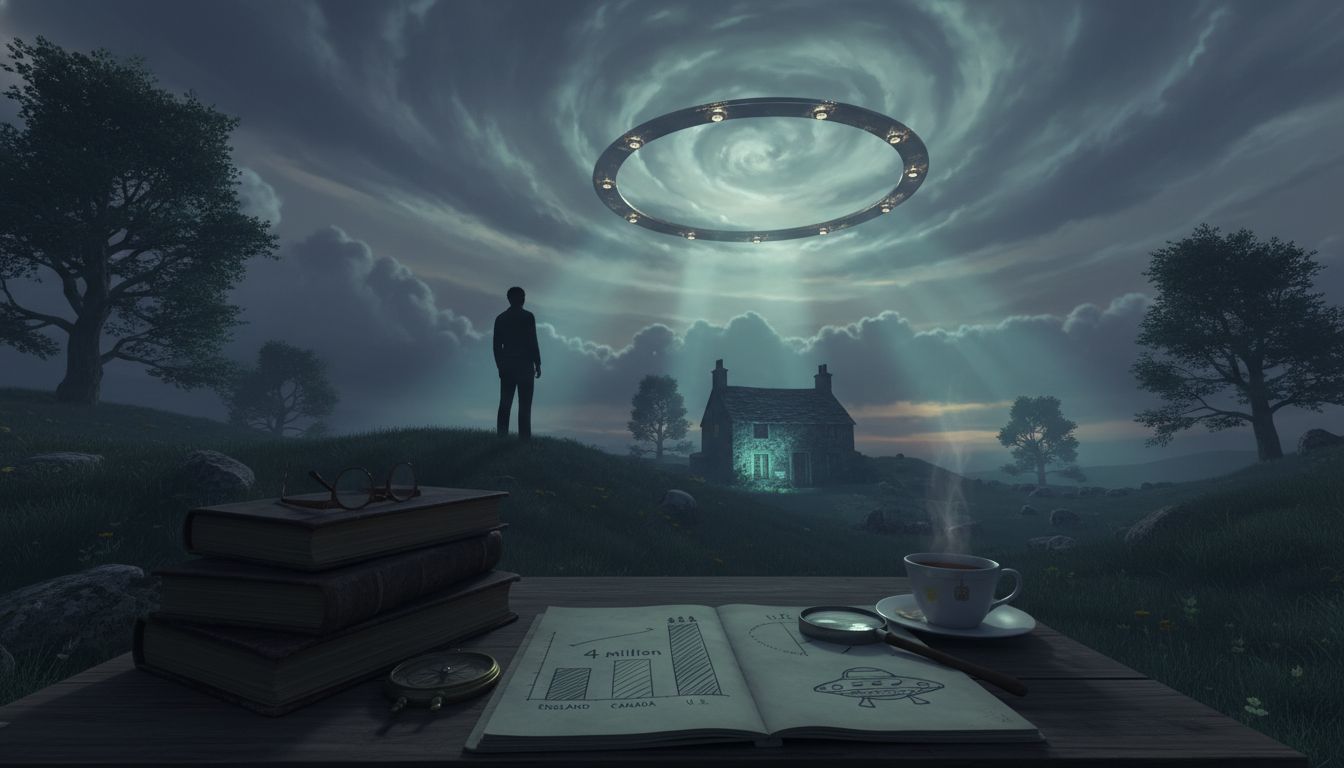
The first truly representative “National Folklore Survey for England” has revealed that more than four million people across the country claim to have witnessed “something in the sky they could not explain.” Conducted over two years and overseen by Dr. David Clarke, an associate professor at Sheffield Hallam University, the 2025 survey asked 16‑ to 75‑year‑olds about a wide range of supernatural and unexplained experiences. In addition to the UFO figures, the questionnaire recorded reports of ghosts, angels and other phenomena, with one in five respondents admitting they have never shared those encounters with anyone else.
Dr. Clarke said the findings “challenge the lingering notion that folklore is a relic of the past.” He emphasized that folklore, by definition, encompasses “the art, stories, knowledge and practices of people” and that contemporary beliefs about aerial mysteries are now part of that living tradition. The survey draws on expertise from Sheffield Hallam, the University of Hertfordshire and Chapman University in the United States, and is funded by the Arts and Humanities Research Council (AHRC) with support from The Folklore Society. It follows a 1964 study by the University of Sheffield, which relied on mailed paper questionnaires and collected roughly 12 000 handwritten entries; the new digital approach allows a statistically robust picture of modern English belief systems.
Perhaps the most striking statistic is the proportion of respondents who suspect a governmental cover‑up: almost one‑third of those surveyed believe that information about extraterrestrials is being suppressed. This sentiment mirrors results from comparable folklore surveys carried out in Canada and the United States over the past decade, where roughly 28 % of Canadian participants and 31 % of American respondents expressed similar doubts about official transparency. Those North‑American studies, conducted by the Canadian Centre for Folklore Research and the UAP Research Institute respectively, also reported comparable levels of personal UFO sightings—approximately 3.8 % of the Canadian sample and 4.2 % of the American sample reported a direct visual encounter. The English figures therefore sit comfortably within a broader Anglo‑American pattern of widespread, yet often privately held, belief in unexplained aerial phenomena.
The survey’s release coincides with a spate of high‑profile UFO‑related reports from elsewhere in the Atlantic basin. In Ireland, the Defence Forces confirmed they had investigated a series of luminous objects over County Kerry in August, noting that “the objects displayed flight characteristics that do not correspond to known aircraft.” Mexico’s civil aviation authority has logged an unprecedented number of anomalous radar contacts over the Yucatán Peninsula, prompting a joint inquiry with the National Institute of Astrophysics, Optics and Electronics. Meanwhile, the United States’ Office of the Director of National Intelligence issued its annual Unidentified Aerial Phenomena (UAP) assessment, which concluded that “most of the observed events remain unexplained” and recommended continued systematic data collection. These developments underscore a growing international appetite for rigorous documentation of sightings, a trend that the English survey now quantifies in demographic terms.
While the numbers are compelling, Dr. Clarke cautions against leaping to extraterrestrial conclusions. “Folklore is a lens through which societies interpret the unknown,” he noted, “and today’s ‘UFO’ may be as much a cultural symbol as a physical object.” He hopes the dataset will serve as a baseline for future interdisciplinary research, potentially expanding to Scotland, Wales and Northern Ireland. By mapping how contemporary English folk beliefs intersect with global reports of unexplained aerial activity, scholars aim to better understand the social, psychological and perhaps even technological forces that shape public perception of the skies above.