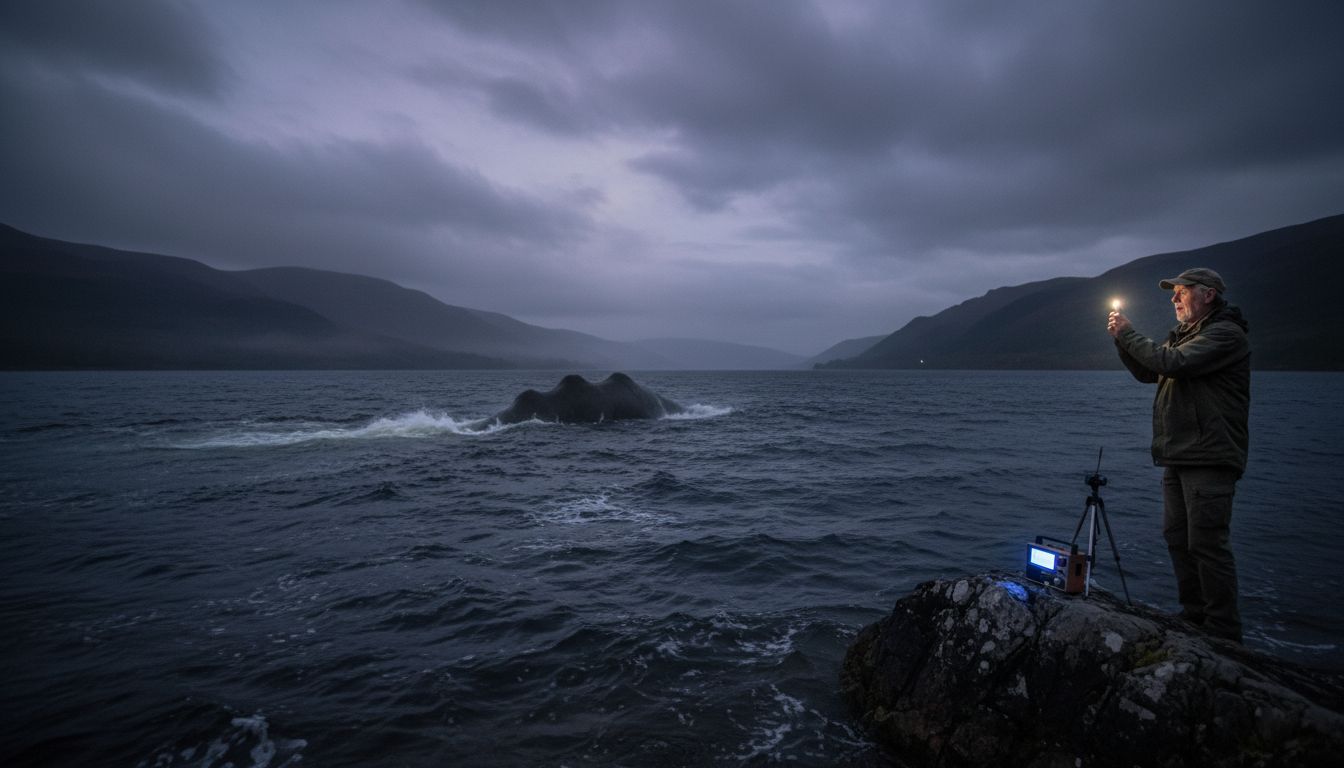
A man who was kayaking on Loch Ness late last week sent a blurry photograph to Coast to Coast AM that the station’s editorial team has logged as the fourth “official” Nessie sighting of 2025. The image, taken from a handheld smartphone, shows a dark, elongated shape skimming the surface of the water before disappearing into a ripple of mist. The witness, who asked to remain anonymous, said the creature moved “far faster than any known animal in the loch” and that he “couldn’t get a clear view because the light was low and the water was choppy.” The photo, while low‑resolution, has been forwarded to the Loch Ness Monster Investigation Bureau (LNMIB), the private group that maintains a public register of reported encounters.
The LNMIB confirmed the submission on Tuesday, noting that the sighting meets its criteria for an “official” entry: a credible eyewitness, a timestamped location, and a visual record, however imperfect. “We receive dozens of reports each year, but only a fraction meet the evidentiary threshold we set,” said Dr. Fiona MacLeod, a marine biologist who volunteers with the bureau. “This particular case is notable because the motion captured appears inconsistent with known loch fauna, such as seals or large fish, and the speed reported is unusually high.” MacLeod cautioned that without additional corroboration—such as multiple angles, sonar data, or a higher‑quality image—the sighting remains an anecdotal piece in a long‑standing puzzle.
The report arrives amid a modest uptick in Nessie claims this year. Earlier in 2025, three other sightings were logged: a nighttime drone video from a local tourism operator, a set of footprints on a muddy shoreline examined by independent investigators, and a sonar echo recorded during a hydrographic survey. While none have produced definitive proof, each has reignited public interest and prompted renewed calls for systematic scientific study of the loch’s depths. The Scottish Environment Protection Agency, which monitors the loch’s ecosystem, has declined to comment on the latest claim, stating that its mandate does not extend to cryptozoological investigations.
In a related segment, Coast to Coast AM host Roland Watson turned his attention to a historic hoax that still haunts Nessie lore. On the show’s “Mystery Files” hour, Watson revisited the 1933 Marmaduke Wetherell incident, when the famed explorer produced a series of large footprints that were later exposed as fabricated. Watson examined newly released archival material from the National Archives of Scotland, which includes the original plaster casts of the tracks and a correspondence chain suggesting the hoax was orchestrated by a rival tourist promoter. “The Wetherell tracks were a clever piece of theatre, but they set a precedent for how easily a story can be amplified,” Watson said on air.
Watson also addressed the whereabouts of the iconic 1934 “Surgeon’s Photograph,” long considered the most persuasive visual evidence of Nessie before being debunked in the 1990s. According to a recent interview with the family of the photograph’s original photographer, the original negative resides in the archives of the National Library of Scotland, catalogued under the reference “NLS‑PH‑1934‑08.” While the image’s authenticity remains discredited, Watson noted that its cultural impact “still shapes public perception of the monster more than any modern sighting.” The host concluded that, whether through genuine anomaly or elaborate hoax, the Loch Ness narrative continues to capture imaginations worldwide, urging both skeptics and believers to keep a watchful eye on the deep, dark waters.


