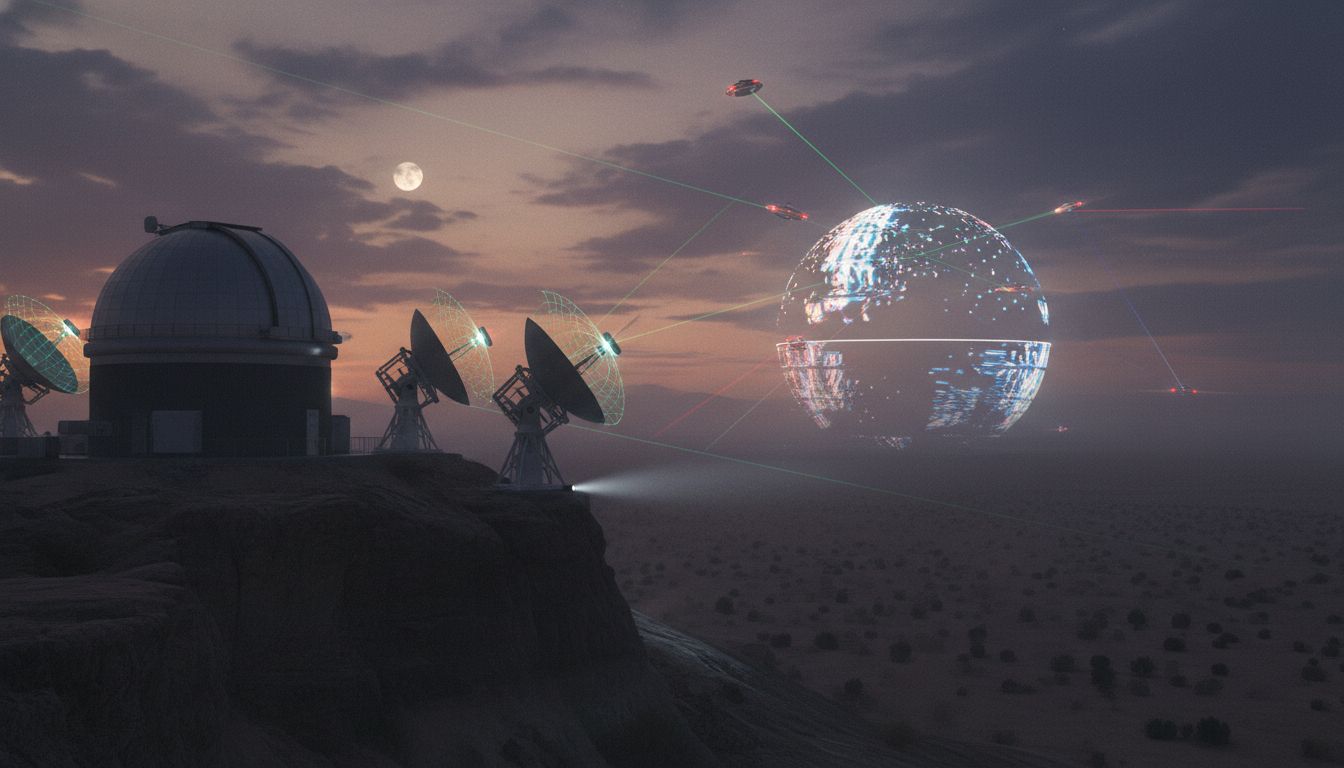
The Galileo Observatory, a new research installation perched atop the iconic Las Vegas Sphere, began operations this week with the explicit aim of gathering scientifically rigorous data on unidentified aerial phenomena (UAP). The facility, conceived by Harvard astrophysicist Avi Loeb and approved by the Sphere’s management in September 2024, combines ultra‑high‑resolution optical and infrared cameras with machine‑learning algorithms to detect, track and classify objects that appear in the night sky above the entertainment complex. By feeding raw sensor data into artificial‑intelligence pipelines, the observatory seeks to eliminate human bias and accelerate the identification of genuine anomalies among the millions of routine aircraft, drones and atmospheric events that cross the region each year.
A key feature of the project is its triangulation network. In addition to the primary sensor suite on the Sphere, two discreet monitoring stations situated roughly ten kilometres to the north and east of the venue relay synchronized observations to a central processing hub. This geometry allows researchers to calculate an object’s altitude, velocity and acceleration with a precision previously unavailable to civilian UAP studies. “When you can measure a sighting from three independent points, you move from anecdote to quantifiable physics,” Loeb said in a briefing on October 27. “Our goal is to build a dataset that can be examined by anyone, from peer‑reviewed journals to independent analysts, without the cloud of speculation that has long shrouded this field.”
The initiative arrives at a moment of heightened public and governmental interest in UAPs. In 2022, the U.S. Office of the Director of National Intelligence released a report acknowledging that many sightings remain unexplained, prompting congressional hearings and increased funding for scientific inquiry. While the Galileo Observatory is privately funded, it aligns with broader calls for transparent, data‑driven research. The project’s scope is ambitious: Loeb’s team expects to catalog “millions of aerial objects annually,” using automated classification to flag those that deviate from known flight patterns or exhibit non‑conventional motion. Those flagged events will undergo manual review by a multidisciplinary panel that includes astronomers, aerospace engineers and atmospheric scientists.
Critics have long warned against conflating the search for extraterrestrial intelligence with the study of atmospheric or technological anomalies. Dr. Margaret Kelley, a senior researcher at the American Institute of Aeronautics, cautioned, “Advanced sensors will undoubtedly capture a lot of noise—weather balloons, experimental drones, even reflections from the Sphere’s own lighting. The challenge is to separate genuine unknowns from the mundane.” Loeb acknowledges the skepticism, noting that his earlier “Galileo Project” proposals have been met with both intrigue and doubt within the scientific community. Nonetheless, he emphasizes that the observatory’s mandate is not to prove alien visitation but to produce “high‑quality, reproducible measurements” that can either confirm or refute extraordinary claims.
Visitors to the Sphere will likely remain unaware of the scientific work unfolding above them, as the observatory operates continuously and its equipment is integrated into the venue’s architecture. Yet the juxtaposition of an immersive “Wizard of Oz” show with a cutting‑edge research platform underscores a broader cultural moment: the blending of entertainment, technology and curiosity about the unknown. As the first weeks of data collection progress, the Galileo team plans to release a preliminary report to the public, detailing detection rates, classification accuracy and any notable incidents. Whether the observatory will capture phenomena that challenge current physics remains to be seen, but its commitment to open, methodical investigation marks a notable step toward bringing the study of UAPs into the mainstream of empirical science.


