Overview
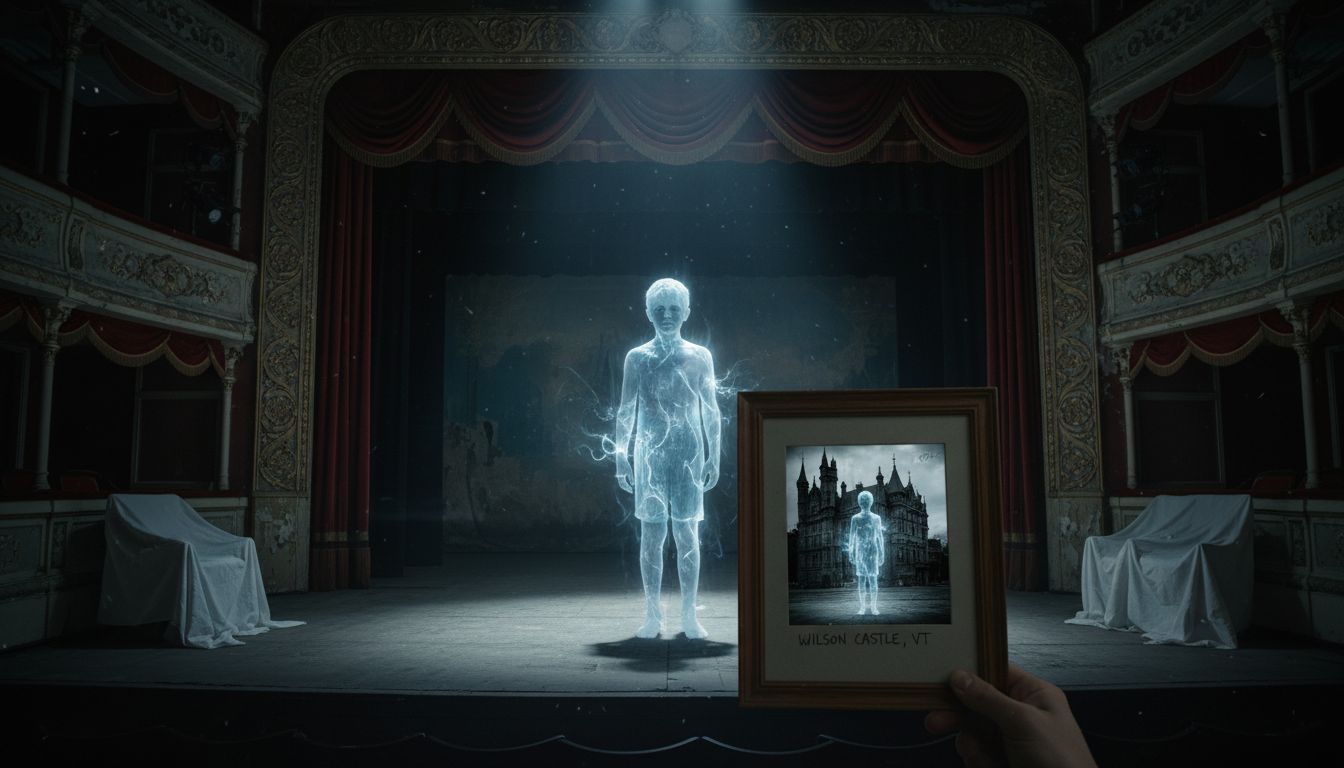
A photograph circulating on social media this week claims to show a semi‑transparent boy standing onstage at the Oldham Coliseum Theatre. The image, posted by a local theatre enthusiast, has been linked to a 2004 television documentary that featured alleged hauntings at the venue. A similar claim has emerged from Vermont, where a visitor to the historic Wilson Castle reported a mirror reflection of a woman in a 19th‑century dress. Both incidents have sparked debate among paranormal investigators, historians, and skeptics about the authenticity of the visual evidence.
The Oldham Coliseum Photo
The image was first shared on a community Facebook page dedicated to Oldham’s cultural landmarks. It depicts a faint, boy‑shaped silhouette near the centre of the stage, appearing to hover above the footlights. The post’s author wrote, “I think we finally have proof that the ‘Little Boy’ story from the 2004 TV show Haunted Britain isn’t just folklore.” The original documentary, aired on a regional channel in 2004, recounted a series of unexplained noises and fleeting sightings reported by staff, but it never produced visual proof.
The Oldham Coliseum, a Grade II listed building that opened in 1885, has a long history of reported paranormal activity, ranging from cold spots in the auditorium to unexplained footsteps in the backstage corridors. Theatre manager Laura Hughes confirmed that the photograph was taken during a routine rehearsal on Thursday night, but she declined to comment on the alleged apparition, stating, “Our priority is the safety and comfort of our performers and audience.”
Historical Parallel: Wilson Castle
The Vermont claim surfaced in a recent article from the Vermont Gazette, describing a visitor’s experience at Wilson Castle, a 19th‑century estate turned museum. The visitor, identified only as “M.J.,” said they saw a woman in a period dress reflected in a hallway mirror, even though the mirror’s surface was clear of any physical presence. The museum’s curatorial staff noted that the house is reputed for “residual hauntings” linked to its original occupants, but they also emphasized that the site is equipped with modern security cameras that have not captured any such anomalies.
Both cases share common elements: a faint, human‑like figure captured in a single frame, and a historical setting with a pre‑existing narrative of hauntings. Critics point out that low‑light photography, digital noise, and post‑processing can easily produce “ghost‑like” artifacts.
Expert Opinions
Paranormal researcher Dr. Evelyn Carter, who runs the UK‑based Society for Anomalous Phenomena, cautioned against drawing conclusions from a solitary image. “While the visual is intriguing, extraordinary claims require extraordinary evidence,” she said. “We would need corroborating data—multiple recordings, independent verification, and controlled environmental measurements—to move beyond speculation.”
Conversely, digital imaging specialist Mark Patel from the University of Manchester’s Department of Visual Sciences offered a technical perspective. “The semi‑transparent effect could be the result of sensor noise amplified by high ISO settings in a dimly lit environment,” Patel explained. “Without the original RAW file and metadata, it’s impossible to assess whether the figure is an artifact of the camera sensor or post‑processing.”
Local historian Peter Whitfield highlighted the cultural context: “Oldham’s theatre has been a focal point for community stories for over a century. Folklore often fills the gaps left by undocumented history, and modern media can amplify these narratives.”
Next Steps
The Oldham Coliseum has invited an independent investigation, offering access to the stage and backstage areas for a team of researchers from the University of Leeds’ Centre for Atmospheric Physics, which will monitor electromagnetic fields and temperature fluctuations over the next month. Meanwhile, the Wilson Castle museum announced plans to review its security footage from the past year to determine if any unexplained visual anomalies have been recorded.
As both sites await further scrutiny, the broader discussion underscores the need for rigorous, transparent methodology when evaluating alleged paranormal evidence. Whether the images represent genuine phenomena or the by‑products of modern photography, they continue to captivate the public imagination and remind us of the thin line between history, folklore, and scientific inquiry.


