Overview
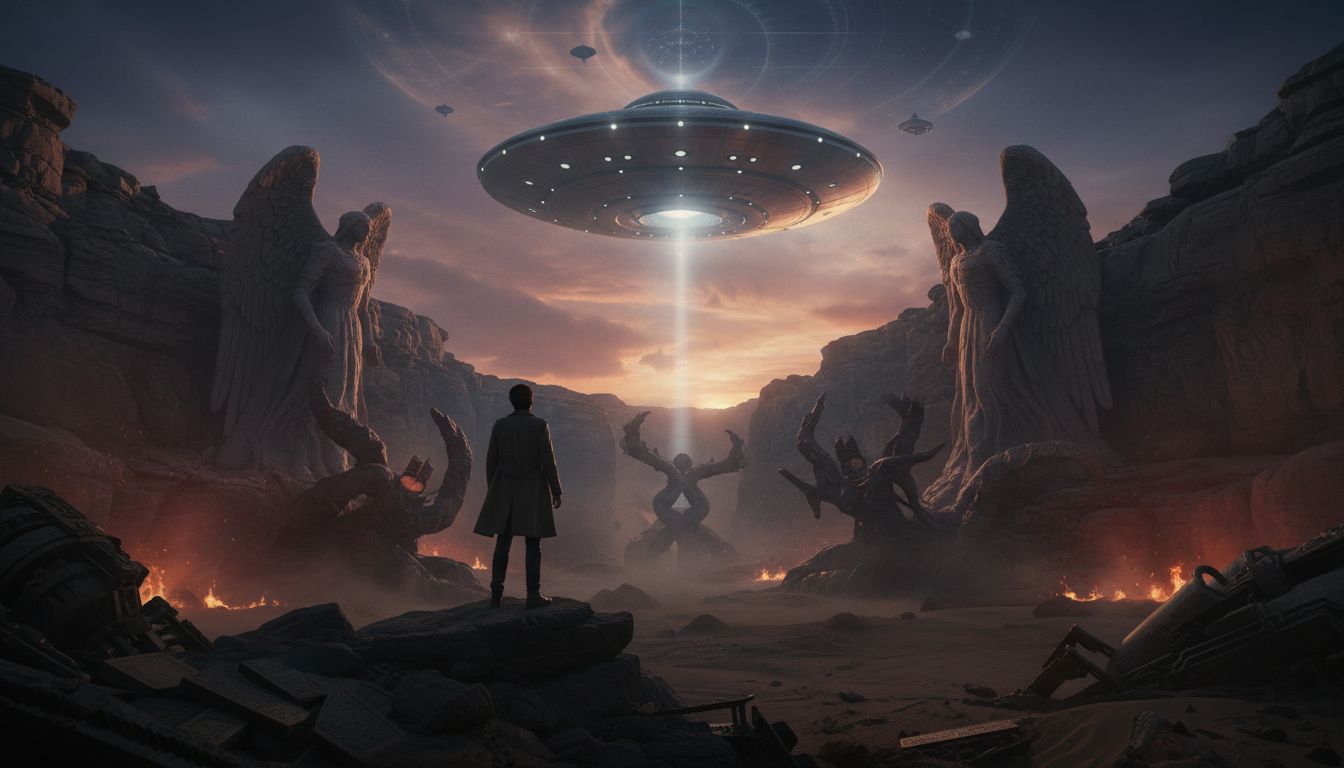
In a recent opinion column for the San Angelo Standard‑Times, columnist Terry Mattingly argues that humanity’s long‑standing fascination with the divine—angels, demons, and other celestial beings—may be a cultural reinterpretation of encounters that modern observers label “UFOs.” Published on May 30, 2026, the piece situates the debate within a broader historical framework, suggesting that the same mystery that inspired medieval mystics now fuels contemporary UFO research. Mattingly’s thesis is that the overlap between religious imagery and extraterrestrial speculation reflects a persistent human drive to make sense of the unknown.
Historical Context
From the biblical visions of Ezekiel’s “wheel within a wheel” to medieval chronicles of “fiery chariots” in the sky, accounts of luminous, unidentified phenomena appear across cultures and epochs. Scholars of religious studies have long noted that descriptions of angels and demons often contain motifs—bright light, hovering movement, incomprehensible language—that parallel modern UFO sightings. Mattingly points out that “for centuries, stargazers of many kinds have debated the meaning of unidentified objects in the heavens and encounters with mysterious beings on earth,” a sentiment echoed by historians who trace similar language in ancient Mesopotamian, Greek, and Chinese texts. The column highlights how the shift from a theologically framed worldview to a scientific one has not eliminated the intrigue; it has merely changed the vocabulary.
Modern Interpretations
The 20th‑century UFO boom, sparked by the 1947 Roswell incident and popularized by the “flying saucer” craze, introduced a secular lexicon for experiences that earlier generations might have described as angelic visitation or demonic attack. Mattingly cites contemporary reports of pilots witnessing “unidentified aerial phenomena” (UAP) that display flight characteristics defying known physics—a modern echo of medieval accounts of “celestial fire.” He argues that the persistence of such reports suggests a continuity of perception, where the same cognitive and cultural mechanisms that once produced visions of holy messengers now generate narratives of alien craft.
Scholarly Perspectives
Academic voices both support and challenge Mattingly’s synthesis. Astrophysicist J. J. Miller of the SETI Institute cautions that “correlating mythic symbolism with empirical UFO data risks conflating distinct epistemologies.” Conversely, cultural anthropologist Dr. Leila Hassan notes that “myth and modern myth—whether angelic or extraterrestrial—serve a similar function: they provide frameworks for confronting the incomprehensible.” The column references the work of UFO researchers such as Jacques Vallée, who have long argued that “the UFO phenomenon is as much a cultural and psychological event as it is a physical one.” By juxtaposing these viewpoints, Mattingly underscores the interdisciplinary nature of the debate.
Implications and Outlook
If, as Mattingly suggests, ancient divine beings and today’s alien narratives are different lenses on a common mystery, the implications extend beyond academia. Public policy on UAP disclosure, funding for aerospace research, and even interfaith dialogue could be reshaped by recognizing the shared human impulse to seek meaning beyond the observable world. Mattingly concludes that “the centuries‑long mystery surrounding the divine and the unknown reflects humanity’s enduring quest to understand the cosmos,” urging readers to approach both religious texts and UFO reports with a balanced mix of curiosity and critical analysis.
Conclusion
While the column remains an opinion piece, its blend of historical citation, contemporary observation, and scholarly input offers a compelling argument that the line between the sacred and the extraterrestrial is more porous than traditionally acknowledged. As governments worldwide declassify UAP files and theologians revisit ancient visions, the dialogue Mattingly initiates may prove pivotal in shaping how society interprets the skies—whether as a canvas for angels, demons, or visitors from distant worlds.


