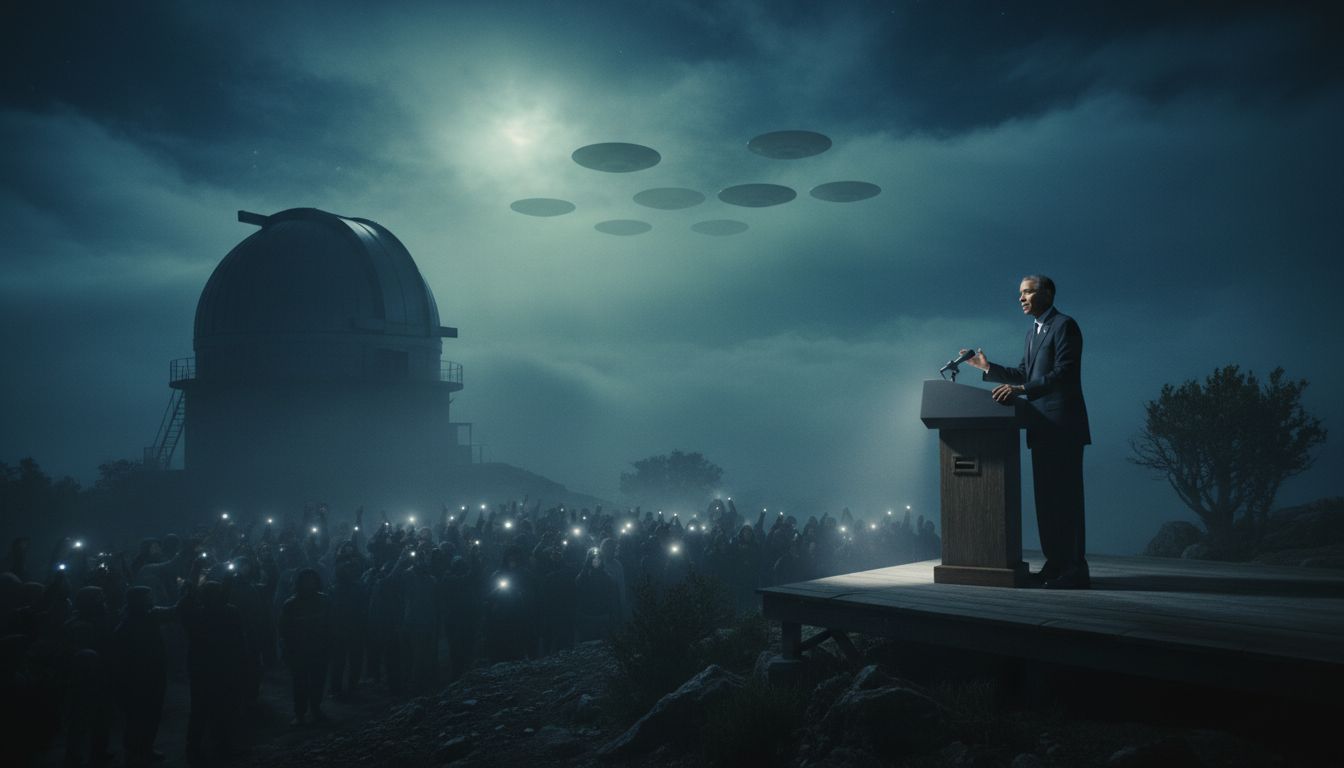
Overview
Former President Barack Obama reiterated on Thursday that the United States government does not possess a hidden cache of extraterrestrial evidence. Speaking at a televised interview with NewsNation, the former commander‑in‑chief emphasized the administration’s commitment to transparency and called for continued scientific scrutiny of unidentified aerial phenomena (UAP). His remarks arrive amid renewed congressional interest in the subject and the recent release of a classified Pentagon briefing that documented several unexplained sightings.
Historical Context
The question of whether the government is “sitting on alien evidence” has resurfaced repeatedly since the 2021 establishment of the All‑Domain Anomaly Resolution Office (AARO). In June 2023, the Office of the Director of National Intelligence published a 144‑page report acknowledging that most UAP incidents remain unexplained, but it stopped short of suggesting extraterrestrial origins. Obama, who previously addressed the topic in a 2021 interview with CBS News, has consistently argued that any credible data would eventually be disclosed through proper channels. His latest statement aligns with that stance, underscoring that “the public’s right to know is a cornerstone of a democratic society.”
Obama’s Statement
When asked whether classified files could contain proof of alien life, Obama responded:
“There is no secret trove of alien technology hidden away in a basement somewhere. If such evidence existed, it would be in the interest of national security and scientific progress to bring it to light. The best way forward is open, rigorous investigation, not speculation.”
He added that the administration’s role is to ensure that any legitimate findings are evaluated by qualified scientists rather than politicized. “We need credible, peer‑reviewed research,” he said, “and we must resist the temptation to fill gaps with sensationalism.”
Scientific Community Reaction
Astronomers and aerospace researchers welcomed the former president’s call for methodical study. Dr. Lisa Ramirez, a senior researcher at the SETI Institute, noted, “Obama’s emphasis on transparent, data‑driven inquiry mirrors the approach the scientific community has advocated for years. The recent AARO data releases provide a valuable starting point for independent analysis.”
Conversely, some skeptics warned that political statements, even well‑intentioned ones, can inadvertently lend undue credibility to unverified claims. “We must keep the focus on empirical evidence, not on the personalities delivering the message,” said Dr. Mark Hsu, a professor of aerospace engineering at MIT.
Policy Implications
Congressional leaders have cited Obama’s remarks in recent hearings on UAP oversight. Representative Jenna Collins (D‑CA) remarked, “The former president’s reaffirmation that there is no concealed alien archive reinforces the need for a robust, bipartisan framework that funds open research while safeguarding national security.”
The Department of Defense, meanwhile, announced plans to expand AARO’s data‑sharing protocols with civilian scientific bodies, a move that aligns with Obama’s appeal for collaborative investigation. Budget proposals for FY 2027 now include a modest increase for “UAP scientific analysis” under the Office of Naval Research.
Looking Ahead
While Obama’s comments do not introduce new evidence, they reinforce a narrative that the government’s stance is one of openness and accountability. As the AARO continues to collect and declassify sightings, the scientific community is poised to apply advanced sensor technology and machine‑learning techniques to discern patterns.
For the public, the message is clear: the search for answers about unidentified aerial phenomena will proceed through rigorous, transparent science, not through conjecture about hidden alien dossiers. The next months are likely to see further data releases, congressional hearings, and perhaps the first peer‑reviewed papers that could finally shed light on what has long hovered at the edge of both national security and popular imagination.


