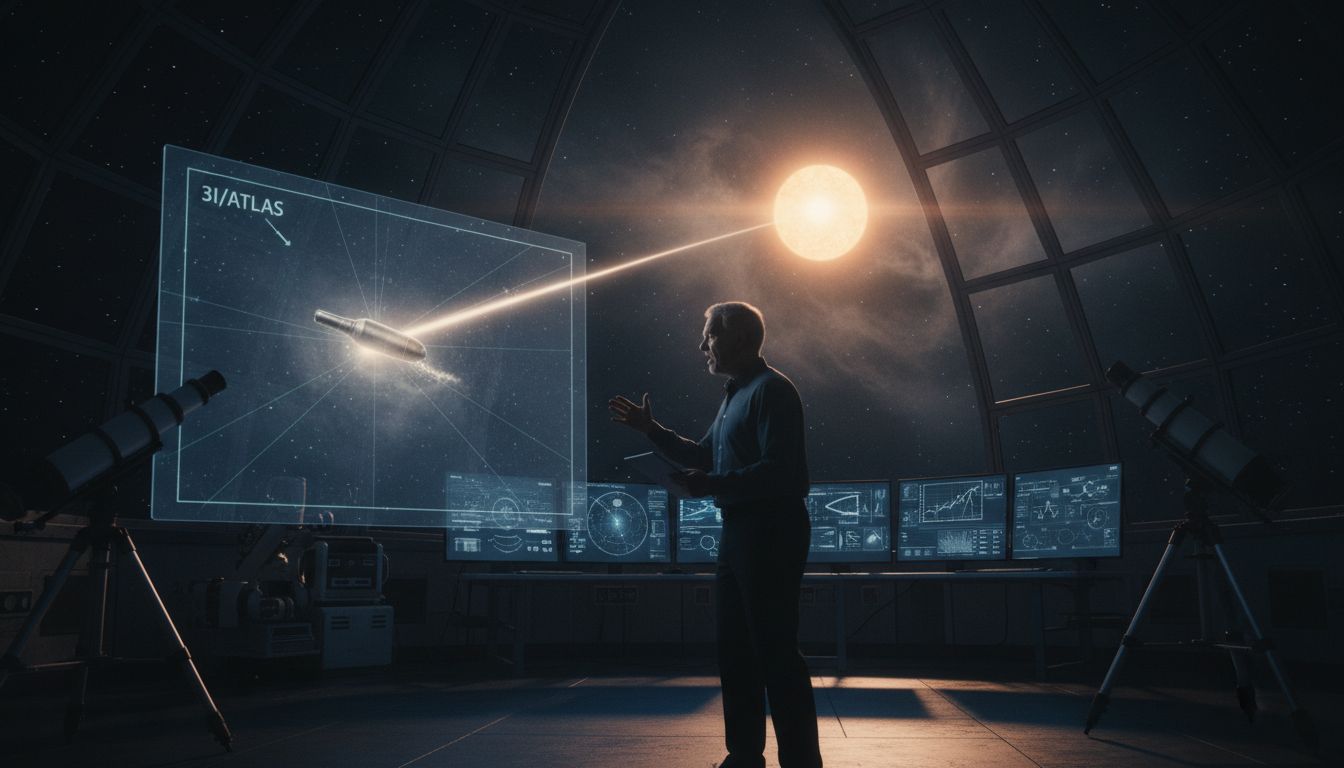
The interstellar object designated 3I/ATLAS swept through the inner Solar System in late October 2025, drawing attention not only for its speed and trajectory but also for a curious feature captured by the Hubble Space Telescope. In a Medium post dated 2 November, Harvard astrophysicist Avi Loeb argues that the Sun’s gravitational lensing of the object produced a narrow, Sun‑ward jet visible in the post‑perihelion images, and he interprets the jet as a potential sign of artificial propulsion. Loeb also points to a newly released “stripe” image from NASA’s Perseverance rover on Mars, suggesting that the two observations may be linked to his broader hypothesis that extraterrestrial technology is present in the Solar System.
Loeb’s analysis rests on three orbital coincidences. 3I/ATLAS passed within 0.08 AU of the Sun on 29 October, just eight days after a solar conjunction that rendered the object invisible from Earth, and it crossed the ecliptic plane on 3 October, when it was nearest to Mars. He writes that this timing “offers a remarkable opportunity to observe the effect of gravitational lensing of 3I/ATLAS by the Sun.” In the Hubble image taken on 31 October with the Lowell Discovery Telescope, a faint, collimated brightening points toward the Sun. Loeb describes the feature as a “Sun‑ward jet” and suggests that the Sun’s gravity could have acted as a massive lens, focusing energy onto a propulsion system embedded in the object, thereby producing the observed emission.
The claim that a natural object could generate a directed jet under solar lensing is extraordinary and has prompted immediate scrutiny from the planetary‑science community. Gravitational lensing is a well‑established relativistic effect, but its influence on a kilometer‑scale body is expected to be negligible; the Sun’s focal length for electromagnetic radiation lies at roughly 550 AU, far beyond the region where 3I/ATLAS was observed. Dr. Sara Seager, a professor of planetary science at MIT, notes, “While the Sun does bend light, the magnitude of that bending for a solid object moving at tens of kilometres per second is far too small to produce a focused beam of energy.” Similarly, Dr. Michael Michaud of the Jet Propulsion Laboratory emphasizes that “the observed brightening could be explained by outgassing or dust scattering, phenomena we routinely see in comets and interstellar visitors.”
Loeb’s reference to the Perseverance rover’s stripe image adds another layer to his argument. The rover captured a high‑resolution photograph of a linear, high‑contrast feature on the Martian surface, which Loeb describes as a “stripe” that may be consistent with a directed energy beam. He writes that the stripe, released by NASA in early November, “could be the surface imprint of the same Sun‑ward jet that illuminated 3I/ATLAS.” NASA’s planetary scientists, however, have offered a more conventional explanation. A statement from the Mars Exploration Program identified the stripe as a “dust devil track” – a common, wind‑driven phenomenon that leaves narrow, darkened paths on the regolith.
The debate highlights a broader tension in the field between open speculation and rigorous evidence. Loeb, who has previously advocated for the possibility that the interstellar object ‘Oumuamua was of artificial origin, continues to push the boundaries of conventional interpretation. Critics argue that his hypotheses, while intriguing, risk conflating rare observational artifacts with definitive proof of technology. “Extraordinary claims require extraordinary evidence,” says Dr. David Spergel, a cosmologist at the Institute for Advanced Study. “A single brightening in an image, without corroborating spectroscopy or dynamical modeling, does not meet that bar.”
As the scientific community digests the data, further observations may help settle the question. The European Southern Observatory plans to re‑examine archival spectra of 3I/ATLAS for signatures of non‑natural emission lines, while the Mars Science Laboratory team will monitor the stripe region for any changes that could indicate an artificial source. Until such evidence emerges, the Sun‑ward jet and the Martian stripe remain subjects of lively discussion, illustrating both the excitement and the caution that accompany the search for possible extraterrestrial technology within our own cosmic backyard.


