Overview
Recent laboratory work is reviving a debate that has lingered on the fringes of neuroscience for decades: can the human brain anticipate events before they occur? A series of replication studies, originally inspired by parapsychologist Dean Radin’s experiments in the mid‑1990s, report statistically significant pre‑stimulus brain activity when participants are later shown emotionally negative images. The effect, observed in electroencephalographic (EEG) recordings as a “pre‑stimulus spike,” has now been reproduced in nearly three dozen independent labs, prompting researchers to explore mechanisms that go beyond conventional sensory processing.
Pre‑Stimulus Brain Responses
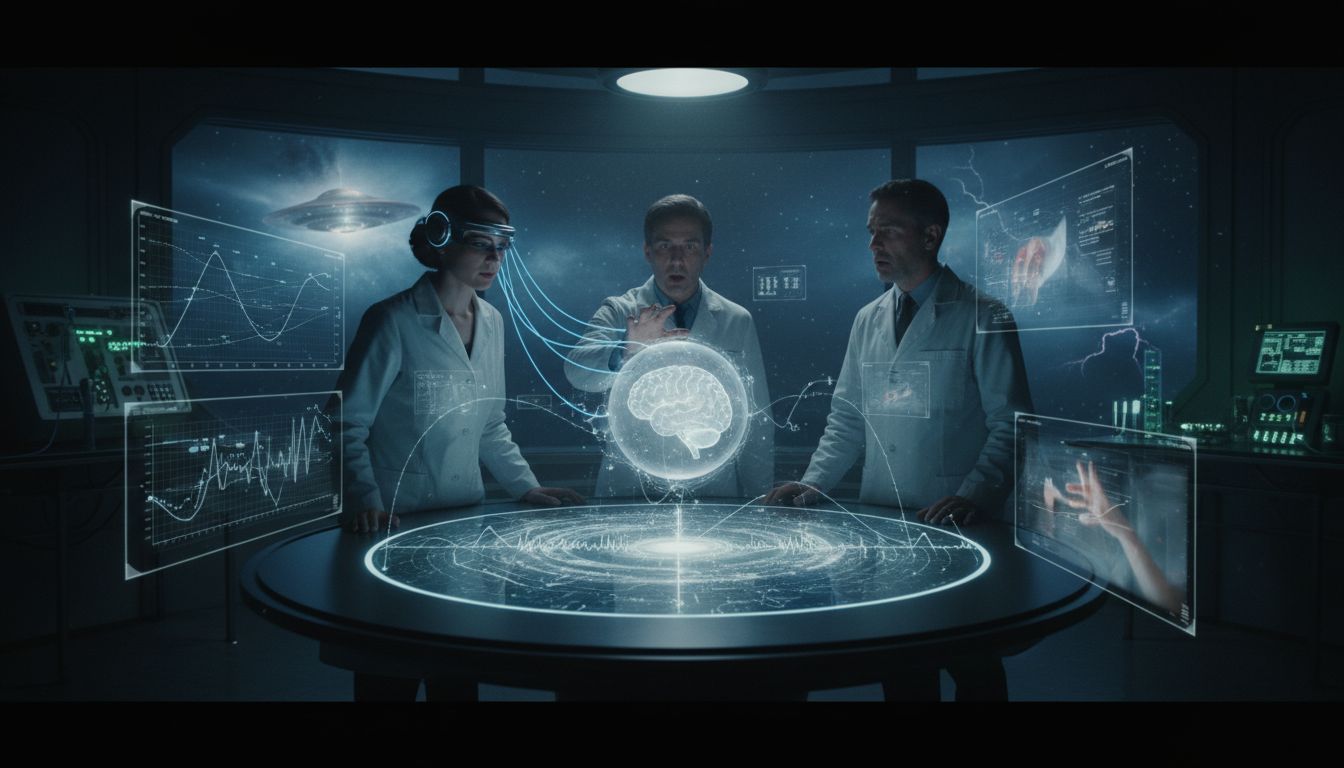
In Radin’s paradigm, participants view a rapid sequence of pictures that are either pleasant or unpleasant. While the subjects have no prior knowledge of the upcoming image, EEG data show a measurable increase in neural firing seconds before a negative picture appears, compared with the relatively flat response preceding pleasant images. Subsequent replication efforts—conducted at universities in the United States, Europe, and Asia—have employed larger sample sizes and blind‑analysis protocols to guard against bias. Dr. Michele Klein, a cognitive neuroscientist at the University of Zurich, summarized the findings: “Across multiple sites, we see a consistent pre‑event neural signature that correlates with the emotional valence of the stimulus that follows. It challenges the assumption that perception is strictly a forward‑only process.”
Quantum Entanglement Hypothesis
To explain the timing anomaly, some theorists are turning to quantum physics. The notion, popularized by Radin and expanded by Dr. Dean Mossbridge of the Institute of Noetic Sciences, posits that neuronal assemblies could become entangled with future versions of themselves, allowing information to flow backward in time. In this view, what we label “gut feelings” are not merely subconscious pattern recognitions but memories of events that have not yet unfolded, transmitted via a non‑local quantum channel. While the hypothesis is speculative, it draws on well‑established phenomena such as “spooky action at a distance,” first described by Einstein. Proponents argue that if brain microtubules or other subcellular structures can maintain coherence long enough, they might serve as conduits for retrocausal signaling.
Competing Explanations: The Adaptive Unconscious
Skeptics caution that quantum explanations are unnecessary. Evolutionary psychologists point to the adaptive unconscious, a fast, automatic processing system that continuously scans the environment for subtle cues. Dr. Laura Peterson, a behavioral scientist at Stanford University, notes, “Our brains are constantly generating predictions based on prior experience, statistical regularities, and peripheral sensory data that we are not consciously aware of. The pre‑stimulus EEG spikes could reflect these predictive models rather than genuine retrocausality.” Computational models of Bayesian inference have demonstrated that anticipatory neural activity can emerge from hierarchical predictive coding, a framework that does not require any violation of temporal order.
Remote Touch and Emerging Applications
Alongside the precognition studies, a separate line of inquiry has documented a “remote touch” phenomenon in which participants report sensing the presence of concealed objects without direct contact. In controlled experiments, subjects placed their hands above a table containing hidden metal or plastic items and, after brief exposure, were able to indicate the object’s location at rates above chance. Researchers hypothesize that subtle electromagnetic fields or vibrotactile cues, amplified by heightened attentional states, might underlie the effect. If validated, such findings could inform the development of non‑contact tactile interfaces, potentially useful in medical imaging, security screening, or assistive technologies for the visually impaired.
While the evidence for pre‑event brain activity is mounting, the scientific community remains divided over its interpretation. Ongoing studies aim to isolate the neural signatures, test alternative predictive‑coding models, and explore whether quantum coherence can plausibly exist in warm, noisy brain tissue. As Dr. Klein emphasizes, “Extraordinary claims demand extraordinary evidence. The next wave of experiments will need to rule out all conventional explanations before we entertain the possibility that our gut feelings are, in fact, glimpses of a non‑linear future.”