Overview
A cache of unpublished notes left by British journalist Harold T. Wilkins has resurfaced, offering a rare glimpse into mid‑20th‑century UFO activity across Latin America and the Iberian Peninsula. The documents, acquired by the UK‑based organization Contact UK and reproduced in its newsletter The UFO Register, span reports from Costa Rica in 1954‑55, alleged “Martian arrivals” in South America, a 1973 chase of a Chevrolet Impala in Mexico, and a series of abduction‑teleportation claims near Seville, Spain. While the material is rich in eyewitness testimony, it also illustrates the challenges of separating genuine anomalies from folklore, media hype, and limited investigative follow‑up.
Costa Rica Incendiary UFO Reports
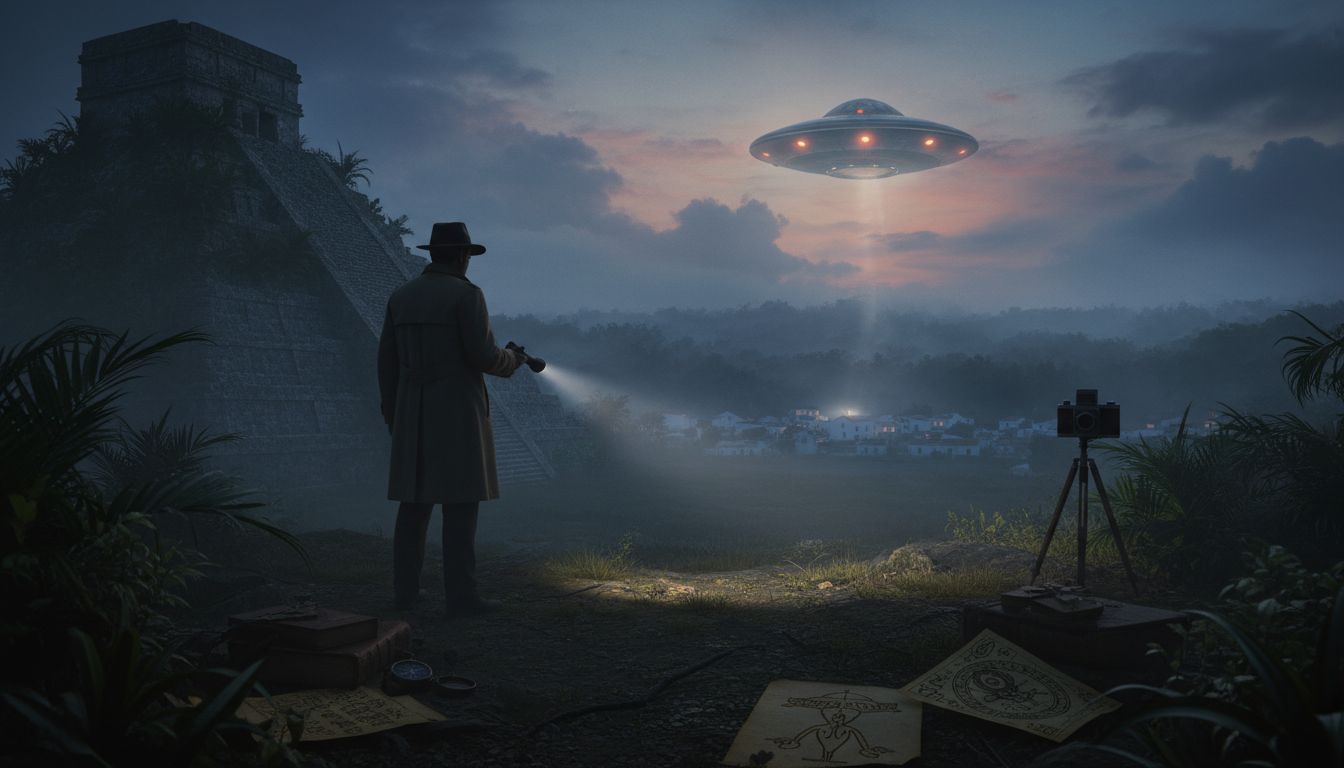
The most detailed portion of Wilkins’s archive concerns two “incendiary UFO” incidents reported by a San José‑based Anglo‑American photojournalist who was then documenting piracy on Cocos Island. In December 1954, charcoal burners in the Candelaria highlands described a “sphere of fire” that landed in a remote clearing, igniting the vegetation and melting stones. When the workers returned days later, the area was completely charred, and local lore quickly linked the event to demonic activity. A second, similar blaze was reported forty miles south, where investigators later found animal remains fused to the soil and rocks that appeared to have softened under extreme heat.
In the spring of 1955, a team from the Católico Costarricense newspaper revisited the sites. Their field notes, reproduced in The UFO Register, state that the vegetation was “completely evaporated” and that no natural fire, drought, or meteorological phenomenon could account for the damage. “The level of thermal alteration we observed was unlike anything seen in typical forest fires,” wrote the expedition’s lead, Carlos Mendoza, a former firefighter turned journalist. The reports were never subjected to a formal scientific survey, and the Costa Rican authorities closed the case as “unexplained forest damage.”
Broader Latin American & Iberian Cases
Wilkins’s files also compile earlier and later sightings that have shaped UFO folklore in the region. In the late 1950s, newspapers in Brazil and Argentina ran sensational headlines about “Martian arrivals” following a series of bright fireball sightings, a narrative that historians now attribute to Cold‑War era anxieties and a lack of astronomical literacy.
A more concrete episode emerged in 1973 when a Mexican farmer reported a high‑speed chase between a Chevrolet Impala and a luminous disc near the town of Puebla. The driver, José Alvarez, recounted that the vehicle’s headlights were “overwhelmed by a blue‑white glare that seemed to follow us for several kilometers.” Police records show the incident was logged, but no physical evidence was recovered.
In Spain, the early 1980s saw a cluster of reports near Seville involving alleged abduction and teleportation. Witnesses described a bright, pulsating object that hovered over a rural farm, after which a farmer claimed to have been “instantly moved” from his field to a nearby road, with no memory of the intervening minutes. Dr. Elena Ruiz, a ufology researcher at the University of Granada, notes that “the Seville cases share common motifs with classic abduction narratives—loss of time, missing hours, and a sense of being observed—but lack corroborating data such as radar tracks or physical traces.”
Investigation and Media Response
The resurgence of Wilkins’s papers has prompted renewed interest among both amateur investigators and academic scholars. Contact UK has organized a symposium in London to evaluate the archival material, inviting experts in atmospheric physics, anthropology, and forensic archaeology. However, the absence of contemporaneous scientific measurements—such as temperature readings, spectroscopic data, or satellite imagery—limits the ability to test the claims rigorously.
Media coverage at the time was mixed. While local Costa Rican outlets reported the forest fires with a tone of caution, international newspapers often sensationalized the stories, echoing the “Martian” and “alien” language that characterized the 1950s UFO craze. Contemporary journalists, including The UFO Register’s editor Megan Clarke, stress the need for “balanced reporting that acknowledges eyewitness credibility without inflating speculation.”
Assessment and Ongoing Questions
The Wilkins archive underscores a recurring pattern: eyewitness accounts of extraordinary aerial phenomena are frequently accompanied by dramatic environmental effects, yet they seldom survive systematic scrutiny. The Costa Rican fire incidents remain intriguing, especially given the reported melting of stone—a detail that would merit geochemical analysis if a site could be revisited.
Meanwhile, the later Latin American and Spanish cases illustrate how UFO narratives evolve, integrating local cultural motifs and contemporary technology. As Dr. Ruiz cautions, “Without verifiable physical evidence, these reports occupy a gray zone between folklore and potential undiscovered natural phenomena.”
The renewed attention to Wilkins’s notes may inspire targeted fieldwork, archival deep‑dives, and interdisciplinary collaboration, but for now the “night of terror” in Costa Rica remains an enigmatic chapter in UFO history—one that highlights both the allure and the methodological hurdles of investigating the unknown.