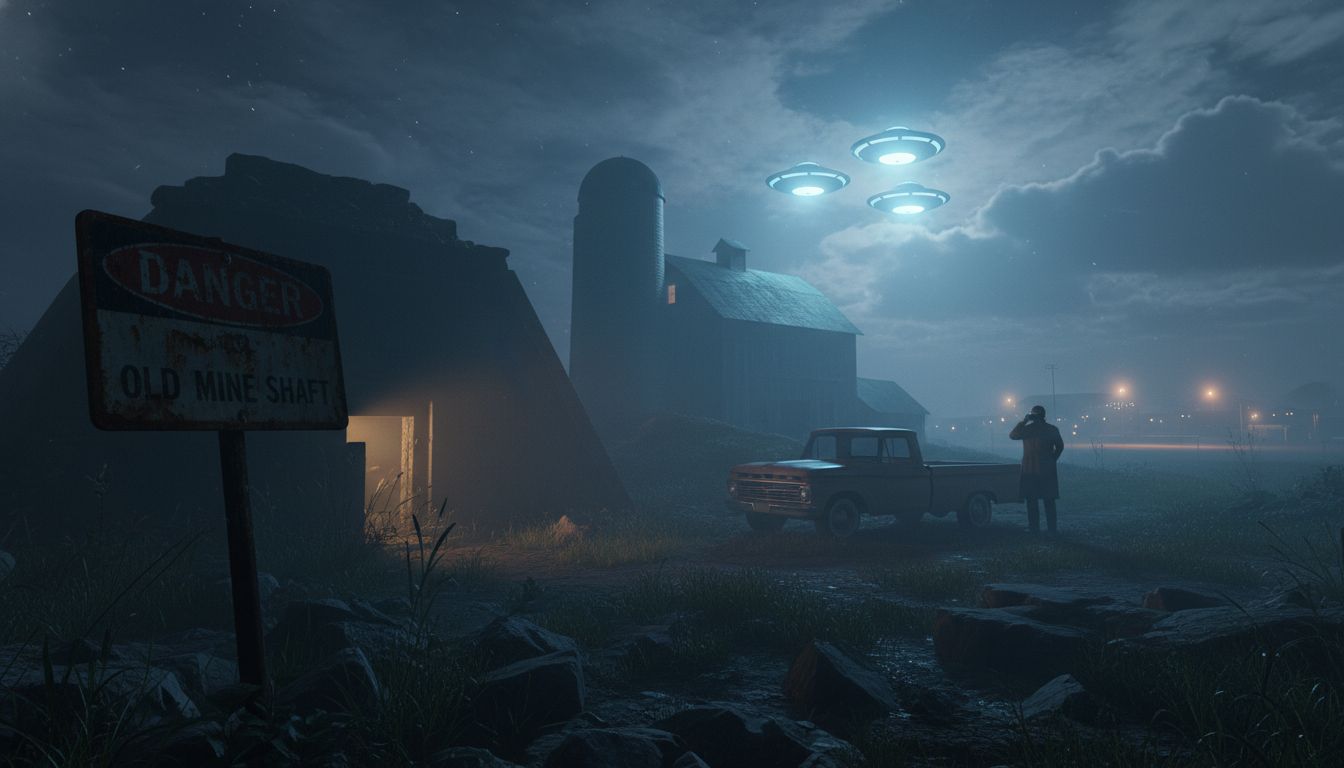
The small town of Hartshorne, Oklahoma, resurfaced this week as a focal point for scholars tracing the early career of John Keel, the journalist whose 1970s books helped shape modern UFO and paranormal discourse. Keel’s investigation of a 1965 sighting—documented in two letters cited by former NICAP (National Investigations Committee on Aerial Phenomena) researcher Gordon Lore and a contemporaneous clipping from the Oklahoma Journal—illustrates the methodological blend of field interviews, newspaper archives and local knowledge that defined his work. The documents, now posted on Keel’s own website, show the investigator warning residents about the lingering danger of abandoned coal mines while simultaneously cataloguing reports of luminous objects hovering near the town’s main street. “The mines are a real hazard,” the field notes read, “but the lights are what keep the townsfolk up at night,” a line that has been quoted by UFO historians as emblematic of Keel’s balanced, if sometimes speculative, reporting style.
Hartshorne’s claim to fame extends beyond the sky. The town is the birthplace of Hall of Fame pitcher Warren Spahn, whose 1957 World Series triumph with the Milwaukee Braves cemented his legacy in baseball lore. Local historians note that the same newspaper that carried Spahn’s game recaps also printed the 1965 UFO reports, underscoring how ordinary community narratives can intersect with extraordinary claims. “It’s a reminder that these sightings happen in the same places where everyday life unfolds,” said Dr. Linda Martinez, a cultural anthropologist at the University of Oklahoma, who has been cataloguing mid‑century UFO reports across the Midwest.
The Hartshorne episode is part of a broader pattern of 1970s sightings that continue to inform contemporary UAP (Unidentified Aerial Phenomena) research. In 1973, a series of “Slo‑Mo Silver Saucerian” encounters were reported across Indiana, described by witnesses as slow‑moving, silver‑hued discs that left a faint, shimmering trail. Although the sightings never garnered a formal government investigation, they were later referenced in a 2022 briefing to the U.S. Senate Intelligence Committee as illustrative of the “Silver Saucer” motif that recurs in civilian reports. Similarly, a 1973 case from northern Mexico involving alleged Men‑in‑Black—uniformed figures who reportedly approached a group of ranchers after a nocturnal light event—has been revisited by independent researcher Charles Lear. Lear’s recent paper, published in Journal of Parapsychology and Anomalous Phenomena, argues that the Mexican incident shares key behavioral traits with U.S. Men‑in‑Black accounts, suggesting a cross‑border cultural diffusion of the archetype rather than a single, isolated phenomenon.
To assess how these historic accounts shape today’s UAP conversation, the article includes an interview with Martin Willis, director of the Center for Aerial Anomaly Studies (CAAS). Willis, who has overseen the digitisation of NICAP archives, said, “When we look at Hartshorne, Indiana’s saucers, or the Mexican Men‑in‑Black, we’re not just cataloguing oddities; we’re tracing a lineage of public perception that informs how the Pentagon’s recent UAP task force frames its own investigations.” He added that the “coal‑mine warning” in Keel’s notes is a reminder that environmental and safety concerns often co‑occur with aerial reports, a factor that modern analysts must account for when evaluating witness credibility.
While the historical material offers rich context, experts caution against drawing definitive conclusions from anecdotal evidence alone. Dr. Raymond Patel, a senior scientist at the National Center for Atmospheric Research, noted that “many of the 1960s and 1970s sightings can be explained by atmospheric optics, aircraft testing, or even local folklore.” Nevertheless, the renewed scholarly attention to Hartshorne and its contemporaries underscores a growing consensus that past investigations, even those conducted by “non‑authoritative” figures like Keel, remain valuable data points in the evolving field of UAP research. As the CAAS prepares to release a comprehensive database of mid‑century sightings later this year, the interplay between historic narratives and modern scientific scrutiny promises to keep small towns like Hartshorne at the forefront of an ongoing, interdisciplinary dialogue.


