Overview
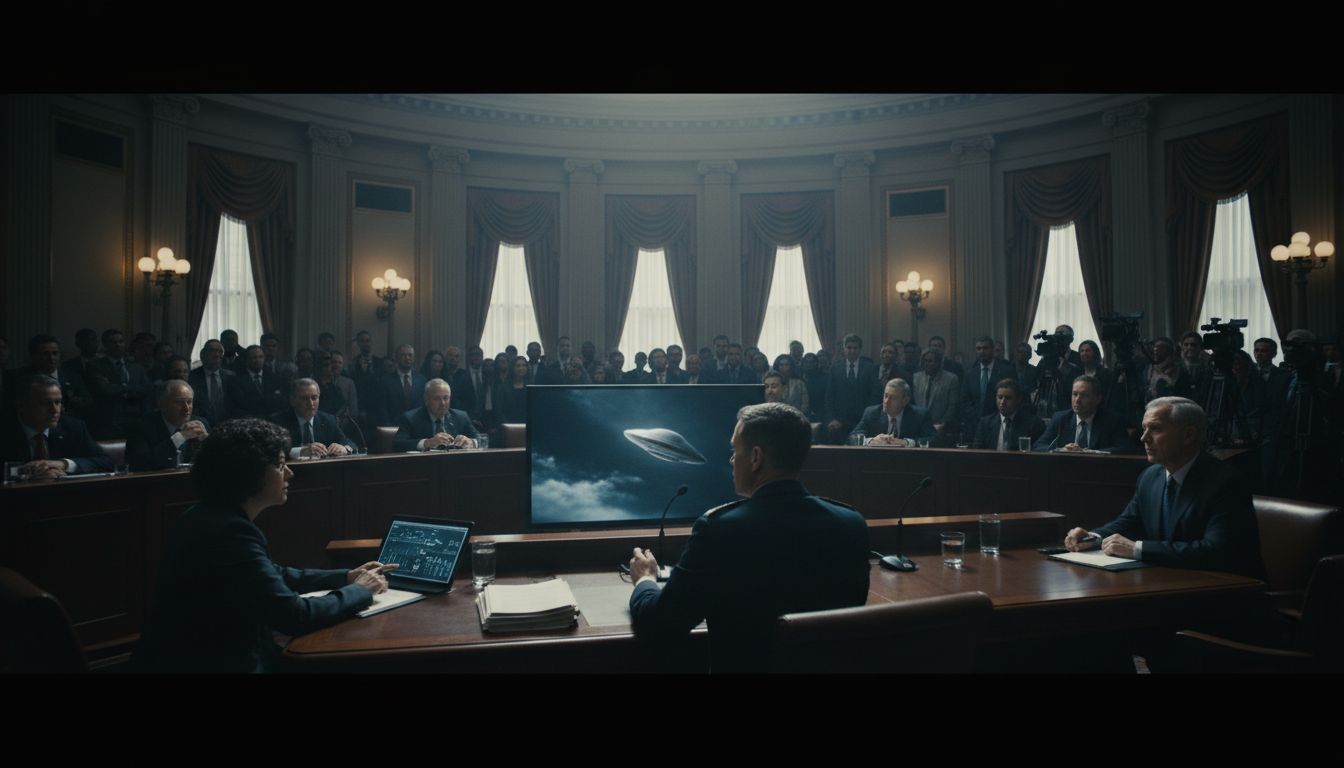
On Tuesday, a bipartisan congressional hearing convened to examine the growing body of reports on unidentified anomalous phenomena (UAP)—the term now preferred by the U.S. government for what were once popularly called UFOs. The session, broadcast live on C‑SPAN, featured testimony from senior defense officials, intelligence analysts, and civilian experts who presented recent sighting data, intelligence assessments, and recommendations for a more systematic investigative framework. Lawmakers framed the discussion as a matter of national security and scientific curiosity, emphasizing the need for transparent, coordinated oversight.
Testimony Highlights
The hearing opened with remarks from Deputy Director of the Office of the Director of National Intelligence (ODNI) for UAP matters, Dr. Lisa M. Harrell, who outlined the agency’s latest assessment. “Our analysis of over 400 credible reports collected since 2020 indicates a non‑trivial risk to flight safety and, potentially, to air‑space integrity,” Harrell told the committee. She cited de‑classified footage from Navy pilots that captured fast‑moving objects exhibiting acceleration profiles beyond known technology, and noted that 95 % of the incidents remain unexplained after initial review.
Representing the Department of Defense, Rear Admiral Thomas J. “Tom” McAllister, commander of the newly established All‑Domain Anomaly Resolution Office (ADARO), described the office’s mandate to “centralize data collection, improve sensor fusion, and develop standardized reporting protocols across the services.” He highlighted a recent joint exercise in which Navy F‑35 pilots and Air Force F‑22 crews exchanged real‑time sensor data, revealing several anomalous contacts that were logged but not yet fully analyzed.
Civilian experts also weighed in. Dr. Emily Chen, a physicist at the University of Colorado Boulder and co‑author of the 2022 UAP Scientific Working Group report, cautioned against premature conclusions. “While many sightings can be attributed to sensor artifacts or conventional platforms, a small subset exhibits kinematic characteristics that challenge our current aerodynamic models,” Chen said, urging the committee to fund peer‑reviewed research rather than speculative investigations.
Bipartisan Momentum
The hearing underscored a rare moment of cross‑party consensus on the issue. House Armed Services Committee Chairman Rep. Mike Gallagher (R‑WI) expressed that “the American people deserve a clear answer on what’s happening in our skies,” while Senate Intelligence Committee Ranking Member Sen. Mark Warner (D‑VA) called for “a robust, inter‑agency framework that balances secrecy with accountability.” Both parties echoed the sentiment that existing reporting mechanisms are fragmented, leading to “information silos that hinder both operational readiness and scientific inquiry.”
Lawmakers also referenced the 2021 Intelligence Authorization Act, which mandated the ODNI to produce an annual report on UAPs. The most recent version, released last month, concluded that “the lack of a unified data repository hampers the ability to assess trends and potential threats.” In response, several members introduced a bipartisan amendment proposing the creation of a Joint UAP Task Force housed within the Office of the Secretary of Defense, with a mandate to produce quarterly briefings for congressional oversight committees.
Next Steps and Implications
The committee voted to grant the task force a $45 million budget for the next fiscal year, earmarked for advanced sensor integration, data analytics, and outreach to academic partners. A timeline was set for the task force to deliver an interim report within six months, outlining classification standards, data‑sharing protocols, and recommendations for public disclosure thresholds.
While the hearing stopped short of confirming any extraterrestrial origin for the phenomena, it marked a significant shift from past dismissals toward a structured, evidence‑based approach. As Dr. Harrell noted in her closing statement, “Our duty is to protect our airspace and our citizens; that begins with rigorous analysis and transparent communication.”
The outcome of this hearing may set the tone for future policy, potentially shaping how the United States balances national security concerns with the public’s right to know. Observers will watch closely as the proposed task force convenes, hoping that the newfound bipartisan will translate into tangible progress on a subject that has long hovered on the fringe of mainstream discourse.