Overview
Egypt’s most iconic monument may soon reveal a hidden architectural feature that could alter scholarly narratives about the Old Kingdom. At the 44th Sharjah International Book Fair, veteran Egyptologist Zahi Hawass hinted that a 30‑meter-long passageway discovered inside the Great Pyramid of Giza is slated for public disclosure in 2026. Hawass, former Minister of Tourism and Antiquities, described the find as “a new chapter in the history of the Pharaohs,” suggesting it could reshape understandings of pyramid construction and royal burial practices. While the announcement has sparked excitement, experts stress that the claim must be substantiated through peer‑reviewed data before any revision of Egypt’s ancient history can be considered.
The Alleged Passageway
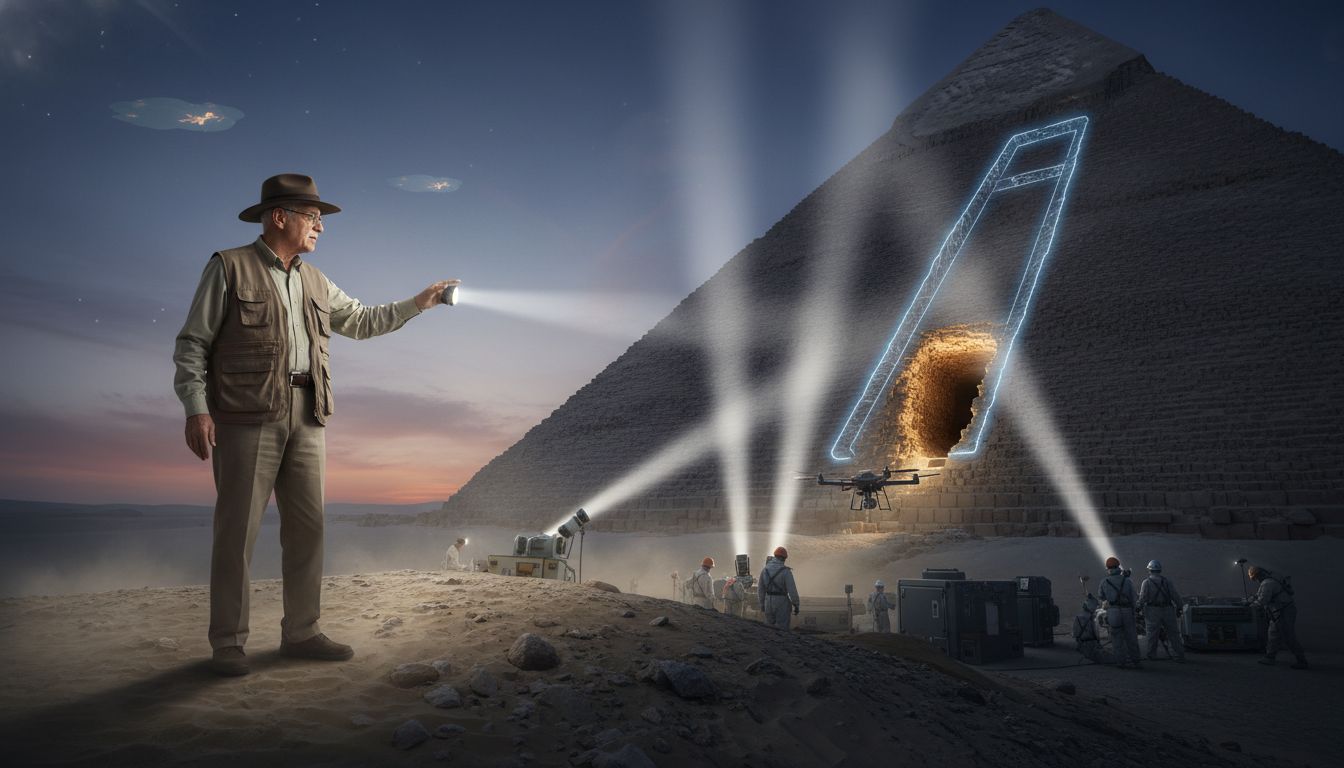
According to Hawass, the concealed corridor was identified with “advanced equipment” and appears to terminate at a previously unknown doorway within the pyramid’s core. He told reporters, “This great discovery is a new 30‑meter‑long passageway … detected using remote‑sensing technologies and advanced robotic systems.” If verified, the passage would join a series of voids first reported by the international ScanPyramids consortium in 2017 and a nine‑meter corridor announced in 2023. Those earlier discoveries, made with muon tomography and infrared scanning, demonstrated that the pyramid’s interior still holds structural surprises, but none have yet been linked to functional chambers or burial shafts.
Technological Methods
The detection reportedly relied on a combination of muon radiography, high‑resolution ground‑penetrating radar, and autonomous robotic probes capable of navigating tight spaces without compromising the monument’s integrity. Similar techniques enabled ScanPyramids researchers to map the “Grand Gallery void” and later to explore the Menkaure pyramid, where a parallel survey is currently underway. Hawass’s team has not released raw data or methodological details, prompting calls from the academic community for transparent publication. “Extraordinary claims require extraordinary evidence,” noted Dr. Lina Abdel‑Rahman of Cairo University, who has collaborated on several remote‑sensing projects in the Giza plateau.
Wider Archaeological Context
The announcement arrives amid a flurry of unrelated yet high‑profile debates in Egyptology. A recent study re‑examined an ancient silver goblet discovered in a tomb near Saqqara, with scholars divided over whether its iconography represents a ritual object or an early diplomatic gift. Meanwhile, a televised claim that sonar scans had located remnants of Noah’s Ark on Turkey’s Mount Ararat was widely dismissed by experts as “misinterpreted geological features.” Both episodes underscore the importance of rigorous peer review, especially when sensational narratives risk eclipsing measured scholarship.
Cautious Outlook
While Hawass’s reputation lends weight to the prospect of a new passage, the scientific method demands verification before the find can “rewrite history.” The upcoming 2026 disclosure will likely include detailed imaging, archaeological context, and, if the doorway is accessible, a controlled excavation plan. Until then, the discovery remains a hypothesis pending evidence, and the broader Egyptological community will watch closely, balancing optimism with the caution that has guided the field’s most credible breakthroughs.


