Overview
Astronomers worldwide are turning their attention to the newly discovered interstellar visitor 3I/ATLAS, the third known object to pass through the Solar System from beyond the Sun’s gravitational reach. While its trajectory and basic composition appear typical of cometary bodies, a series of high‑resolution observations have revealed unusual phenomena—including transient “mini‑jets” and a pronounced anti‑tail—that have sparked debate over whether these features could be natural or indicative of advanced technology. The discussion has been amplified by physicist Avi Loeb, who has long advocated for a broader scientific framework when confronting anomalous extraterrestrial observations.
Key Observational Details
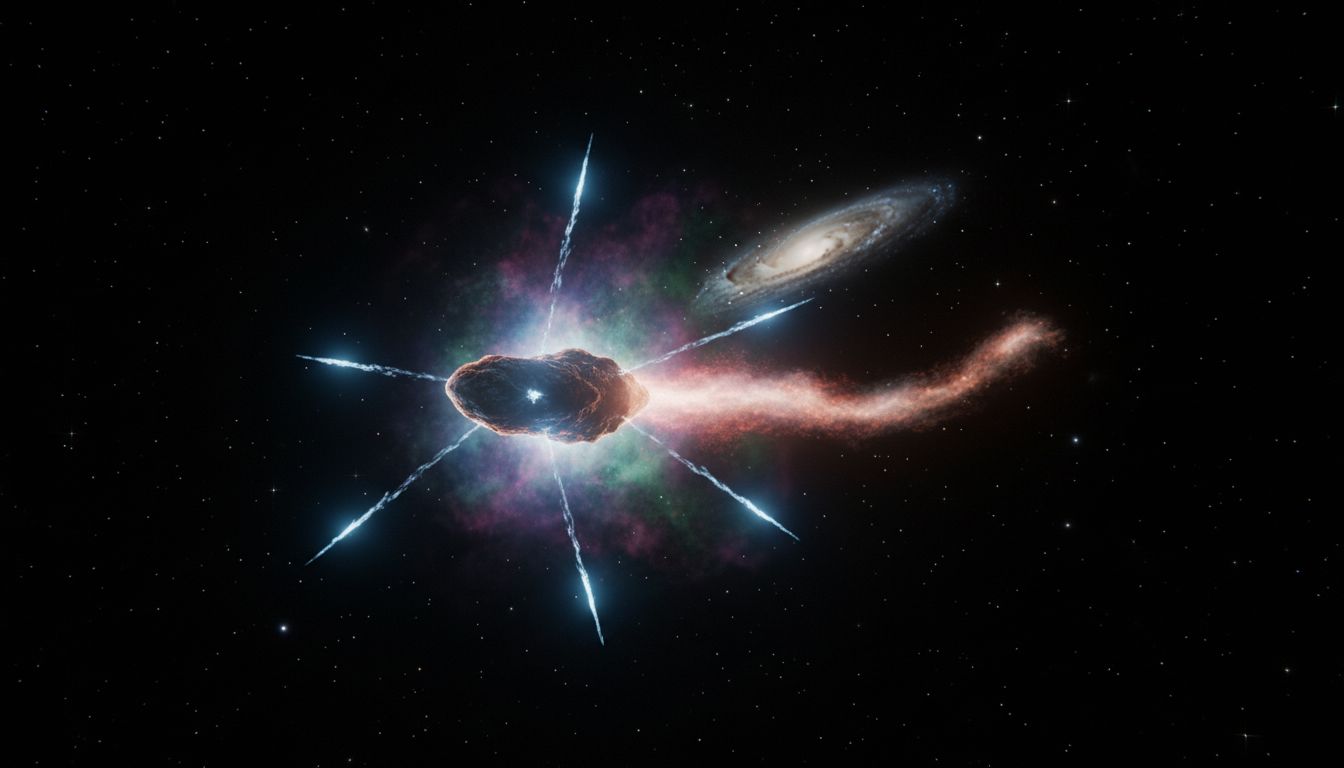
The object was first detected by the Pan‑STARRS survey in early 2025 and quickly catalogued as a hyperbolic comet. Follow‑up imaging from the Hubble Space Telescope and several ground‑based observatories captured brief, collimated bursts of material—dubbed “mini‑jets”—emerging from the nucleus at irregular intervals. Unlike the sustained outgassing typical of comets, these jets lasted only seconds to minutes and displayed velocities that exceeded expectations for sublimation‑driven processes.
In addition, 3I/ATLAS exhibited a distinct anti‑tail, a dust feature that points sunward rather than away from the Sun. Anti‑tails are rare but have been observed in a handful of Solar System comets when large dust particles are pushed by solar radiation pressure. However, the anti‑tail of 3I/ATLAS was unusually bright and maintained a coherent structure over several days, suggesting a persistent and directed emission of material.
Scientific Interpretation
Most planetary scientists interpret the mini‑jets as a fragmentation event—perhaps a loosely bound aggregate of icy and rocky material that is shedding debris as it heats up. The anti‑tail could arise from a combination of large dust grains and complex electrostatic interactions with the solar wind, phenomena that are still being modeled for interstellar objects that may possess unfamiliar compositions.
Nevertheless, a minority of researchers have raised the possibility that the observed features could be artificial in origin. The precise timing, narrow collimation, and high velocities of the mini‑jets bear a superficial resemblance to engineered propulsion or waste‑exhaust mechanisms. While such speculation remains highly controversial, it underscores a growing sentiment that existing astrophysical models may be insufficient to explain all aspects of interstellar interlopers.
Expert Commentary
Avi Loeb, a Harvard astrophysicist known for his work on the potential technological nature of Oumuamua, commented on the findings:
“When we encounter objects that do not fit comfortably within our current paradigms, we must entertain all plausible hypotheses, including those that involve ultra‑advanced engineering. The data from 3I/ATLAS are intriguing enough to merit a systematic, interdisciplinary investigation.”
Other analysts, such as Dr. Elena Martínez of the European Southern Observatory, cautioned against premature conclusions:
“The mini‑jets could simply be the result of volatile pockets exploding under solar heating. Until we have spectroscopic signatures that clearly differentiate natural from artificial processes, the burden of proof remains on the extraordinary claim.”
The conversation has also prompted calls for new scientific frameworks that integrate astrophysics, planetary science, and the emerging field of technosignature research. Several research groups are now proposing coordinated observation campaigns, including radio and infrared monitoring, to capture any anomalous emissions that might accompany future passes.
Looking Ahead
The window for detailed study of 3I/ATLAS will close by late 2026 as it recedes beyond the reach of current telescopes. In response, the International Astronomical Union has announced a special task force to evaluate the data and recommend follow‑up missions, potentially involving rapid‑deployment CubeSats equipped with high‑resolution spectrometers.
Whether 3I/ATLAS ultimately proves to be a natural cometary fragment or a signpost of extraterrestrial technology will hinge on the rigor of forthcoming analyses. As Loeb emphasizes, “History awaits on objects like 3I/ATLAS; they may hold clues not only to the composition of distant planetary systems but also to the limits of our own scientific imagination.” The coming months promise a decisive test of how the astronomical community balances skepticism with openness in the face of the unknown.


