Overview
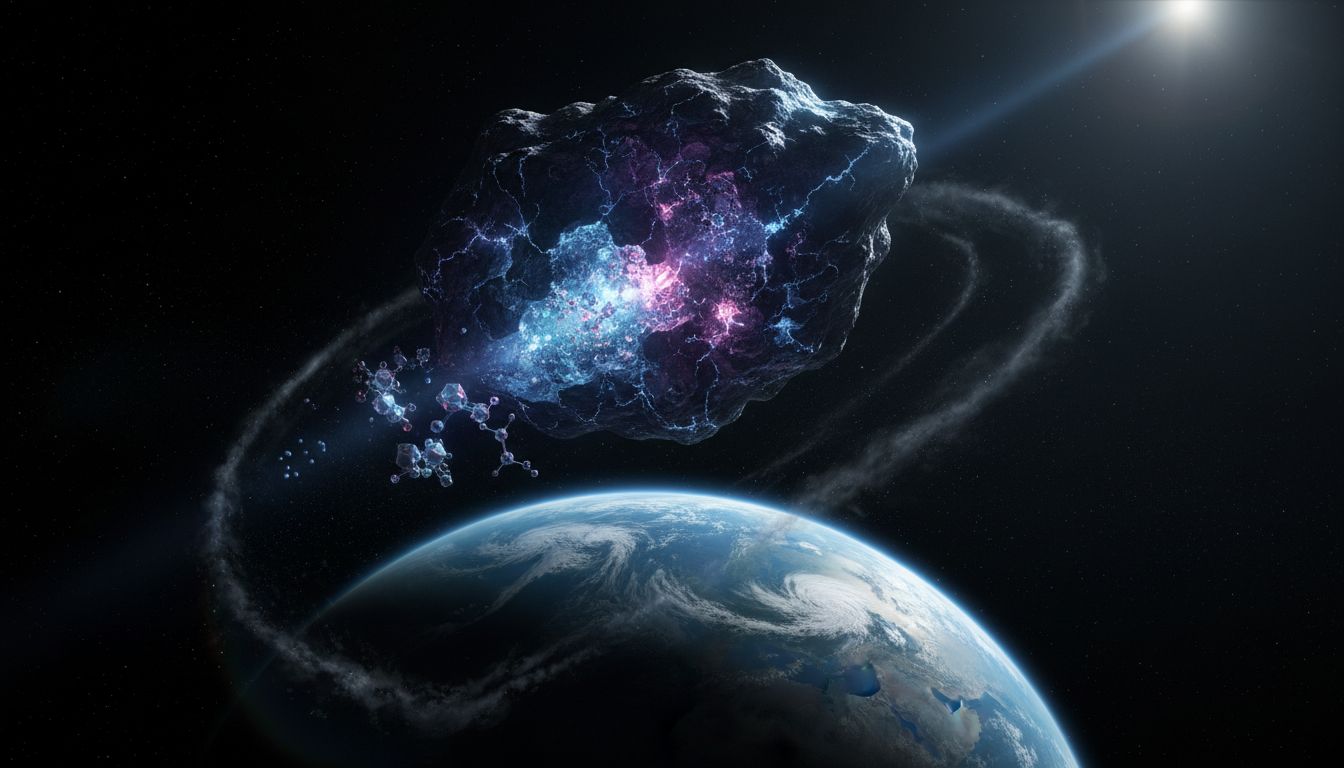
A fresh line of research is challenging long‑standing ideas about how life began on Earth. Recent analyses of material returned from asteroid Ryūg‑yu reveal nucleobases—the molecular building blocks of DNA and RNA—formed in space and possibly delivered to the early planet. The discovery dovetails with a growing appreciation for symbiosis in biology and resurrects Charles Darwin’s “warm little pond” speculation, suggesting that life’s origin may be a story of cosmic chemistry meeting terrestrial partnership. The implications reach beyond Earth, offering a new framework for the search for alien biology.
Space‑Born Nucleobases
Japan’s Hayabusa‑2 mission retrieved samples from Ryūg‑yu in 2020, and subsequent laboratory work identified several uracil and adenine derivatives that match those found in terrestrial organisms. Researchers argue these molecules formed in the asteroid’s icy matrix under ultraviolet radiation and cosmic‑ray bombardment, a process that can assemble pyrimidine and purine rings without any biological catalyst. “The chemistry we see on Ryūg‑yu is indistinguishable from that required for the first genetic polymers,” says Dr Miyu Tanaka of the Institute of Space and Astronautical Science. If such compounds were abundant in the early solar system, they could have been delivered in large quantities to the Hadean Earth, seeding the planet with the raw material for RNA‑based life.
From Darwin’s Pond to Hydrothermal Vents
For more than a century, the dominant narrative has been that life emerged in a “warm little pond” rich in ammonia, phosphates and energy sources, an idea Darwin himself entertained in an 1871 letter to Joseph Hooker. Modern studies, however, have shifted focus to deep‑sea hydrothermal vents, where mineral pores create natural electrochemical gradients that could drive pre‑biotic reactions. Biochemist Nick Lane of University College London notes, “The internal pores of the vents have cell‑like structures with electrically charged catalytic surfaces, while the continuous flow gives continuous reactivity.” The Ryūg‑yu findings add a third dimension: organic precursors may have arrived from space before terrestrial environments became chemically favorable, providing a head‑start that bridges the gap between cosmic synthesis and Earth‑bound catalysis.
Symbiosis as a Lens on Origins
The new perspective aligns with a broader scientific movement that places symbiosis at the heart of biological complexity. In her forthcoming book Togetherness, author‑researcher Gilles Hooper‑Rowan argues that cellular cooperation—whether between algae and fungi in lichens or between mitochondria and host cells—has been under‑appreciated in evolutionary narratives. By viewing the origin of life as a collaborative process—first between molecules formed in interstellar ice, then between mineral surfaces in vents, and finally between emerging protocells—researchers gain a more integrated picture of how complexity can arise without invoking a single “primordial soup” event.
Implications for the Search for Extraterrestrial Life
If nucleobases can be synthesized and preserved in asteroids, they become a universal metric for habitability. Future missions to carbon‑rich bodies such as Ceres or comet 67P/Churyumov‑Gerasimenko will likely prioritize detecting these molecules, expanding the catalogue of “pre‑biotic inventory” beyond Earth. Moreover, the idea that life’s chemistry is portable across planetary systems strengthens the case for looking for biosignatures on exoplanets with volatile delivery histories, such as those orbiting young, dusty stars where cometary bombardment is common.
Next Steps and Cautious Optimism
Scientists caution that delivery alone does not guarantee the emergence of life; the transition from free nucleobases to self‑replicating polymers remains a formidable gap. Ongoing laboratory simulations aim to replicate the combined effects of space‑borne organics, vent‑like mineral scaffolds, and fluctuating redox conditions. As Dr Tanaka emphasizes, “We are moving from asking whether extraterrestrial chemistry contributed to life, to how it integrated with Earth’s own processes.” The convergence of astrobiology, geochemistry, and symbiosis research promises a more nuanced narrative—one that may finally answer the age‑old question of our origins while guiding the hunt for life beyond our world.


