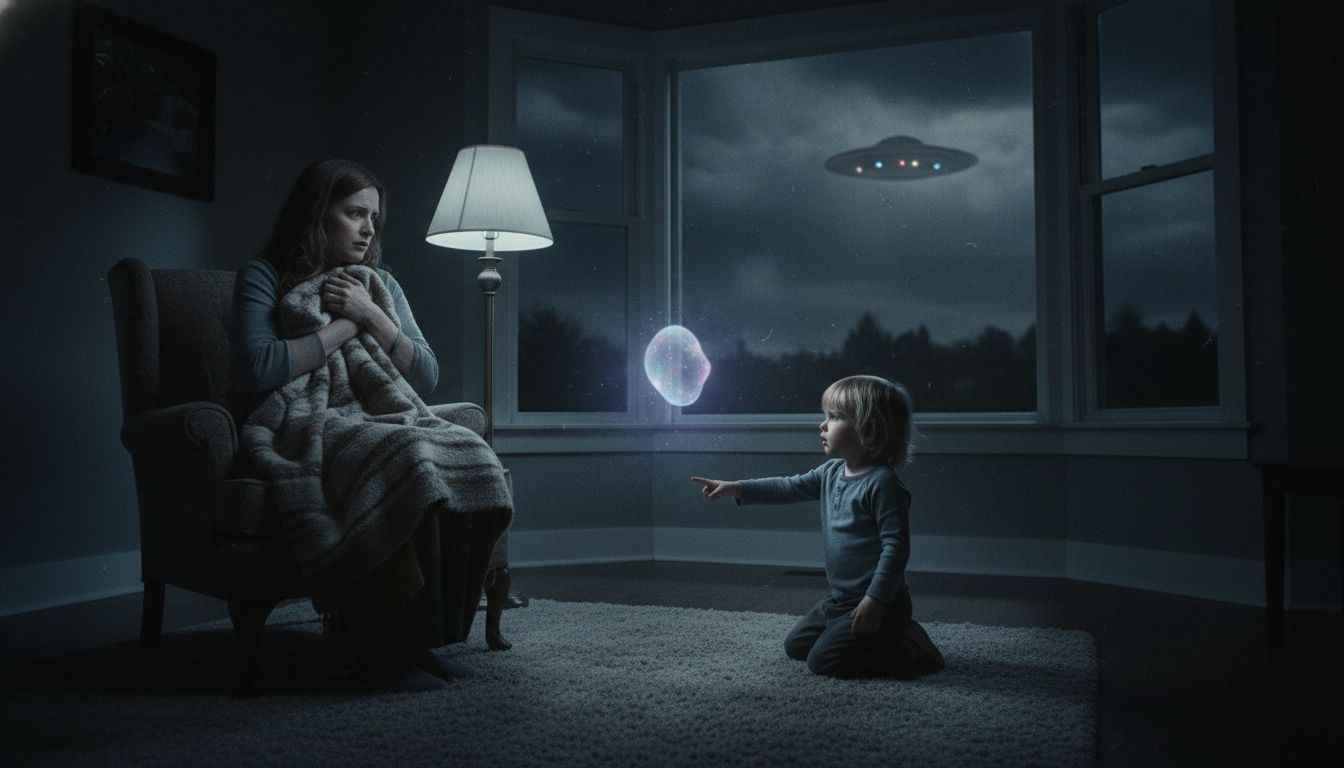
Living in a 1908 wood‑frame house, a mother of a three‑year‑old son, Simon, first noticed an odd pattern of behavior that she initially dismissed as typical toddler imagination. While nursing her infant, Simon abruptly turned his head and stared intently at a spot just over the mother’s left shoulder. The mother recalled seeing nothing—no spider, no sunbeam—yet the stare recurred over several days, always in the same corner of the living room. When she finally asked Simon what he was looking at, he simply said, “I see Toddy Ro sometimes. He’s here, in our house.” The calm certainty of those five words unsettled her, prompting a month‑long series of questions that yielded only the vague description of a “funny hat” and a persistent sense that the presence was real.
Psychologists say such experiences are not uncommon in early childhood. Dr. Elena Ramirez, a developmental psychologist at the University of Michigan, explains that children’s visual systems are highly attuned to subtle changes in light, shadow and motion that adults often overlook. “A three‑year‑old can detect a flicker of sunlight moving across a wall or a slight shift in temperature, and the brain will try to make sense of that input,” Ramirez said. “When the stimulus is ambiguous, the child may create a narrative—a friend, a character—to fill the gap, which can feel very concrete to them.” This cognitive tendency, known as pareidolia, is amplified in environments like historic homes where creaking floors and drafty windows provide a constant stream of low‑level sensory cues.
The anecdote also taps into a broader cultural fascination with the paranormal. A Gallup poll released earlier this year found that 35 % of Americans believe in ghosts, a figure that has remained steady despite advances in science and technology. Sociologist Dr. Mark Liu of Northwestern University notes that belief in spirits often rises in settings where the built environment carries a sense of history. “Older houses act as repositories of collective memory,” Liu said. “When families move into a home with a long lineage, the narrative of past occupants becomes part of the lived experience, making it easier for unusual sensory events to be interpreted as supernatural.” In Simon’s case, the family’s awareness of the house’s age may have primed both mother and child to assign meaning to the unexplained stare.
Neuroscience adds another layer to the discussion. Researchers at the University of California, Irvine, have shown that the human brain is wired to create stories as a way of organizing fragmented information, a process that can occur even without conscious awareness. “Our brains are pattern‑seeking machines,” said Dr. Priya Natarajan, a cognitive neuroscientist who studies narrative cognition. “When children encounter ambiguous stimuli, the narrative engine kicks in, often producing characters that feel real. Adults, who have more developed logical filters, may dismiss these narratives, but they can still feel emotionally resonant, especially in a setting that already feels ‘haunted.’” This explains why the mother’s reaction was one of unease despite her rational skepticism.
While the family’s experience did not culminate in any overt paranormal activity, it illustrates how everyday sensory anomalies can intersect with cultural expectations and developmental psychology to produce compelling, if unsettling, stories. The mother, who declined to name herself, said she now views the episode as a reminder of the “thin line between imagination and perception” that children navigate daily. As experts agree, such moments are less about ghosts and more about the intricate ways the human brain interprets the world—especially when the world is an old house with creaking floors, shifting light, and a child eager to fill the gaps with a friendly, hat‑wearing companion.