Overview
The interstellar object designated 3I/ATLAS was detected on 30 December 2025 by the Virtual Telescope Project in Italy. Its trajectory and brightness profile sparked immediate debate among astronomers about its nature—whether it is a typical comet, an asteroid, or something more exotic. In a recent Medium essay, Harvard astrophysicist Avi Loeb argues that the most parsimonious explanation is that 3I/ATLAS is a comet, but he warns that dismissing it outright could mask a “black‑swan” event with profound scientific and security implications. Loeb’s piece also draws attention to a longstanding “neither deny nor confirm” (NDNC) response from the CIA when asked about the existence of classified records on the object, suggesting a layer of secrecy that warrants scrutiny.
Scientific Assessment
Loeb points out that 3I/ATLAS displays several hallmarks of cometary activity: a pronounced anti‑tail jet pointing toward the Sun, a rapid increase in brightness as it approached perihelion, and a spectrum rich in volatile compounds. These characteristics align with known behavior of long‑period comets that originate in the Oort cloud, albeit on an interstellar trajectory. By applying standard cometary dynamics, Loeb estimates that the object’s nucleus is likely a few hundred meters across, with a mass comparable to a modest ice‑rich asteroid. He cautions, however, that the limited observation window—just a handful of 120‑second exposures—means that subtle anomalies could be missed, and that the object’s high velocity (≈ 30 km s⁻¹ relative to the Sun) leaves little time for detailed follow‑up.
Intelligence Community Response
When journalists and researchers filed Freedom of Information Act (FOIA) requests regarding any CIA dossiers on 3I/ATLAS, the agency responded with its classic NDNC stance: it would neither deny nor confirm the existence of such records. Loeb interprets this as more than bureaucratic routine. “An NDNC reply on a purely astronomical object is unusual,” he writes, noting that the CIA typically reserves such language for matters of national security, not celestial phenomena. The lack of transparency, he argues, fuels speculation and undermines public confidence in how potential extraterrestrial evidence is handled.
The Loeb Classification Scale
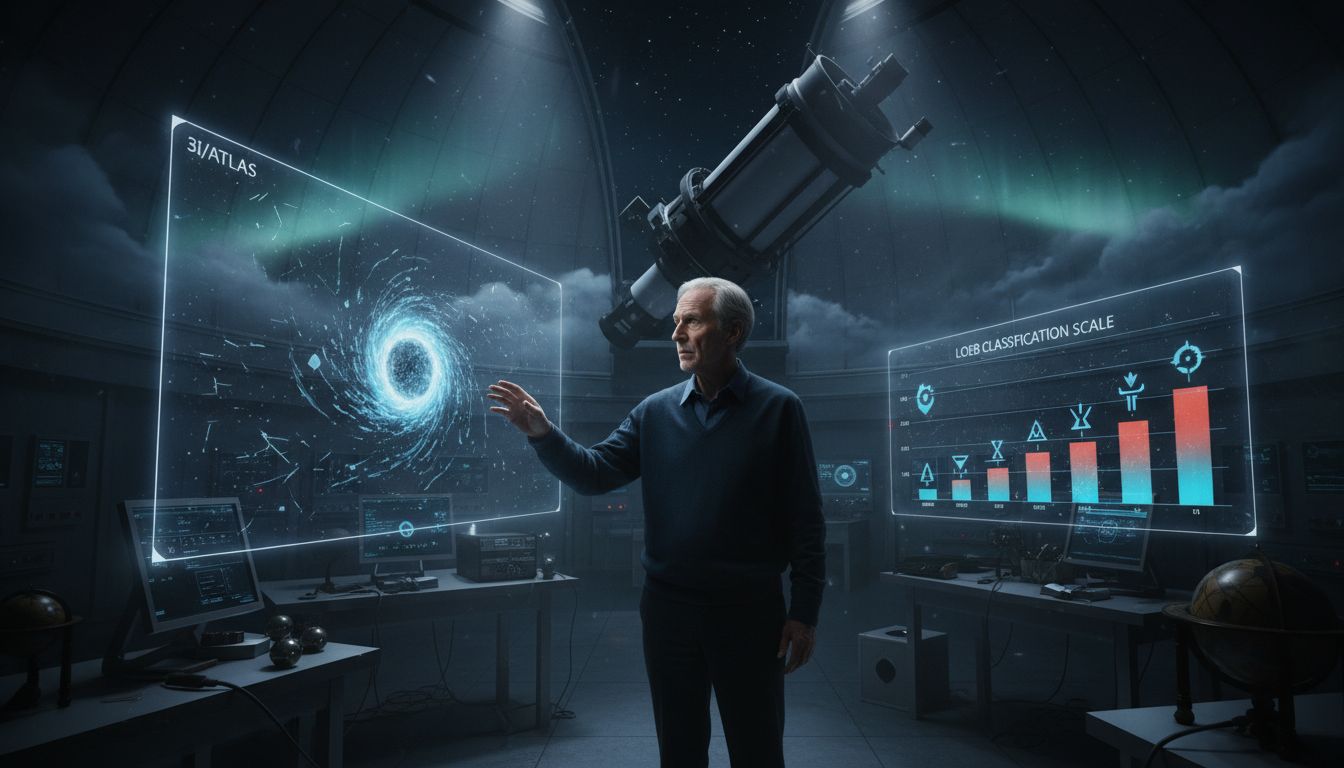
To address the uncertainty surrounding objects like 3I/ATLAS, Loeb proposes a new Loeb Classification Scale (LCS) for alien‑technology threats. The scale ranges from L0 (ordinary natural bodies) to L5 (definitive evidence of extraterrestrial engineering). 3I/ATLAS, under current data, would be placed at L1—a natural object that merits close monitoring because of its unusual interstellar origin. The LCS is intended to guide both scientific teams and security agencies in allocating resources, establishing observation protocols, and determining when to involve intelligence communities. Loeb emphasizes that the scale is “a pragmatic tool, not a sensationalist label,” designed to prevent both complacency and overreaction.
Implications and Next Steps
If 3I/ATLAS is confirmed as a comet, the episode underscores the challenges of studying fleeting interstellar visitors. It also highlights a growing tension between open scientific inquiry and classified intelligence practices. Loeb urges the astronomical community to push for transparent data sharing and for policymakers to clarify the criteria that trigger NDNC responses. Meanwhile, he calls for the establishment of an International Interstellar Object Task Force, comprising astronomers, planetary scientists, and security analysts, to coordinate rapid observations and assess any anomalous signatures that could indicate non‑natural origins.
Looking Ahead
The detection of 3I/ATLAS adds to a short but expanding catalog of interstellar objects, following ‘Oumuamua (2017) and 2I/Borisov (2019). Each new visitor offers a rare glimpse into the composition of distant planetary systems. While Loeb’s assessment leans toward a conventional cometary explanation, his broader warning—that the absence of denial does not equal confirmation of benign nature—invites a more disciplined approach to future discoveries. As telescopes become more sensitive and survey coverage expands, the scientific community and intelligence agencies alike will need clear, jointly‑agreed frameworks to navigate the thin line between curiosity and caution.