Overview
A recent feature in The Business Standard asks a question that has long occupied both scientists and philosophers: if extraterrestrial intelligences exist, how might they view humanity? The article, published on April 5, 2026, frames the inquiry not as speculation for its own sake but as a mirror for assessing our own progress. By juxtaposing Earth’s rapid technological advances with mounting ecological crises and deep‑seated social contradictions, the piece suggests that any advanced observers would likely see us as a fragile, conflicted species teetering between cooperation and conflict.
Technological Milestones
The author highlights several achievements that would be unmistakable markers of intelligence to an outside observer. Humanity has launched more than 7,000 satellites, sent probes beyond the heliosphere, and built a global internet that connects billions in real time. “Our capacity to manipulate matter at the nanoscale and to decode the human genome in a single decade is unprecedented,” the article notes, pointing to the rapid development of CRISPR gene‑editing and quantum‑computing prototypes. Such milestones signal a species capable of abstract thought, long‑range planning, and self‑reflection—qualities that any technologically mature civilization would likely recognize and respect.
Environmental Concerns
Yet the same article warns that these triumphs are shadowed by environmental degradation that could dominate an alien assessment. Satellite imagery shows deforestation rates exceeding 10 million hectares per year, while atmospheric carbon dioxide has surged past 420 ppm, driving global temperatures toward a 1.5 °C rise above pre‑industrial levels. Marine biologists quoted in the piece describe “the sixth mass extinction” as already unfolding, with coral reefs losing 50 % of their cover in the past three decades. From an external viewpoint, the planet’s biosphere might appear a delicate, destabilized system struggling under the weight of its own creators.
Social Contradictions
The article also explores the paradoxes embedded in human societies. On one hand, global cooperation has produced the International Space Station, the COVID‑19 vaccine consortium, and the Paris climate accord. On the other, the same year saw record‑high refugee movements, widening wealth gaps, and renewed geopolitical tensions in regions such as Eastern Europe and the South China Sea. A sociologist referenced in the feature observes that “our collective intelligence is often eclipsed by tribalism and short‑term self‑interest.” An alien intelligence, accustomed perhaps to long‑term stability, might interpret this as a species caught between collaborative potential and destructive rivalry.
Possible Alien Perspective
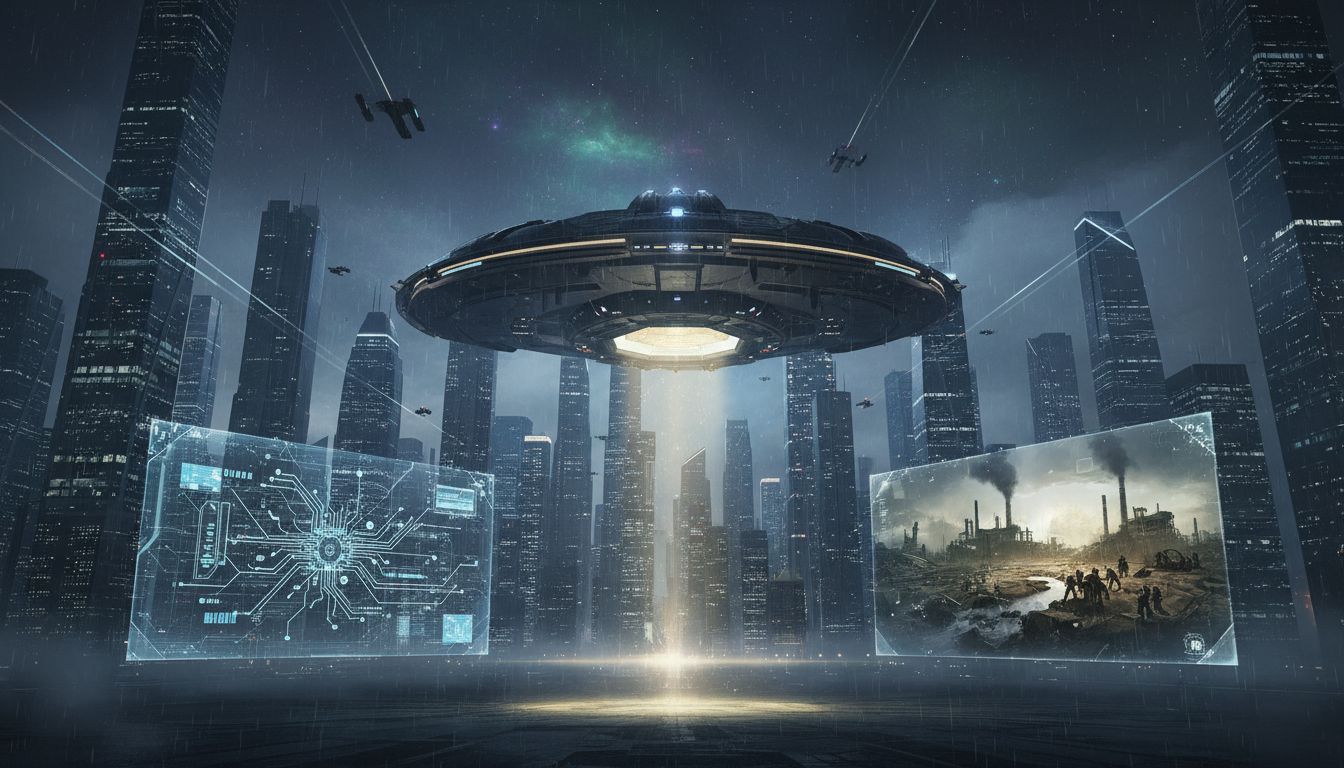
Synthesizing these strands, the author concludes that extraterrestrials—if they exist and possess the ability to observe Earth—would likely view humanity as a nascent civilization at a crossroads. They might admire our scientific ingenuity while lamenting the unsustainable exploitation of our planet’s resources and the volatility of our political structures. The piece invites readers to consider that the very act of pondering alien judgment can serve as a catalyst for introspection, urging policymakers and citizens alike to prioritize sustainable development, equitable governance, and planetary stewardship before any hypothetical interstellar audience arrives.
Implications for the Future
While the article stops short of claiming any imminent contact, it underscores a practical takeaway: the imagined gaze of an advanced civilization forces a stark appraisal of our choices. By aligning technological ambition with ecological responsibility and social cohesion, humanity can reshape the narrative from “fragile and conflicted” to “resilient and unified.” As the author puts it, “The question is less about what aliens would think of us, and more about what we think of ourselves when we imagine that perspective.”