Overview
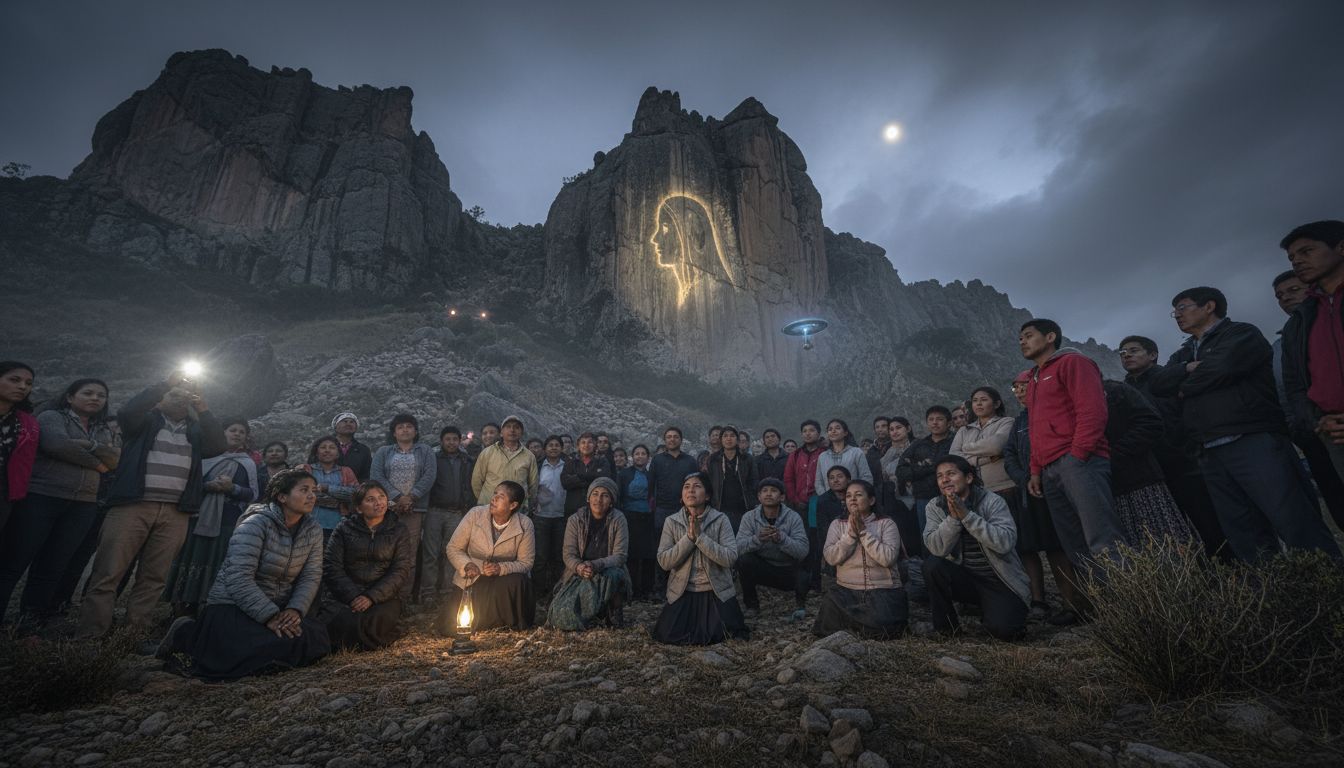
Pilgrims have begun to gather at the small town of Morcá, in the department of Antioquia, after a video circulated on social media showing a faint, light‑filled outline on a rocky outcrop that many say resembles the Blessed Virgin Mary. The image, which appears on the east‑facing slope of the mountain known locally as Cerro de la Virgen, was first posted on a Colombian news site on November 9 and has since been viewed by tens of thousands online. At the same time, a separate incident reported from Farabari, India, described a brief, luminous “face” that seemed to hover over the night sky before vanishing. Both occurrences have sparked lively debate among believers, skeptics, and scientists about whether they represent genuine supernatural phenomena or classic cases of pareidolia—the brain’s tendency to perceive familiar patterns in random stimuli.
Local Reactions in Morcá
The sight has quickly turned Morcá into a spontaneous pilgrimage site. Father Miguel Torres, the parish priest of the nearby San Juan de Morcá church, told local reporters, “Our community has always felt a deep devotion to Mary, and when people see what they believe is a sign, it strengthens our faith.” He added that a temporary altar has been set up at the base of the outcrop, where visitors light candles and pray. The influx of visitors has also drawn the attention of municipal authorities; the mayor’s office confirmed that a police presence has been deployed to manage traffic and ensure safety, while local vendors have begun selling rosaries and water bottles to the crowds.
Scientific and Psychological Insight
Geologists from the University of Antioquia were called to the site to examine the formation. Dr. Laura Méndez, a structural geologist, noted that the “rock face is composed of layered sedimentary stone that naturally erodes into curves and shadows, which can create the illusion of facial features under certain lighting.” She cautioned that without a thorough, on‑site analysis, it is premature to attribute the image to any supernatural cause.
Psychologists point to a well‑documented cognitive bias. Dr. Arjun Patel, a cognitive scientist at the Indian Institute of Science, explained, “Pareidolia is a universal human tendency. When we see a vague shape, our brain fills in the gaps with familiar icons—often faces, especially religious ones, because they carry deep emotional significance.” Dr. Patel referenced similar phenomena, such as the famous “Mona Lisa” clouds and the “Jesus on a toast” meme, emphasizing that cultural context heavily influences what people perceive.
Comparative Case: The Farabari Glowing Face
The Indian incident, reported by regional outlet The Hindu on November 10, described a “bright, oval shape with two luminous points that resembled eyes” hovering over the village of Farabari for roughly thirty seconds before disappearing. Residents described the experience as “eerie” but also “beautiful,” and a local temple priest suggested it could be a “divine messenger.” However, atmospheric scientists from the Indian Meteorological Department noted that the region experienced a brief, low‑altitude ball lightning event that night—a rare but documented electrical discharge that can appear as a glowing orb or face‑like shape.
Outlook and Ongoing Investigation
Both events underscore the intersection of faith, media, and scientific inquiry in the digital age. Colombian authorities have pledged to conduct a formal geological survey of Cerro de la Virgen, while the Vatican’s Dicastery for the Doctrine of the Faith has not issued an official comment, noting that “miraculous claims require rigorous verification.” In India, the Meteorological Department plans to release a detailed report on the atmospheric conditions that could have produced the Farabari glow.
As the videos continue to circulate, researchers stress the importance of critical observation and transparent data collection. “Whether these are genuine miracles or natural optical effects, they remind us of the powerful role that perception plays in shaping human experience,” said Dr. Patel. For now, the faithful in Morcá and Farabari will likely continue to interpret the fleeting images through the lens of their own beliefs, while scientists work to unravel the natural explanations behind the striking visuals.


