Overview
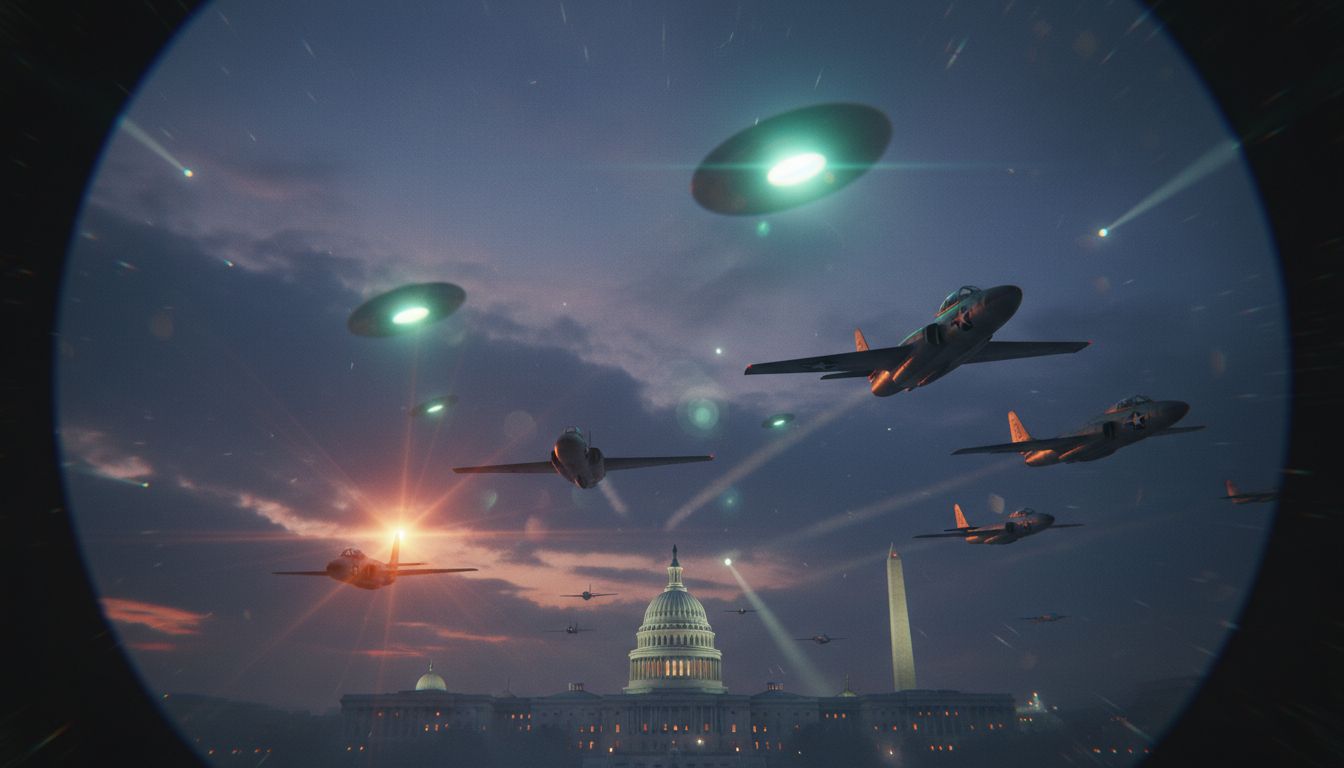
In the early hours of July 26, 1952, radar operators at Washington National Airport and Andrews Air Force Base detected a series of unidentified contacts that penetrated restricted airspace surrounding the White House and the Pentagon. The sightings prompted an emergency scramble of two Republic F‑94C Starfire interceptors from the 142nd Fighter Interceptor Squadron at New Castle Air Force Base, Delaware. Pilots Lt. William L. Patterson and Capt. John McHugo were ordered to investigate, launching into a humid night that would become one of the most documented Cold‑War UFO incidents.
The 1952 Intercept
Patterson’s aircraft climbed to 20,000 feet while McHugo followed in formation. Controllers reported that the radar returns behaved unlike any known aircraft: the targets dipped, stopped, vanished, and reappeared repeatedly across a 100‑mile sweep, executing rapid reversals, sharp 90‑degree turns, and abrupt accelerations. When Patterson reached the vicinity of the first cluster, he observed four bright lights roughly ten miles ahead, hovering at a slight altitude above his jet. “They didn’t blink or drift like normal aircraft lights,” Patterson later recalled in an interview archived by the Air Force Historical Research Agency. He accelerated to near 600 mph, yet the lights remained stationary, and the radar contacts mirrored his maneuvers in real time.
Operational Details
The incident unfolded against a backdrop of heightened Cold‑War tension. The United States was in the midst of a record‑breaking year for UFO reports, with multiple civilian and military sightings logged nationwide. Just a week earlier, commercial pilots and radar operators over the capital had reported similar “unfamiliar objects” that performed maneuvers beyond the capabilities of known aircraft. At the time, the Air Defense Command launched a formal investigation, compiling unclassified documents, flight logs, and eyewitness statements. The final report concluded that the contacts could not be identified, but stopped short of attributing them to any foreign aircraft or known atmospheric phenomena.
Legacy and Modern Context
For decades, the 1952 Washington events were treated as a Cold‑War curiosity, largely absent from mainstream discourse. In recent years, however, pilots’ reports of unexplained aerial phenomena (UAP) have risen sharply. According to Americans for Safe Aerospace, a nonprofit that provides confidential reporting channels for aviators, the number of pilot submissions in U.S. airspace has more than doubled since 2020. Researchers note a striking parallel between the 1952 radar behavior—erratic accelerations and instantaneous direction changes—and several contemporary UAP encounters logged by military pilots. The historical record therefore serves as a reference point for current investigations conducted by the Department of Defense’s Unidentified Aerial Phenomena Task Force.
Ongoing Investigation
The declassification of additional Cold‑War-era files in the past five years has renewed scholarly interest in the 1952 incidents. Historians and aerospace analysts are re‑examining the original radar data, pilot testimonies, and contemporaneous weather reports to assess whether the phenomena could be explained by sensor anomalies, experimental aircraft, or other conventional sources. While no definitive conclusion has emerged, the case remains a benchmark for evaluating modern UAP sightings, illustrating how unexplained aerial events can persist across generations despite advances in detection technology. As the United States continues to refine its reporting and analysis frameworks, the 1952 Washington scramble stands as both a cautionary tale and a catalyst for transparent scientific inquiry into the skies above.