Overview
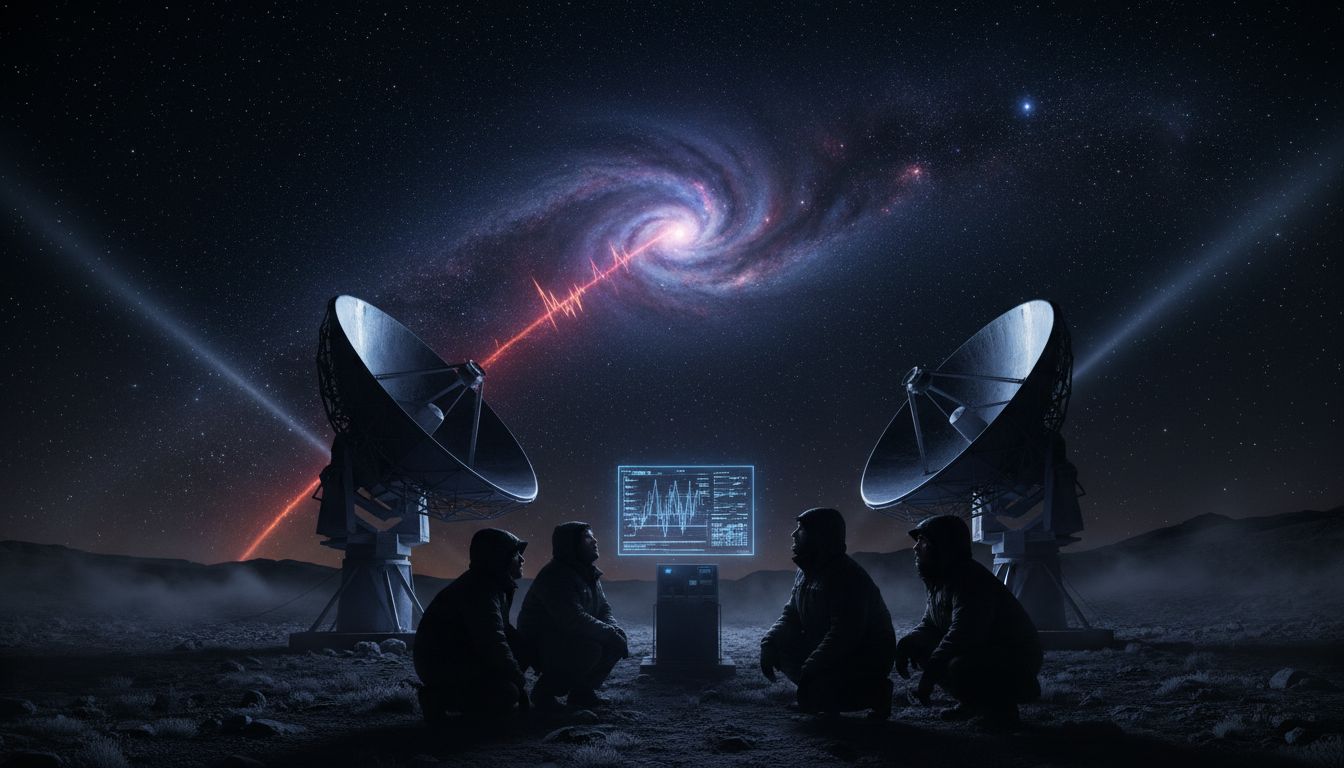
Astronomers have been left with a celestial mystery near the centre of the Milky Way: ASKAP J173608.2−321635, a radio source that appeared and vanished in a way that defies easy classification. Detected six times in 2020 by the Australian Square Kilometre Array Pathfinder (ASKAP), the object flashed in the radio band, then disappeared from follow-up searches in X-rays and near-infrared light. Its behaviour was unusual enough to draw attention precisely because it did not match the profile of any familiar source category. For now, the name itself — a coordinate label rather than a conventional astronomical designation — is a reminder that the object has not yet revealed what it truly is.
What the surveys found
The source was identified in ASKAP’s Variables and Slow Transients survey (VAST), a programme designed to catch objects that change brightness over timescales from seconds to years. According to the discovery paper led by Ziteng Wang and published in The Astrophysical Journal in 2021, ASKAP J173608.2−321635 was detected at 888 megahertz six times between January and September 2020, in the Galactic plane roughly four degrees from the Galactic Centre. When it appeared, it showed about 25% circular polarisation, a striking signal that often points to coherent emission or a strongly magnetised environment. It was also steep-spectrum and highly variable, meaning it was brighter at lower radio frequencies and changed dramatically over time.
Follow-up observations deepen the mystery
After the initial detections, astronomers turned to the South African MeerKAT radio telescope for continued monitoring. The source was absent at first, then reappeared on February 7, 2021, when it reached a peak flux density of 5.6 millijanskys before fading within about a day. MeerKAT added another layer of complexity: the source remained circularly polarised and also showed as much as 80% linear polarisation, while its rotation measure — a marker of how magnetised plasma twists radio waves — changed significantly over just three days. Despite the radio activity, the object left no detectable counterpart in Swift or Chandra X-ray observations, and no obvious signal in archival or new near-infrared imaging down to J-band magnitude 20.8.
Why standard explanations fall short
Those non-detections are crucial because they eliminate or weaken several ordinary explanations. A flare star, brown dwarf, pulsar, magnetar, or X-ray binary can each account for part of ASKAP J173608.2−321635’s behaviour, but none comfortably explains the full package: transient radio emission, strong variability, high circular and linear polarisation, and the lack of counterparts at other wavelengths. Even the class of objects known as Galactic Centre radio transients does not neatly solve the puzzle. As the researchers noted, the finding is not proof of a new type of object, but rather a well-documented case in which standard models fail to account for all the evidence.
What it means for future searches
For astronomers, ASKAP J173608.2−321635 is less a solved case than a signal that the sky still holds surprises. Wide-field radio surveys like VAST are increasingly important because they can spot fleeting or rare phenomena that targeted observations might miss. Objects like this one also underscore how much remains unknown about the dynamic environment near the Galactic Centre, where dense plasma, strong magnetic fields and crowded stellar populations can produce unusual signals. Whether ASKAP J173608.2−321635 turns out to be an extreme version of a known source or something genuinely new, it has already shown the value of persistent, multiwavelength follow-up in separating astrophysical noise from potential discovery.