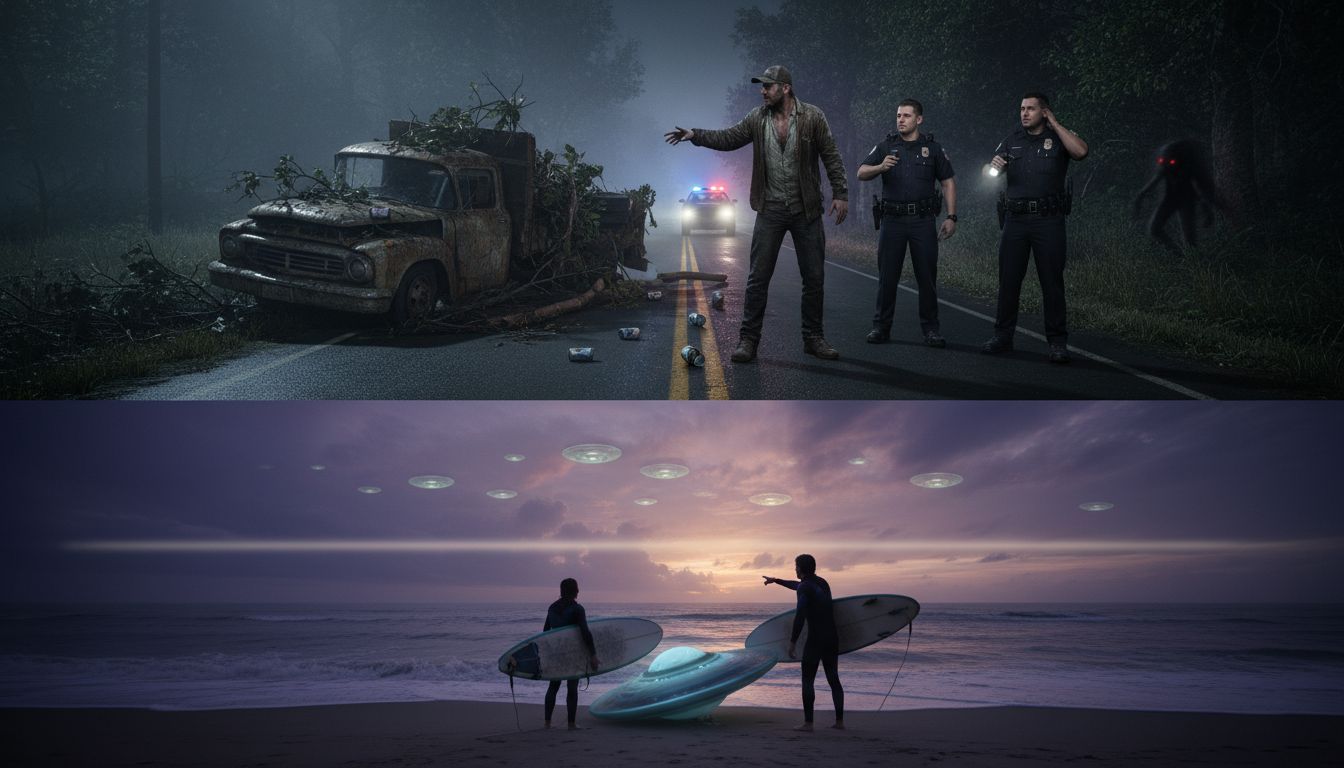
A Bedford, Indiana, truck driver told investigators that a “large, hairless creature” he identified as a chupacabra leapt onto the highway just before his vehicle left the road and rolled over on October 12. The driver, whose name has not been released, filed a police report that blamed the alleged cryptid for the crash that left his 26‑foot tractor‑trailer badly damaged. However, a subsequent breath‑alcohol test showed the driver’s blood‑alcohol concentration was 0.12 percent—well above Indiana’s legal limit of 0.08 percent—prompting the Allen County Sheriff’s Office to classify the incident as a DUI rather than a supernatural encounter.
Sheriff’s Deputy James Whitaker, who responded to the scene on County Road 31, said the driver’s account “does not align with the physical evidence.” Whitaker noted that skid marks, the angle of impact and the lack of any animal tracks or debris at the site indicated a loss of control rather than an external collision. “We did not find any footprints, hair, or other material that would support a creature‑related claim,” he told reporters. The driver was subsequently cited for operating a commercial vehicle while intoxicated and for reckless driving, charges that could result in the suspension of his commercial driver’s license and a possible jail term.
The chupacabra, a creature first reported in Puerto Rico in the 1990s, has become a staple of modern folklore, described variously as a hairless, dog‑like predator that attacks livestock. Cryptozoologists caution that most sightings can be traced to misidentified known animals—such as coyotes with mange—or to hoaxes. Dr. Elena Martínez, a professor of folklore at the University of Indiana, explained that “the chupacabra narrative thrives on fear of the unknown, especially in rural, low‑light environments where drivers are already vulnerable.” She added that “stress, fatigue, and, in this case, alcohol impairment can easily distort perception, leading a driver to attribute a routine loss of traction to something extraordinary.”
While the Indiana incident drew attention for its outlandish claim, a separate, unrelated report emerged from Uruguay’s coastal town of Punta del Este, where a group of surfers filmed a three‑foot‑wide, spiny‑bodied organism surfacing near a popular break. The surfers described the creature as resembling a giant sea cucumber or an unidentified marine invertebrate, noting its “sharp, bristly projections” and sudden, erratic movement that caused them to abandon their boards. The video, posted on a local surfing forum, has not been verified by marine biologists, and experts caution that ocean debris, a large jellyfish, or a misidentified sea urchin could produce a similar visual impression. “Without a clear frame‑by‑frame analysis and physical specimens, we cannot confirm whether this is a new species or a known marine animal behaving unusually,” said marine ecologist Dr. Luis Pereira of the University of Montevideo.
Both episodes underscore a recurring pattern in which extraordinary claims arise in the wake of accidents or unsettling encounters, often prompting media coverage that blurs the line between genuine investigation and sensationalism. Law enforcement agencies continue to prioritize concrete evidence—such as toxicology reports, skid‑mark analysis, and eyewitness corroboration—over anecdotal narratives. As the Indiana driver faces court proceedings next month, officials reiterate that “public safety depends on accountability, not myth.” Meanwhile, the Uruguayan surfers’ footage remains under review, reminding observers that, while the allure of the unknown persists, rigorous scientific scrutiny remains the most reliable path to understanding.