Overview
A Long Island research team known as Nightcrawler UAP is trying to bring a more systematic approach to one of the most persistent questions in aerospace mystery: what, exactly, is moving across the sky when people report unexplained aerial events? In a recent conversation on the podcast All Things Unexplained, John Tedesco, Gerry Tedesco, and Donna Lee Nardo described a project built around careful observation, multi-sensor imaging, and data verification, rather than speculation. The group’s work reflects a broader shift in UAP research, where independent investigators are increasingly using tools more commonly associated with engineering, surveillance, and environmental science.
From curiosity to a field platform
The Nightcrawler project began with a different mission. According to Gerry Tedesco, the brothers were originally developing a mobile laboratory to examine possible electromagnetic links to cancer clusters on Long Island. That effort changed direction after the release of the U.S. government’s ODNI report on military UAP encounters. “We realized the platform we were building could also be used to investigate aerial anomalies,” Gerry explained. From that pivot came Nightcrawler’s current form: a heavily modified vehicle designed to move quickly to reported hotspots and collect data from multiple points of view at once.
A multi-sensor approach to the sky
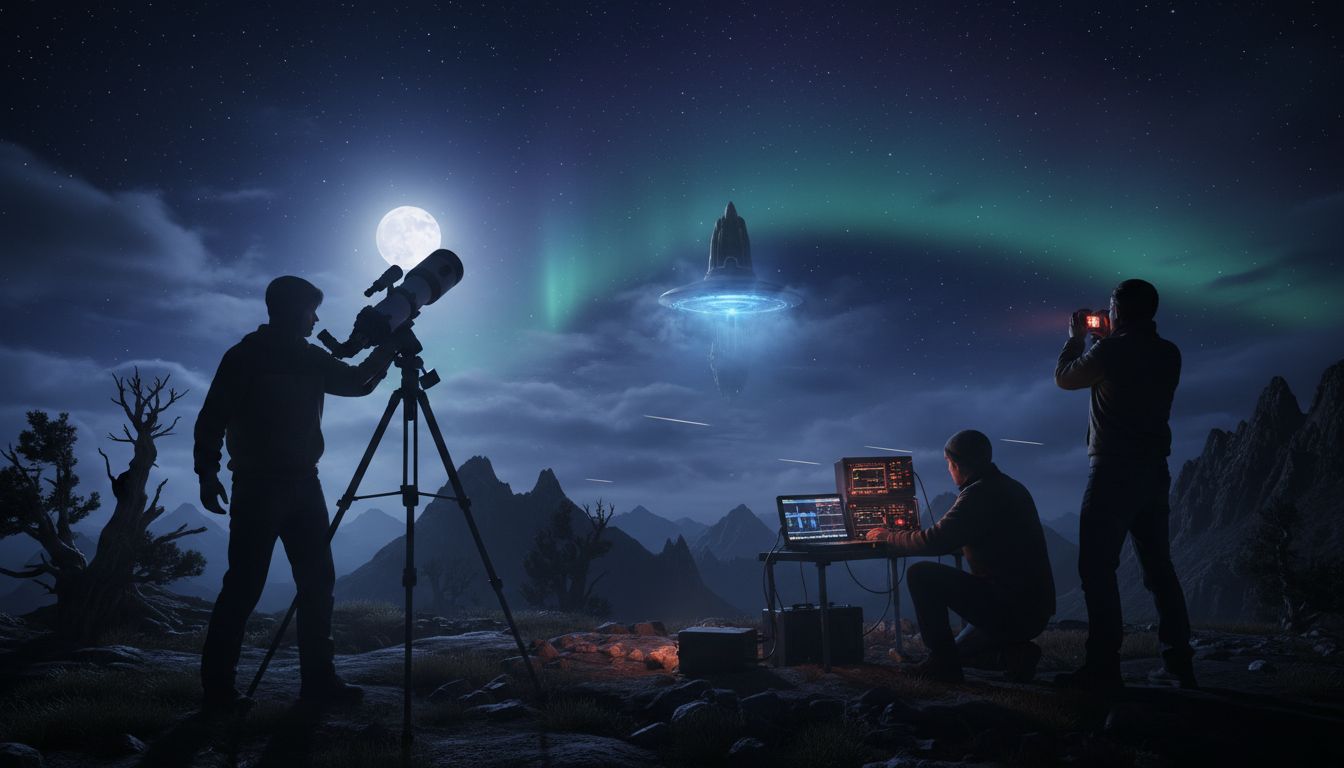
What sets Nightcrawler apart is its attempt to layer sensors rather than rely on a single camera or observer. The vehicle is equipped with radar, hyperspectral cameras, magnetometers, radio-frequency detectors, thermal imaging, and optical cameras, creating what the team describes as a mobile sensor array. John Tedesco said, “We’re layering sensors. Each one covers a different part of the electromagnetic spectrum, so nothing overlaps and nothing gets missed.” The goal is to determine whether an object seen in visible light behaves the same way under infrared, radar, or RF analysis — a crucial step in distinguishing atmospheric effects, conventional aircraft, and genuinely unusual phenomena.
Separating anomalies from ordinary activity
That verification process is at the heart of UAP field work. Nightcrawler’s team acknowledges that many apparent mysteries turn out to be planes, satellites, drones, balloons, or even ships on the horizon. To reduce false positives, researchers check ADS-B transponder data to identify aircraft and monitor other expected sources of motion in the environment, including marine traffic. This kind of cross-checking is essential, since a single unverified image or radar return can easily be misread. In that sense, the group’s work is less about chasing spectacle than about building a disciplined method for ruling out the ordinary before considering the extraordinary.
Why Nightcrawler matters
Nightcrawler UAP’s mobile approach highlights how the UAP conversation has changed in recent years. Once dominated by anecdote and rumor, the field now increasingly includes instrumented observation, environmental context, and repeatable testing. Even if many sightings can be explained away, the effort to document them carefully may help clarify what researchers are actually seeing — and what they are not. For teams like Nightcrawler, the challenge is not simply to find anomalies in the sky, but to prove, with enough evidence, that an anomaly is truly an anomaly.