Overview
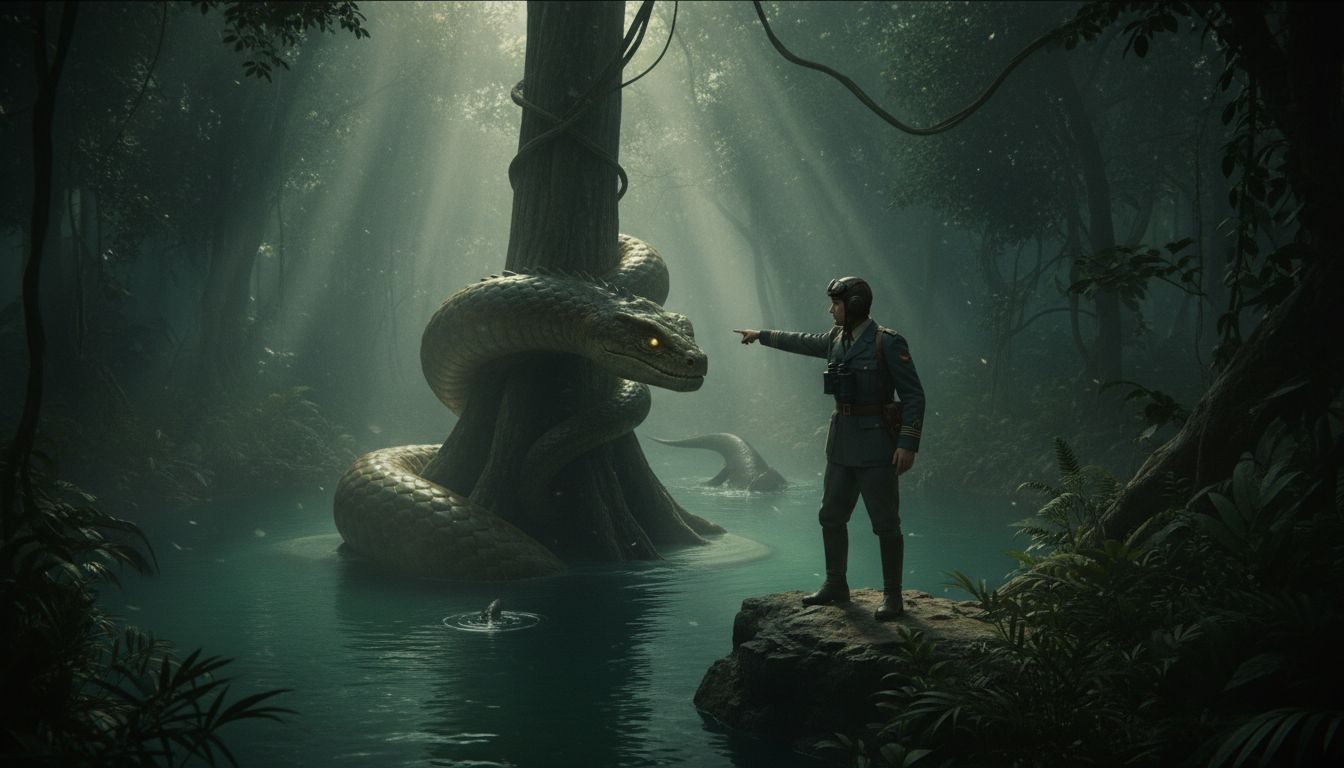
A 1959 report by Belgian Air Force Colonel Remy Van Lierde describing a 50‑foot (≈15 m) greenish snake lurking in the dense rainforests of the Congo has long been cited as cryptozoology’s most outlandish claim. Recent scrutiny by veteran cryptozoologist Karl Shuker suggests the “Congo snake” may be a case of misidentification, intertwined with the legend of the dinosaur‑like mokele‑mbembe. Shuker also revisits two historic hoaxes—a preserved “St Augustine globster” and a 1930 illustration tied to the fabricated Loys Ape—arguing that the latter likely inspired the former. The reassessment underscores how anecdotal reports can evolve into enduring myths when unverified details go unchecked.
The 1959 Congo Snake Claim
Colonel Van Lierde, stationed at a remote airbase near the Ubangi River, filed a formal observation after his crew allegedly spotted a massive, green‑tinged reptile coiled around a fallen tree. He described the creature as “longer than any known python, with a sleek, almost iridescent hide,” and estimated its length at roughly 50 feet. The report was circulated among military intelligence and later entered the cryptozoological literature as evidence of a possible surviving megareptile in Africa.
At the time, the claim dovetailed with heightened interest in the mokele‑mbembe—a purported sauropod‑like beast said to roam the Congo Basin. Some researchers posited that the two sightings could represent the same unknown species, while others dismissed them as folklore. The lack of physical evidence—no photographs, tissue samples, or corroborating eyewitnesses—has kept the story in the realm of speculation for more than six decades.
Re‑examining the Evidence
In a recent article for Live Science, Shuker examined the original field notes and contextual clues surrounding Van Lierde’s account. He notes that large constrictor snakes such as the African rock python (Python sebae) can reach lengths of 6–7 meters, and that environmental factors—dense foliage, low lighting, and the stress of a military operation—can dramatically distort size perception.
“When you’re in a hostile jungle environment, a 6‑meter python can easily appear double its actual size, especially if the observer is unfamiliar with local fauna,” Shuker wrote.
Shuker also highlights that the greenish hue described by Van Lierde aligns with the iridescent sheen of certain python scales when wet, a phenomenon often misinterpreted as an exotic coloration. He concludes that the most parsimonious explanation is a misidentified, unusually large rock python, rather than a previously unknown 15‑meter reptile.
Parallel Hoaxes: The St Augustine Globster and the Loys Ape
Shuker’s analysis extends beyond the Congo snake, drawing connections to two other infamous cryptozoological hoaxes. The St Augustine globster, a preserved marine carcass displayed in a Florida museum in the 1970s, was touted as a “living fossil” resembling a giant sea serpent. Decades later, forensic examination revealed the specimen to be a decomposed basking shark (Cetorhinus maximus), its cartilage and skin altered by decay.
The second case involves a 1930 illustration that appeared in a French naturalist’s pamphlet, depicting a humanoid ape with a pronounced brow ridge—later labeled the Loys Ape. Subsequent research uncovered that the drawing was a fabricated composite, likely inspired by contemporary artistic renditions of Gigantopithecus and the era’s fascination with “missing links.”
Shuker argues that the visual similarity between the Loys Ape illustration and the later St Augustine globster display suggests a cultural borrowing, where the earlier hoax provided a template for the latter’s presentation. “The eerie resemblance is too striking to be coincidental,” he notes, “and it illustrates how a single fabricated image can seed multiple myths across disciplines.”
Broader Implications for Cryptozoology
These reassessments serve as a reminder that extraordinary claims demand extraordinary evidence. While the allure of undiscovered megafauna captivates the public imagination, scientists emphasize rigorous documentation—photographic proof, DNA analysis, or repeatable observations—as essential to moving a claim from folklore to fact.
The Congo snake episode, alongside the St Augustine globster and Loys Ape cases, exemplifies how misidentifications, visual distortions, and the recycling of sensational imagery can perpetuate myths for generations. As Shuker cautions, “The responsibility lies with both investigators and audiences to critically evaluate anecdotal reports before they become entrenched legends.”
In an era of rapid information exchange, such scrutiny is more vital than ever, ensuring that the line between genuine discovery and imaginative storytelling remains clear.